Bareboating
Bob and Elizabeth Sweet of Brookfield, Wisconsin. Meg and Jim Atkins of Fort Myers, Florida. Christine and Tim Keiper of Bellingham,
Washington. David Lang of Los Angeles. These people, and scores of others, have an important message for you: They did it, and so can you—really.
What they’re talking about, of course, is your very first bareboat charter. It’s the sailing adventure that delivers you to the far side of that vast, murky psychological canyon—the one full of wants, wishes, and fears of the unknown—where you can bask in the crisp emerald waters and sunny skies of self-confidence, teamwork, and accomplishment. And while we’re at it, let’s not forget the supersized jumbo serving of fun and adventure that you get to enjoy along the way.
“I grew up in the Midwest and knew nothing about sailing,” says David Lang, who took lessons from O.C.S.C. Sailing in San Francisco Bay, then organized a group of friends to join him aboard a Beneteau 44.4 as part of a 12-boat flotilla in Turkey in September 2010.
“I was a skipper,” he says. “The closer I got to the trip, the more the anxiety set in. The extent of my sailing was on the bay and daysails. I’d only practiced Med mooring a couple of times. And the prospect of maintaining a happy, engaged crew of uneven skill levels for two weeks was daunting.
“I think I was successful because it was a flotilla, the administrative details were handled, and I could focus on planning the route and anchorages. Had it been something I had to totally plan on my own, I’m sure I would’ve been even more nervous. I felt like I had a support network. I feel confident now that I can set one of these up on my own.”
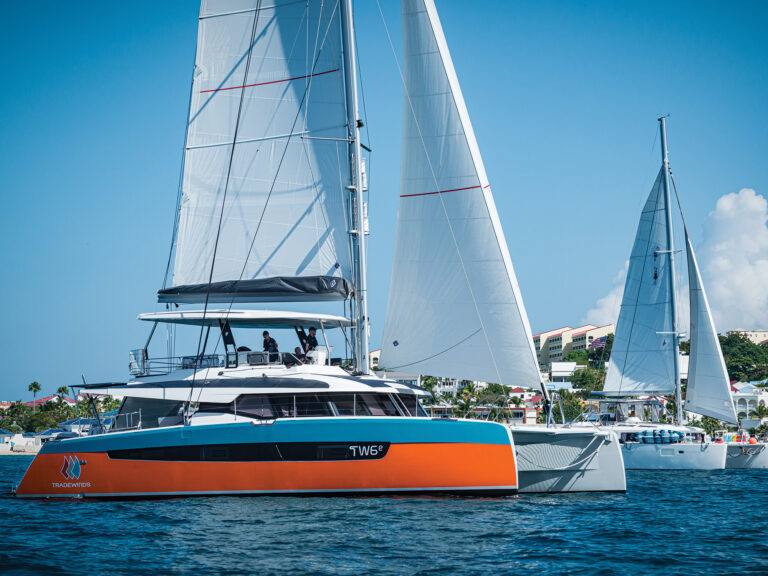
Meg and Jim Atkins of Fort Myers, Florida, set their sights on buying and moving aboard a 50-foot cat, so they went beyond the basics. They took coastal navigation and passagemaking courses with Doris and Steve Colgate’s Offshore Sailing School. Then, in July 2010, they invited along another couple whose background was in power, not sail, and took their very first bareboat charter aboard a Moorings 4600 catamaran in the British Virgin Islands.
“On your first cruise alone, you will make mistakes,” says Meg. “You will run over your dinghy line. But these aren’t life or death situations. It’s more that you’re mortified that people know how many times you screw up. You can look back on it and be scared, or you can grab every opportunity to learn, keep safety uppermost in your mind, then look back and say ‘Wasn’t that silly?’ The last night of our trip, we had a decadent buffet dinner. It’s the experience of a lifetime.”
Bob Sweet grew up sailing. With a busy career and a family to raise, he crews aboard a C&C 110 out of Milwaukee, Wisconsin. “Some of the guys I race with had chartered,” he says. “At dinner one night, one of the couples who’d bareboated before said they were eager to do it again. We talked about it, looked around, debated it. At the end of the day, anywhere you go is fun.”
In June 2010, the group took a Moorings 4600 and sailed out of Tortola, in the British Virgin Islands. “It was my first bareboat charter anywhere,” Sweet says. “It was an easy boat to sail.”
Getting Started
While Sweet and his crew didn’t take formal classes before heading south, they availed themselves of a Moorings Friendly Skipper once they arrived at the base. That’s the trained pro who, for no extra cost, hops aboard for a few hours to help boat and crew get acquainted. “It let’s you maneuver with someone looking over your shoulder,” Sweet says. “It certainly helped.”
While the real-time services of a skipper at the start of a bareboat trip are lauded throughout the charter industry as a sure-fire way to help dial down jitters, it’s not a replacement for experience and knowledge gained by sailing as much as you can in home waters and by taking classes.
Classes, whether through such accredited organizations as the American Sailing Association, US Sailing or a reputable independent school, show that you’re committed to your sailing vacation. Learning options abound. (See last page.)
Perhaps the leading and largest program that puts sailors on the road to their first bareboat charter is Fast Track to Cruising, offered by Doris and Steve Colgate’s Offshore Sailing School. Over the course of its impressive 47-year history, the school, also the official sailing school of The Moorings, has offered a range of courses, through its own curriculum as well as through the US Sailing curriculum, that have successfully trained sailors like the Atkinses of Fort Myers.
“The program that works for most people is the Fast Track to Cruising,” says chief executive officer and president Doris Colgate. “With Fast Track, you’re taught all the drills you need to know to successfully handle a cruising boat such as what you’d get from The Moorings.”
Others also praise the importance and value of instruction.
“Formal training looks good on a sailing résumé,” says Dave Conrad, the owner of Bay Breeze Yacht Charters, in Traverse City, Michigan. Conrad spent years working at Caribbean bases and reviewing credentials of bareboaters before he started his own company, which also teaches A.S.A. courses.
As you eyeball your prospective destination and begin to ask a charter company questions, never hesitate to let the base manager know what your worries are, Conrad adds. “A good charter company will always work with a client who’s genuinely interested in safety and getting comfortable with sailing,” Conrad says.
Learning the Ropes
The course to your first bareboat charter is more straightforward than you might suspect.
While sailing schools are committed to teaching the basics, instructors also understand the minimum level of competency that charter companies expect from aspiring first-time bareboaters, and they tailor coursework to help you attain that goal. And programs like the Colgates’ Fast Track course are taught in such a way that crews with uneven abilities can learn together.
“US Sailing schools do a good job of placing people based on an interview,” says Richard Jepsen, the chair of US Sailing’s education division and the chief executive officer of O.C.S.C. Sailing. “We’ll suggest a short coaching session of three hours aboard a boat with an instructor to run through basic maneuvers. Then we’ll make a call. We’re career counselors as well as instructors.”
At the end of classes at a particular level comes a formal test that ultimately leads to certification, which, while not always a formal requirement, “has a lot of value vis-à-vis the U.S. Coast Guard and in Europe, where proof of boater competency is important,” Jepsen says. “Certification in bareboat cruising is about equivalent to 10 weekends on a boat larger than the one you sail at home.”
The benefits of going this route are several: “Certification is a confidence builder and shows that you have the skills to keep a boat safe in Greece, Turkey, and in the B.V.I.,” he says. “If you don’t have formal training, a company will seldom charter you a boat substantially larger than the one you’re already sailing at home. If you own a 32-footer and get certified, they’ll feel comfortable giving you the larger boat. Having it is a great way to bridge the gap in a sailing résumé, especially for the white knucklers who want a 40- to 45-foot boat in the Caribbean when the résumé doesn’t support The Moorings giving them that boat.”
But don’t assume that a piece of paper is your passport to palm trees and white-sand beaches. “Nobody ever learned to operate a boat in a classroom,” Jepsen says. “Doing the maneuvers and refining your ability to do the maneuvers over a period of time takes training and practice. Instructors take time to run through drills in sufficient numbers so folks feel like they can recall those skills in an emergency. The key is to do the maneuver enough times with an instructor so that there’s enough muscle and brain memory to launch through the procedure with enough confidence,” Jepsen says. “We love certification, but the skills are critical.”
By combining the core points of key courses with onboard instruction, the Colgates’ Fast Track program in one week puts students through enough drills to prepare them for their own sailing vacation. First, sailors spend two daylong sessions learning aboard the tiller-driven Colgate 26. On Day Three, they move to a bareboat in the 30- to 40-foot range and continue the learning process while living aboard. On Day Five, the crew drops off the instructor and takes off on its own overnight. “It’s intense,” says Doris Colgate. “Students tell me, ‘If you told me I was going to take this 49-footer off the dock when I started, I would’ve told you that you were crazy.’ But it happens.”
**
Following the Fleet**
OK. You sail a 32-footer at home. You’ve taken some courses. But you still haven’t booked that first bareboat charter. And you still want the sun and the fun of a sailing adventure. And you want it now—but you’re still a little anxious. How on earth do you make it happen?
Relax: You join a flotilla!
This group of bareboats organized by a qualified individual or group, charter company, or school follows an itinerary to a specific destination. In other words, it’s a trip whose organizers match and place more experienced sailors with less experienced sailors aboard the same boat.
“We have about five flotillas a year in different locations,” says Charlie Nobles, the executive director of the American Sailing Association. “We provide everything from the beginning to the end, and it becomes a mentoring process. Getting students out with those who’ve chartered before is the best way to get students over that hump.
“Some skills and experiences are impossible to teach, and some students may have technical skills but they may not be confident, especially in unfamiliar waters. There’s customs, local winds, provisioning, navigating. People can tell you about these things, but there’s nothing like going out there and seeing it for yourself,” he says.
“Flotillas have consistently been a huge part of chartering,” adds US Sailing’s Jepsen. “How can we get newer sailors without the certification excited about the Caribbean? We’ll put them on boats with our certified skippers. We’re confident enough in our program and our certified skippers. Experienced sailors do it because it’s a bigger party. Inexperienced sailors do it for security. Flotilla sailing helps you meet new people. There are always people to go with to see ruins or to go shopping with.”
Financial incentives, such as first-timers discounts, flotilla fees waivers, and course discounts are also created to help motivate jittery sailors, adds Jermaine Larson, the sailing school director for San Juan Sailing. “Our financial incentives are intended to help them join our flotillas and courses and, ultimately, to boost their confidence. We really want them to feel more confident because then they’ll make wiser choices and have a better time chartering.”
Weighing In
In letters and emails to their instructors, sailing-school graduates who are now veterans of their first bareboat charter detail the value of the experience.
“My husband and I are not only 100 times more competent sailors. We also have a redefined mutual respect for each other,” writes Offshore grad Meg Atkins after her coastal navigation and passagemaking courses. “You have the supervision of two instructors who allow you to fail at anything. Then you learn more than a few correct ways to do what you couldn’t do before. That’s invaluable.”
Adds Pacific Northwest sailor and bareboat vet Christine Keiper: “Having my A.S.A. skipper certification is one accomplishment that I’m thrilled about. I never dreamed that I’d do this. I have my husband to thank for forging ahead with the idea. And then there’s my own stubbornness. If he could do it, I could do it. Truth be told, I wanted to be fully trained in case he went over the side in those cold waters of the San Juan Islands, and I needed to fish him out!”
Elaine Lembo, Cruising World_’s deputy editor, writes about chartering._
Resources
Organizations offering sailing curricula and certification include US Sailing (www.ussailing.org) and the American Sailing Association (www.american-sailing.com).
Schools include Steve and Doris Colgate’s Offshore Sailing School (www.offshoresailing.com) and O.C.S.C. Sailing (www.ocscsailing.com).
Also offering instruction:
Abaco Sailing (www.abacosailing.com),
Annapolis Bay Charters (www.annapolisbaycharters.net),
Annapolis Sailing School (www.annapolissailing.com),
Barefoot Yacht Charters (www.barefootyachts.com),
Blue Water Sailing School (www.bwss.com),
Fair Wind Sailing School (www.fairwindsailing.com),
Florida Yacht Charters (www.floridayacht.com),
Horizon Yacht Charters (www.horizonyachtcharters.com),
J World (www.jworldschool.com),
San Juan Sailing (www.sanjuansailing.com),
Southwest Florida Yachts (www.flsailandcruiseschool.com),
Sunsail (www.sunsail.com),
Tall Ship Sailing School (schoonerjeanieb@gmail.com),
TMM Yacht Charters (www.sailtmm.com),
Yachting Vacations (www.yachtingvacations.com).
For a complete list of US SAILING and A.S.A.-certified schools, go to:
www.sailingcertification.com/FINDASCHOOL/tabid/54/Default.aspx