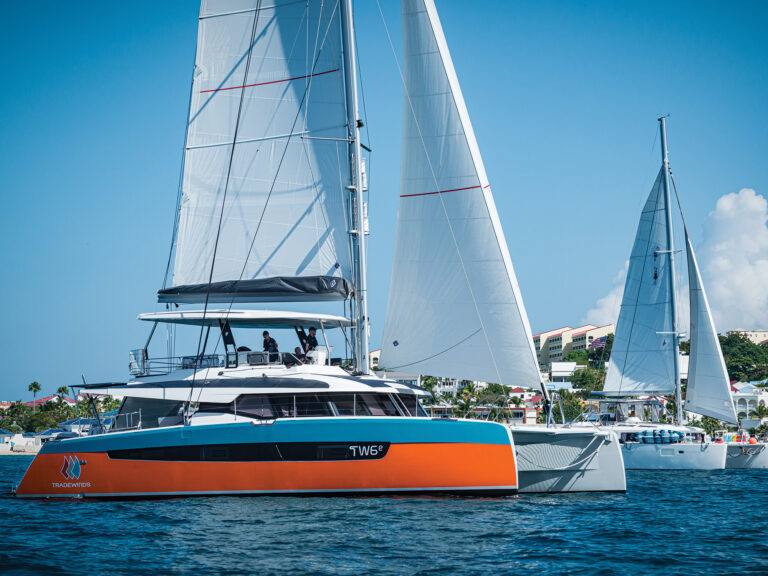

Billy Black| |Ben Ellison (above, left) puts Navico’s Broadband Radar through its paces.| While Tony Bessinger, my predecessor as Cruising World’s electronics editor, did a bang-up job covering 2009 marine-electronics innovations in “Sailing into the Future: What’s New This Year!” (March 2009), the Miami International Boat Show nonetheless yielded plenty more new stuff for me, the new guy, to write about. First up, and winner of the show’s Innovation Award for electronics, has to be Broadband Radar from Navico (www.broadbandradar.com). This 18-inch scanner-which, during the demo, fed target imagery to certain models of the company’s Lowrance, Northstar, and Simrad brands of multifunction displays-is astonishingly different, especially in ways that will be of great interest to sailors.
Instead of using a magnetron to fire out short 2-kilowatt or 4-kilowatt pulses, as a conventional dome scanner does, Broadband Radar uses transistors to transmit a continuous, though frequency-modulated, signal at a mere 0.1 watt! That adds up to a 30-percent power savings when in use, and more battery savings are possible since Broadband Radar can go from Off to low-draw Standby mode in seconds and from Standby to On instantly. Moreover, since silicone chips are not only faster but more stable than old-school vacuum tubes, Broadband Radar’s automated tuning algorithms are purportedly more reliable, as is the whole scanner. And finally, the extreme low wattage leads to the emission of considerably less dangerous radiation and a “human safe distance” of zero feet, as certified by the Federal Communications Commission, which means that Broadband Radar broadens a sailor’s installation choices.
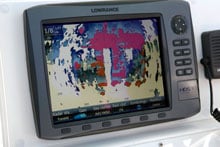
Billy Black| |** At close range, the radar provides lots of detail for the navigator.**|
But can you see anything with a 0.1-watt radar? After several hours of scoping target-rich Biscayne Bay, my impression was a qualified “Wow!” Timing target returns on frequency changes instead of pulses means that Broadband Radar claims an unheard-of range resolution of about 10 feet at range settings under a few miles, and it doesn’t lose really close targets in noise. In other words, targets don’t vanish into the blotch seen around your own vessel on conventional radars or into the blankness created by most newer “high-definition” radars, even at never-seen-before 200- and 300-foot ranges. The result was extraordinarily clean detail for an 18-inch radome; it would, for instance, tightly resolve all the vessels in an anchorage, even moving tenders, which would be a godsend when negotiating, say, my home port of Camden, Maine, in fog or darkness.
I was further impressed with how easy Broadband Radar was to use on both an NX45 from Simrad (www.simradyachting.com) and a new HDS10 from Lowrance (www.lowrance.com). Incidentally, the latter’s handsome built-in charts, low-powered LED screen, and excellent support for NMEA 2000 data and Sirius Weather/Audio suggest that sailors should start paying attention to Lowrance in the way that fishermen do.
What we didn’t get to see on Biscayne Bay was the radar’s long-range target plotting-purportedly OK, but
not great, to 24 miles-or its performance in rough seas and/or rain-both supposedly excellent. I also didn’t assess its ability to reject interference from other radars, although Navico said it was close to a solution for this problem. These are all good reasons for me to test Broadband Radar aboard my own boat this summer and report on it in an upcoming CW. Navico’s scanners, priced from $1,700 to $2,100, depending on such extra features as automatic target tracking, are definitely unique and interesting.
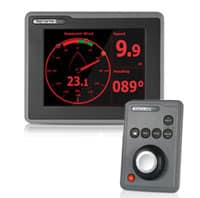
Courtesy of the Manufacturer| |Raymarine pairs its ST70 Plus with a remote keypad.|
Other Gear You’ll Want to See
Also demo cruising around Miami was Raymarine (www.raymarine.com), with no fewer than three inventive new products. Yes, the new $1,750 ST70 Plus is like the original ST70 instrument display in terms of a graphically playful yet powerful interface able to put all sorts of instrument and system data onto multiple, highly customizable screen pages, even using third-party NMEA 2000 data. But it improves big time on all that, and it separates its ultrabright 6.5-inch, high-res LED screen from a $545 keypad, which can be mounted, say, at the helm and can control many mast- or bulkhead-mounted Plus displays at once or one at a time. ST70 Plus displays can also be set up with an alternate $600 keypad to serve as matching and integrated autopilot heads.
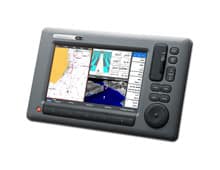
Courtesy of the Manufacturer| |Raymarine’s C-Wide multifunction display|
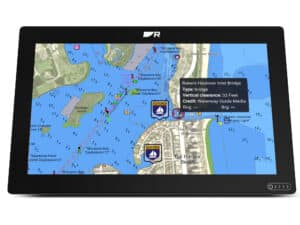
But the “theaterlike” wideness of Raymarine’s new C-Wide multifunction display series frankly didn’t impress me until I saw both how well the company’s split windows-which allow you to simultaneously display two info sources, such as a chart and radar-fit into a vertical helm space formerly limited to smaller screens and how well they looked in C-Wide’s extra-high resolution. The three new C’s-ranging in size from 9 inches to 14 inches and starting at $2,700-also boast built-in charts and SeaTalkHS Ethernet networking to a second station and to various sensors, such as Raymarine’s new Digital Radomes, which I also hope to include in my upcoming testing.
While it was wonderful, I thought, to see AIS B transponders available in Miami from many vendors, even West Marine, Raymarine’s new AIS500 distinguishes itself by including a VHF antenna splitter, an NMEA 0183 multiplexer, and output to both NMEA 0183 and NMEA 2000 (a.k.a. SeaTalkNG). Its premium $1,400 price may make sense when the whole installation is considered; in addition, desirable future AIS features, such as easy and effective digital selective calling to a target vessel, are more likely to come via the 2000 protocol rather than through the 0183 protocol.
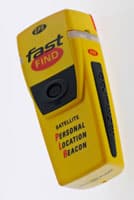
Courtesy of the Manufacturer| |** Fast Find 210 PLB**|
Handheld safety gear was another newsy niche at the Miami show. McMurdo’s U.S. distributor, Revere Supply (www.reveresupply.com), announced the Fast Find 210 PLB, which somehow fits a 50-channel GPS, an LED strobe, and a five-year battery into a waterproof case that’s only about 4 inches long. It’s not yet F.C.C. approved, but the remarkable rumored street price is “under $300,” and as Revere notes, it’s “subscription free.” The latter applies to all personal locator beacons, of course, but it’s a dig of sorts at the competitive Spot Satellite Messenger (www.findmespot.com), which does require an annual fee. Spot in turn announced that one of the Messenger’s buttons can now be used to hail (using another subscription) towing service from BoatU.S. with your location. Meanwhile, ACR Electronics (www.acrelectronics.com) has several noteworthy new personal locator beacons almost ready for introduction. And so it is that I visualize another comparative testing opportunity and CW article in my future.
In fact, you’ll be hearing a lot of my electronics blathering in the months ahead, including some about the worthy Miami introductions that I’ve had to leave out of this short review. If you can’t wait, or if you want to go deeper, please pay a visit to my blog at Panbo, the Marine-Electronics Weblog (www.panbo.com), where the dialogue goes on 24/7.
Ben Ellison is CW’s electronics editor.