Torqeedo Travel 1003
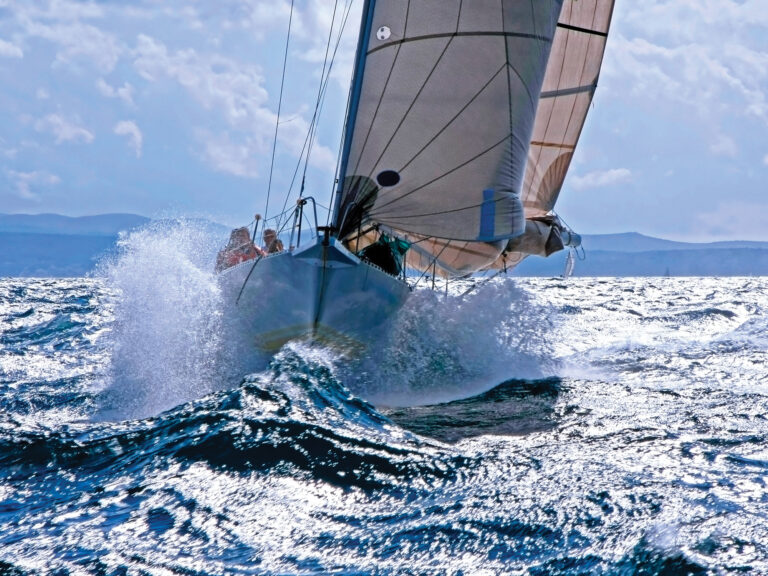
The joy of sailing. A finely balanced hull cutting through waves. Blue sky above. Salt spray sparkling across the bow. Warm breeze against skin. A delightful whiff of gasoline. Wait! Stop! And I did, upon noting the first sniff of gasoline that I’ve detected on any boat that I’ve owned, over a span of almost 40 years.
Gannet, the Moore 24 I bought in 2011, came with not one but two gasoline outboards. I thought I’d keep whichever was more reliable—until that first whiff. Moore 24s have open interiors with limited places to stow outboards and jerry jugs of gasoline below, and I keep my decks uncluttered. On a passage, I’d inevitably find myself sleeping next to the outboard and gasoline and oil. It wasn’t going to happen.
Although before I made my first circumnavigation in her, I sailed the engineless, 37-foot Egregious in and out of her slip in San Diego, having no engine on Gannet was not an option. Her then home, North Point Marina on Lake Michigan, near the Illinois/Wisconsin border, with 1,500 slips the biggest freshwater marina in the world, doesn’t permit “sailing, rowing, paddling, or sculling” inside the breakwater. Neither do many other marinas. You may have noticed that the world is falling apart. Perhaps that’s happening because it’s being run by powerboaters.
After some research, I ordered a German-made electric Torqeedo Travel 1003—and learned that it isn’t easy being green. Why? First, in this case, is cost, and second is range.
A Travel 1003 costs roughly $2,000, more than twice the price of a gas outboard of similar power, and has a range of 2 to 16 miles. The 2 miles is at full throttle, when the 520-watt-hour battery will be discharged in 30 minutes. The 16 miles is at low throttle, when the battery will last eight hours.
On the light and easily driven Gannet, I’ve found that at medium throttle, which provides a speed of 2.5 knots, the battery is good for about three hours and a distance of 7 miles. In practice, this means that in and out of the harbor twice leaves the battery close to needing to be recharged, a task that takes more than 23 hours. Even with a boat that sails well, this short range presents problems.
When coastal cruising, I want to be at the next harbor before dark, and I like to start early. Powering across smooth water at first light before the wind comes up has its charms. With the quiet but not completely silent Torqeedo—there’s a not unpleasant whirring sound—those charms aren’t much compromised. But not many miles are covered, either.
Torqeedo offers a possible solution: a solar panel that rolls up for storage and is said to provide unlimited range in bright sunlight. This panel costs $1,000. Nevertheless, I requested and received one for my 70th birthday. Being old has its compensations.
I knew the dimensions of the panel, but sometimes you have to see something to really understand. When the box arrived, I thought it big. When I opened it and unrolled the panel, Carol, my wife, immediately said, “There’s no place for that on Gannet.” And within the length of its connecting cord, there wasn’t. I sent the panel back.
I’m considering buying a second battery, for $700, that would more than double my range by allowing one battery to be used while the other is being partially recharged by the boat’s main electrical system with its own solar panels. This would also increase the cost of being green to about three times that of an equivalent 3-horsepower gas outboard.
Having said all this, I don’t regret my choice at all.
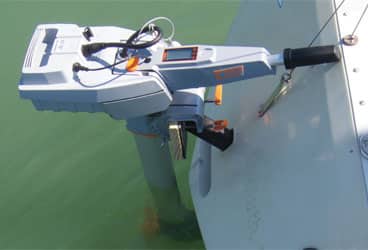
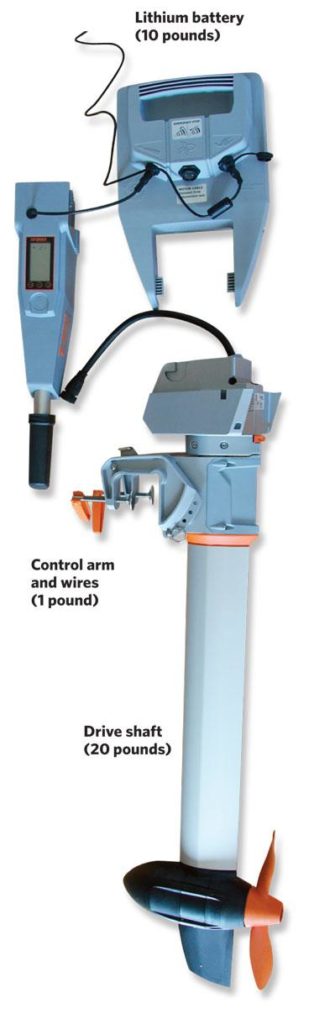
The good news begins just after I place the clever Moore 24 outboard bracket in its slot in the stern. The bracket is easy to insert and remove even while the boat is under way, and so is the three-part Torqeedo, which, at 31 pounds for the long-shaft version, weighs about the same as a comparable gas outboard.
On the advice of a former Moore 24 owner, I bought the long-shaft version. He meant well, but this was a mistake. The short shaft would’ve worked, saved a pound, taken up less room below, and not required special manipulation to clear the water when the engine isn’t in use.
On our first venture into Lake Michigan with the Torqeedo, I found that even when the engine was locked in the raised position, the long shaft left the prop partially dragging in the water, undercutting sailing performance and creating far more noise than the engine does in use. The solution—to tilt the engine more and secure it with sail ties to the stern-pulpit stanchions—means that I have to remove the tiller arm and stow it below. Slightly awkward, but necessary.
With the shaft tightened to the outboard bracket by two plastic-handled bolts, the battery is slipped into its slot, lowered, then locked by inserting a plastic pin. Finally, the tiller arm is attached and two electric cables connected: one from the battery to the shaft, the other from the tiller arm to the battery.
I’m struck by three things in this process: how well the Torqeedo is engineered and designed, how easy it is to mount and assemble, and how clean the parts are. No grease. No oil. No scrubbing my hands before I touch anything else.
My only reservation about the quality of the Travel 1003 is that the electrical cable connectors are plastic rather than metal and raise a concern about eventual cross threading. Thus far, I haven’t had a problem, but I do think metal connectors would be better and more appropriate on what is a top-end product.
With the Travel 1003 assembled comes a great moment: instant, one-finger starting. Press a button on the tiller arm and the Torqeedo is on, although the only way you know that is by the tiller-arm display lighting up. No repeated pulling on a cord. No curses. No fiddling. Not even a sound. In fact, there’s wonder and doubt that the engine is on, relieved by twisting the tiller handle and seeing the big, two-bladed prop turn. Back to neutral and absolute silence.
The Travel 1003 has forward, reverse, and, for 2,050-pound Gannet, ample power and torque. I don’t know how fast it will drive the little boat, but I’ve had her at 6 knots in one brief burst.
I knew my speed from the remarkable tiller-arm display, with built-in GPS, that shows the percentage of remaining battery charge, remaining range at the current speed, speed over ground, and consumption in watts. Increasing rpm and observing the often-dramatic decrease in range is instructive. An alarm sounds when battery charge drops to 30 percent.
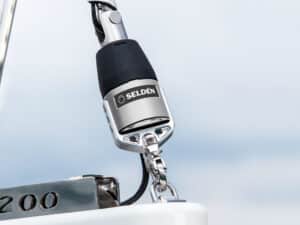
I’ve only approached setting off that alarm once, when haze and a wind shift caused me to come in a mile downwind of the breakwater entrance. Unfortunately, I lowered sails before I realized my mistake. Gannet dislikes being powered into chop, and I had to keep increasing rpm to make any headway. Lesson learned, I’ve subsequently been more careful on my returns to the marina, and I’ve added jib-furling gear so I can resume sailing without having to haul a jib back on deck.
Engines are necessary because people have made them necessary.
I don’t take exception to North Point Marina’s rules. More than 1,500 boats trying, on a busy weekend, to use one narrow, partially silted over entrance, with some of them short-tacking under sail in front of confused powerboaters, is certain chaos and probable disaster.
Harbors all over are now laid out with the expectation that vessels have engines. To clear in with officials in many ports requires tying to docks impossible to reach under sail. So an engine or a tow is needed for the last few hundred yards. And I need an engine for the .75-mile trip from my slip to beyond the maelstrom of powerboat wakes at the breakwater entrance.
For those distances, and for me, the Torqeedo Travel 1003 is excellent.
Webb Chiles has moved Gannet to San Diego to prepare her for his next voyage. Kindle editions of his books are available from Amazon.com.
To read another family’s account of using the Torqeedo, click here.