Dinghy
My wife, Sharon, and I purchased Possessor, our 51-foot Morgan Out Island, six years ago, and we still consider it the deal of the century. Richard, the previous owner, took Different Drummer, our 33-foot Morgan Out Island, in trade along with some extra cash and our almost-new dinghy and outboard. Possessor, however, had been on the hard in the Bahamas for more than three years, and the only evidence of a dinghy was the sturdy set of davits on her transom.
A few days before my crew, Jim and Dave, and I were set to leave from Marsh Harbour with Possessor, Richard pulled up to our mooring. “Ron,” he called out, “I brought you the dinghy that goes with the boat. It doesn’t look like much, but you can ski behind it.”
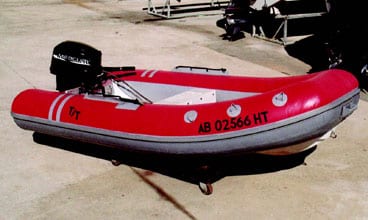
He was right. The red tubes on the old Apex hard-bottom inflatable had faded to a nondescript orange. A lot of fabric was showing, and the multicolored assortment of patches had evidently given up the ghost long ago, causing the 10-footer to deflate every two days. The upside: No one would steal it, and it was powered by a smooth-running 25-horsepower Mercury outboard.
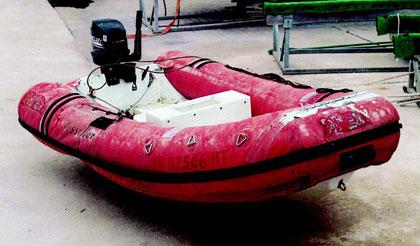
I assumed that our relationship would be short-lived, so I immediately went shopping for a new hard-bottom dinghy, which resulted in some serious sticker shock.
It was time for Plan B: I’d try to bring the old dinghy back to life. At West Marine, I discovered several products from Inland Marine that were designed to help me solve my problem and revive the old dinghy.
Once I bought the products—patches, sealant, a rubber coating, and paint—I now had to get the dinghy out of the water to start the process. Craig, the dockmaster at Beach Marine in Jacksonville, Florida, where Sharon and I live on Possessor, used a forklift to remove the Apex from the water and place it on a rolling dolly. Then the work began.
Since my dinghy needed so much work, I planned for the project to take several weeks, which would allow the products used in each step to cure properly before proceeding to the next.
Step One: I applied patches to all the major leaks. There are separate patch kits for P.V.C. and for Hypalon, so you have to be careful to choose the right one. I made sure to round the corners of each patch, since I’ve learned from past experience that 90-degree corners tend to come unglued. After that was done, I allowed several days for the patches to set.
Step Two: You’ll need help with this step. My brother, Gary, volunteered to assist me, so the first order of business was to inflate the dinghy and check for leaks. Finding a few small ones, we let some air out and poured Inland Marine’s inflatable-boat Sealant into each of the three chambers. Next, we rolled the Apex from side to side and end to end several times to ensure that all of the interior surfaces were coated. We repeated the rolling process many times during the next hour. For several days, I partially deflated and inflated the tubes to aid in the curing.
Step Three: This step will vary with your dinghy’s degree of deterioration. If your dinghy just needs cosmetic work, you can skip to Step Four. My Apex was in desperate shape, so instead of one coat, I applied two coats of Inland Marine’s Liquid Rubber. With this two-part rubber coating, the application is like painting with honey that just came out of the refrigerator. Be sure to thin the rubber with xylene or your project will end up looking like stucco. Once thinned, the Liquid Rubber applies easily with an inexpensive two-inch chip brush, but it does take a lot of time. My 10-foot inflatable required three quarts for two coats, but a less-damaged dinghy would require only one coat.
Step Four: Even though the Apex looked new, I wasn’t satisfied with the gray. I wanted to restore it back to red, because when I’m on the water aboard a small boat, I like to be seen. Liquid Rubber only comes in gray, white, or black.
So for my next move I used Inland Marine’s Top Side Paint, a product made for less-damaged inflatables that comes in different colors, including red. I applied two coats to the top half of the tubes and carefully painted around the fittings, leaving them gray. This gave the dinghy a much more professional look than if I’d just slapped the red on everything.
Step Five: This final step includes all the finishing touches and will vary from boat to boat. I had to glass over two minor cracks in the transom. Because the 25-horse Mercury is a little robust for a 10-foot boat, I attached diamond-plate aluminum to both sides of the transom, then bolted the engine in place.
The total cost of the project was less than $350, and the old Apex looks like a million bucks. The final payoff came when several of my sailor friends asked me where I bought the new dinghy.
Material and Cost:
• Inland Marine Sealant $55
• Inland Marine Liquid Rubber $55 x 3 = $165
• Inland Marine Topside Paint $39
• Inland Marine Patch Kit $32
• Miscellaneous items $50
• Xylene thinner
• 2-inch chip brushes
• Fiberglass
• Diamond-plate aluminum
Total cost: $341
When not cruising in northern Florida, Ron Reynolds and his wife, Sharon, find all sorts of do-it-yourself projects to keep their 51-foot Possessor shipshape.