green osprey 368
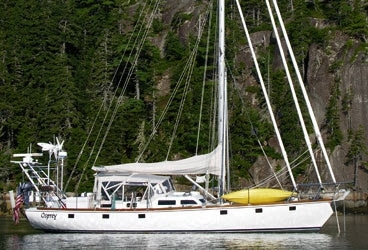
When thinking through our cruising plans and the refit of our 45-foot steel sloop, Osprey, my husband, Johnny Clarke, and I decided that we’d take advantage of the many technologies available to sailors today who want to “go green” rather than install a genset to meet the boat’s new power needs.
Having lived in a house with a carbon footprint the size of Montana that routinely cost us thousands of dollars in fuel and electric bills, we were ready for the freedom to make our own power using sustainable sources. Also, we wanted to be as self-sufficient as possible, since we planned to travel in places where shoreside services might be slim to none. Finally, and perhaps most important, we wanted our kids to see that solar and wind panels for boats are viable alternatives to oil and that we could live just as comfortably using the first two as the last. Integral to our decision was the certainty that we didn’t want to be amp squirrels, hoarding our electricity like nuts and being reluctant to turn on lights or run a pressure-water pump every day for showers. Osprey is our family’s home, and we wanted it to be as comfortable as possible. That meant being able to use our everyday equipment and even our luxuries when and how we wanted.
After we’ve spent nearly a year of living aboard and cruising, our hopes and expectations have panned out. The solar panels and wind generators we installed routinely produce enough power for our needs, which aren’t insignificant. We’ve also found that the majority of our power comes from the wind; if we had to choose between the two, we’d choose wind generators over solar panels-presuming, of course, that we’d be spending most of our time in windy places, which, so far, it seems that we do.
The downsides, so far, have been mostly up front: the cost of the units, and the cost and complexity of the installations. Because Johnny owned a boatyard at the time of Osprey’s refit and has worked on all aspects of boat repairs and installations for years, he had the resources and expertise to overcome the inevitable difficulties that pop up when building such complicated systems as ours; he also contributed much to the information presented in this article. Not everyone has that experience nor wants to be so involved. These aren’t minor issues, and they could make someone else go the simpler route of installing a generator. Although the needs of boats and cruisers differ, perhaps our experience with Osprey can help others when it comes time for them to decide how to best produce power for their boat.
Energy Needs
On Osprey, we need power for 12-volt refrigeration, a stand-alone 12-volt freezer, a 2,500-watt inverter (primarily used at night to power a heat pad for our son’s pet gecko), a watermaker, an SSB and a Pactor modem, a fuel polisher, and such miscellaneous power drains as lights, fans, and water pumps. When sailing, we need additional power for an autopilot, a 4-kilowatt radar, a chart plotter, and various electronics. On an average day at anchor, in 24 hours we use roughly 200 amps. When sailing, depending on conditions, this drain may increase by another 70 amps.
Osprey’s electrical heart is a single bank of two Rolls lead/acid 12 MD 375 batteries with a total capacity of 750 amp-hours. We also have a dedicated engine-starting battery and windlass battery charged through a 150-amp combiner. We replaced all batteries just before we moved onto the boat fulltime and headed south. We went with tried-and-true battery technology because we knew it would work. However, the R & D of higher-tech batteries is expanding so rapidly that anyone starting a refit will want to examine the new choices carefully. The bottom line is that strong, dependable batteries are the foundation of our entire energy system, and this wasn’t a place to go cheap.
Another key part of the system is a good monitoring device so that you can see exactly what’s happening in the system at any given time. This lets you measure how many amps have been used, how many have to be put back in, and whether the various parts of the system are working as they should be. On Osprey, we chose a Link-2000R monitoring system to maintain an accurate measure of the batteries at any given time. The Link-2000R can also be reprogrammed to work with a Honda 2000-watt generator, which we carry on board as emergency backup.
Harvesting the Wind
Once we made the decision to go with wind and solar, Johnny spent months on research, especially on the wind options. This included online study as well as motoring around the Annapolis anchorage and sneaking up on cruisers to see how loud their wind generators were, then asking lots of questions.
In the end, we chose the D400 model from Eclectic Energy (www.eclectic-energy.com), out of Nottinghamshire, England. The units are sold in the United States by Southeast Marine Services (www.semarine.com), located in Scappoose, Oregon. Though it’s not specifically a marine unit (they’re routinely used on houses and buildings, too), we’d seen one on a well-found boat in the harbor and were immediately impressed with its quiet operation and elegant lines. Also, while some wind generators work best at low wind speeds, the D400 would work well across a wide range of wind. Based on the company’s output guide-and because Johnny believes in backups in everything possible-we decided to purchase two. We projected that this pair would produce about 20 amps when Osprey is at anchor in 15 knots of wind. According to the information supplied by the battery monitor, this expectation has been born out in practice. Quiet and efficient, the wind generators work so well that we love a breeze of at least 15 knots, even when Osprey’s on the hook.
That said, it took considerable engineering to figure out how to install them on our boat. They weigh 30 pounds each, and the wind loading can exceed 110 pounds, so the mounting platform had to be strong enough to hold them. We hired our metal fabricator to build an arch of 2.5-inch aluminum tubing, then used tie-rods to attach it to an existing arch at the transom. We mounted the generators on two aluminum tubes that were beefed up with gussets for lateral strength and attached on top of the new arch.
Wiring the units was also a challenge. To make the most out of the generators, we ran 6-gauge wire from them to the controllers, which were approximately 35 feet away. Installing the thick wire in the new arch proved quite difficult, and running wire of that size through all of the holes, nooks, and crannies down below was tedious and knuckle busting.
Another issue with our wind generators is that it isn’t easy or possible to stop the generators if, for instance, we’re off the boat all day. At the time, Eclectic Energy didn’t offer the braking system for the D400 that it does now. And even with the new brake, the device only slows the unit down; to stop it completely, we still have to lash the blades in place.
Instead, at the time we were doing our installation, Southeast Marine Services recommended that we use two regulators for our system; we went with a pair of NCHC-12 models from Flexcharge U.S.A. (www.flexcharge.com), located in Charlevoix, Michigan. The regulators come with resistors designed to absorb the excess electricity still being produced when the batteries are fully charged. Because they can get extremely hot, however, we needed a well-ventilated space for them. Some water heaters can be adapted to use this excess power to heat water; unfortunately, ours wasn’t one of them. Our solution was to dedicate a whole locker under the main-saloon settee for the resistors, with 4-inch PVC ducting and computer pie fans that come on as soon as the regulator goes into dump mode. We also built an aluminum heat sink and mounted the resistors on top. After a year of operation, this system seems to be working well.
One final consideration about the D400s is their cost. The units themselves cost about $1,600, plus $350 for a single regulator, and shipping. Certainly you can find less expensive wind generators-even used ones-but we feel that the remarkably quiet operation and efficient output of the D400 have made our pair worth the expense.
Recharging with Solar
Osprey came with two 110-watt and two 85-watt solar panels. Other than the engine’s 120-amp alternator, those panels were the only source of electricity on the boat. We didn’t like their prop-up installation outside of the lifelines; it looked cluttered, exposed them easily to damage, and made docking even trickier than it already is. In the first winter that we owned the boat, we installed an arch at the transom and mounted the two 110s on top. We removed the 85s altogether. Once we began Osprey’s full refit, we asked our canvas maker to install 1.25-inch bows for the bimini and dodger so that we could mount two 130-watt Kyocera solar panels (www.kyocerasolar.com) on top of the bimini.
Choosing the solar panels for our boat wasn’t as complicated as our decision about the wind generators, because all solar panels more or less do the same thing. We knew Kyocera had a great reputation for quality, and many of the cruisers we talked with highly recommended them. The two Kyocera panels together would produce about 20 amps at “high sun,” meaning between 1000 and 1400. The older panels, Shell 110s, produce about 10 amps total at high sun. We use a Blue Sky Solar Boost 3034IL regulator (www.blueskyenergyinc.com) to run the panels. The factory numbers have turned out to be accurate on clear days. We determined the panels’ production by measuring it on sunny days when there was no wind input at all.
Although not as difficult to install as the wind generators, the new solar panels on the bimini presented their own challenges. To mount the panels to the bimini, we had to make special brackets and fittings to accommodate the structure’s curves. The solar-panel wiring was easier to install than that of the wind generators largely because the wire was smaller and more easily worked.
However, one of the most time-consuming and meticulous aspects of the entire installation involved the three regulators-two for the wind generators and one for the solar panels-that are the real brains of the system. They had to be synchronized so that the charge, accept, and float voltages were the same. Having three regulators is probably overkill, but after considerable research, we felt that it was more important to have the redundancy built in so that if one failed, one of the other two, with some rewiring, could pick up the load. After nearly a year, this system, although complicated, has worked extremely well. And as this is written, Osprey has been sitting on the anchor for four days in Chesapeake Bay, and we haven’t had to start the engine yet to charge the batteries.
The cost of the Kyocera panels themselves wasn’t especially higher than other brands; they cost about $750 each. The Blue Sky regulator cost $350. There was considerable extra cost, though, because we had to beef up the tubing for the bimini and other canvas so that it could support the panels. We figure this added $1,500 to the expense of the solar-panel installation. We felt this was worth the money, because we knew the added strength of the frames would give us peace of mind when we were sailing in rough conditions.
What We’ve Concluded
It’s all well and good to estimate power consumption and output, then base your decisions on those numbers. But you never know for sure if reality will match the math. We’d hoped that the combination of wind and solar as we’d set it up would meet our basic energy requirements. But we hadn’t even factored in the energy draw from our watermaker when we ran our initial numbers. We assumed that we’d need to use the engine and alternator to power the watermaker, which draws 18 amps. Over the first full winter of living aboard, which happened to be in the breezy Bahamas, our expectations were more than met. The wind generators in particular have become invaluable, since they can produce power day and night, cloudy or sunny, as long as we have breeze. More often than not, we have more than enough power to run everything on the boat, including the watermaker. The only reason we need to start the engine over the course of a breezy week is to make hot water for showers, and even this could be changed if we had a water heater with the necessary adaptors. Of course, when the wind is down, the solar panels come increasingly into play, and if there’s no wind or sun-rare in our experience-we depend more on that old standby, the engine and alternator.
We’re extremely happy with our green combination of electricity generators, but it wasn’t easy to accomplish. It required all of Johnny’s expertise to design and install the various elements, and admittedly, it’s probably more than most cruisers would want to tackle. But because we’re a family of four people and one heat-seeking gecko, we wanted it overbuilt, and we had the resources to do it. Nor was the system cheap. A quality generator of 8 or 9 kilowatts, which would take care of Osprey’s energy needs, would cost about $15,000-$10,000 for the generator and about $5,000 for labor and extra parts-and take about 60 hours to install. Our wind and solar systems, including all of the modifications we made to accommodate them, cost about $12,800. However, this number doesn’t include an estimated labor cost of about $10,000 because we did the work ourselves, except for fabricating the arch and frames. Also, it took about twice as long to complete all the installations as it would have to add a generator.
On the face of it, going the green route cost us a lot more in time and money. Going green involved significantly more engineering, and there was greater complexity throughout the whole system. We feel, however, that the higher initial investment will pay for itself when compared to the ongoing fuel and maintenance costs of a generator. Also, there’s something intangible yet extremely satisfying in knowing that we’re accomplishing our personal goals of self-sufficiency, setting a different example for our children, and-trite as it sounds-treading more lightly on the planet.
Wendy Mitman Clarke, her husband, Johnny, their two children, and the gecko planned to head south from the Chesapeake in the fall, bound for the trade winds and warm sun that will keep them well powered up.