Trash and plastic
Video Extra: A discussion of ocean pollution with crew from the Around the Americas expedition.
The photographs from the Midway Islands are what finally got me. For 13 months and over 27,000 nautical miles on our recent Around the Americas expedition that circumnavigated North America and South America, we saw our fair share of filthy, disgusting, appalling waterways littered with garbage and plastic. No place, really, was totally spared, and the images of blight and effluence are seared into my mind’s eye.
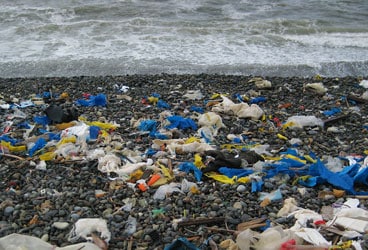
There was the gull regally perched on a detergent bottle in a small cesspool of rubbish near our marina in downtown Miami. And the once pristine beach along the coast of Peru, where as far as the eye could see, the dunes were rife with every sort of colorful, man-made flotsam imaginable. And on a spin with my kayak near the center of the hip, progressive city of Portland, Oregon—Portland!—a quiet Columbia River backwater that was absolutely teeming with discarded food containers, soda bottles, and shopping bags. With each stroke, my paddle parted not the waters, but the thick sheet of debris that floated atop them.
By the time we’d finished the voyage back where it began, in Seattle, I’d seen so much unadulterated crap—inshore and offshore, in the Atlantic and the Pacific—that I’d become desensitized and largely immune to it. Or so I thought.
That’s when someone forwarded me a link to a gallery of pictures taken on the distant Pacific atoll of Midway by Chris Jordan, the noted Seattle-based environmental photographer. The subjects of the photos were all the same: the rotting remains of baby Laysan albatross. So was the one common denominator central to every shot: the bellyful of cigarette lighters, bottle caps, and other plastic detritus in each feathered corpse, the stuff that had ended their young lives.
“These photographs of albatross chicks were made in September 2009 on Midway Atoll, a tiny stretch of sand and coral near the middle of the North Pacific,” writes Jordan in a note on his website (www.chrisjordan.com). “The nesting babies are fed . . . plastic by their parents, who soar out over the vast polluted ocean collecting what looks to them like food to bring back to their young. On this diet of human trash, every year tens of thousands of albatross chicks die on Midway from starvation, toxicity, and choking.

“To document this phenomenon as faithfully as possible,” he continues, “not a single piece of plastic in any of these photographs was moved, placed, manipulated, or altered in any way. These images depict the actual stomach contents of baby birds in one of the world’s most remote marine sanctuaries, more than 2,000 miles from the nearest continent.”
These days, people can, and do, argue about the validity and consequences of such concerns as climate change and ocean acidification, volleying opinions and statistics on these often highly politicized topics back and forth like a tennis ball at Wimbledon. But you only need a glimpse at a single image from Jordan’s awful, remarkable Midway portfolio to understand, beyond a shadow of a doubt, that there’s too much plastic junk in the ocean. And the ramifications thereof, for our planet and us, extend far beyond the fate of those distant fluffy chicks, as heartbreaking as images of them may be.
Vortex of Trash
The fact that there are enormous amounts of plastic in the ocean is, of course, not exactly breaking news, and sailors are leading the charge in raising awareness about this ever-expanding issue. For example, most every mariner by now has heard something about the Great Pacific Garbage Patch, the so-called “trash vortex” formed by a series of interconnected ocean currents in the North Pacific Gyre. We’ll return to this important, if often misunderstood, subject shortly.
In terms of sheer publicity, the most visible recent voyage to cast a light on ocean-borne plastic was banking heir David de Rothschild’s six-month expedition last summer from San Francisco to Australia aboard a 60-foot catamaran called Plastiki (www.theplastiki.com), the hulls of which were created with 12,000 discarded beverage bottles; the figure is significant in that the same number of plastic bottles are reportedly tossed away every 8.3 seconds. Inspired by Thor Heyerdahl’s Kon-Tiki (and with a pair of the late Norwegian’s grandchildren as crew), de Rothschild’s aim was to showcase recycling and ocean cleanup efforts.
“Every day, we’re seeing bits of trash floating past us,” he said in an underway interview early in the trip. “They look like jellyfish, but then we realize that they’re plastic bags.”
Actually, Plastiki’s voyage was the second such undertaking in recent years. In 2008, scientist and educator Marcus Eriksen and his crew set sail on a three-month passage from Long Beach, California, to Hawai’i aboard Junkraft (www.junkraft.com), a vessel cobbled together from old fishing nets bulging with some 15,000 discarded plastic bottles. Eriksen and his wife, Anna Cummins, have since formed an organization called 5 Gyres (www.5gyres.org), named after the planet’s five major circulating currents. (In addition to the North Pacific, gyres occur in the South Pacific, the North and South Atlantic, and the Indian Ocean.)
The group’s mission “is to conduct research and communicate about the global impact of plastic pollution . . . and employ strategies to eliminate the accumulation of plastic pollution in the five subtropical gyres.” To that end, 5 Gyres has built five portable surface-sampling research trawls to lend to “vessels of opportunity” such as long-range cruising boats planning to sail through one or more of the respective gyres; they can use the trawls to collect scientific samples of debris and sea life for later analysis. They’ve also partnered with another association, Pangaea Explorations (www.panexplore.com), that employs its 72-foot sloop, Sea Dragon, on research voyages to the various gyres, offering charter berths for paying crew who wish to assist with the program.
Earlier this year, on a voyage from the Caribbean to the Azores via Bermuda and the Sargasso Sea, the Sea Dragon team collected 37 trawling samples en route, all of which tested positive for plastic (one turned up a triggerfish trapped alive in a plastic bucket, as well), thus confirming the existence of significant concentrations of “marine debris” in the North Atlantic gyre, too.
“Our job now is to let people know that plastic ocean pollution is a global problem,” says Cummins. “Such pollution, unfortunately, isn’t confined to a single patch. We’ve managed to leave our footprint, really, everywhere.”
The debris situation in the North Atlantic was confirmed independently in a separate study by undergraduates of the Sea Education Association (www.sea.edu), who have collected, cataloged, and archived since 1986 more than 100,000 individual plastic bits using fine-mesh plankton nets. Last summer, in waters ranging to 1,000 miles east of Bermuda, S.E.A. conducted its latest research voyage aboard the school’s research vessel, the 134-foot brigantine Corwith Cramer. Over the years, the S.E.A. studies discovered the highest concentrations of plastics between 22 degrees and 38 degrees north latitude, an area roughly equivalent to the distance from Cuba to Annapolis, Maryland.
The National Oceanic and Atmospheric Association is also conducting independent research, and it’s set up its own website devoted to related ocean issues ().
A Synthetic Stew
Of course, plastic in the ocean is only one part of the problem; the litter that washes or is swept ashore is the other. Three young Canadian cruising sailors and surfers made that the focus of their recently concluded three-year circumnavigation aboard the 40-foot Khulula, a mission they dubbed Ocean Gybe. Wherever they stopped, they took to the beaches and conducted detailed pollution surveys, recording their findings in succinct reports that they posted on their website (www.oceangybe.com).
For instance, on the isolated Indian Ocean atoll of Cocos Keeling, because of “the incredible amount of trash” before them, the Ocean Gybe trio had to narrow their sampling to sandals and water bottles as indicators of beach pollution, counting 339 of the former and 246 of the latter in a narrow strip of sand 100 meters long. Eventually, as is already happening in Peru and on many beaches in Hawai’i and elsewhere, the plastic will dissolve into the sand itself, the particles displacing the coral and rock from which the beach was originally formed.
However, much more than the Atlantic or Indian oceans, the endangered North Pacific—and the aforementioned Garbage Patch—has become the poster child and focal point for the excesses of our modern, rampant, throwaway consumer society and its debilitating effects on the high seas. And no one has done a better, more eloquent job of describing and analyzing the phenomenon and its attendant dangers and challenges than the person who’s credited with officially “discovering” it, Charles Moore, an oceanographer and also an offshore sailor.
In 1997, Moore was returning from the Transpac race, which goes from Los Angeles to Honolulu, aboard his 50-foot, Crowther-designed aluminum catamaran, Alguita, when he decided to cut the corner on the delivery back.
“When we got up to the latitude of our home port of Long Beach, 35 degrees north latitude, instead of going up to 40 degrees north and getting the westerlies like most boats, we hung a right and went through the middle of this high-pressure system, these doldrums,” he says. “That’s when we saw this stuff. It wasn’t an ‘Ah-ha!’ moment. But for a week I couldn’t come on deck and not see some human-made object floating by, most of it unidentifiable shards of plastic. But I realized that this wasn’t appearing just for me and that it was unlikely that our single track was polluted and the surrounding area wasn’t.”
Moore did some rough calculations and reckoned that the accumulation of garbage in the broader region he was traversing could equal or surpass the size of a year’s worth of deposits at Los Angeles’ biggest landfill. “I got it in my mind that I had to go back out there and measure it, and that’s what got me involved in the scientific sampling of the area,” he says. In 1999, he did return and eventually published his findings in a seminal paper titled “A Comparison of Plastic and Plankton in the North Pacific Central Gyre” that drew the attention of the broader scientific community. Moore also founded the Algalita Marine Research Foundation to further the study of the impact of plastic contamination on the planet’s oceans.
A.M.R.F.’s core issue, as summarized on the non-profit corporation’s website (www.algalita.org), sounds deceptively simple: “The base of the food chain is being displaced by a non-digestible, non-nutritive component that is actually outweighing and outnumbering the natural food.”
But when you read between the lines, the crux of the message is anything but simplistic. Moore says, “There’s no such thing anymore as a wild-caught organic fish. You can buy organic produce, but not organic fish. They all have pollutants in them at some level. The chemicals in plastic are being transmitted to the food web, from the bottom to the top. It’s a serious issue.”
Moore and his team have returned to the gyre on numerous occasions since his first trips in the late 1990s. On one voyage, they sampled 671 lantern fish, the small baitfish that constitutes 50 percent of the ocean’s fish biomass. From this collection, they extracted 1,350 pieces of plastic, an average of about two per fish.
“These plastic bits are sponges for pollutants,” says Moore. “That’s why they use plastic booms for oil spills. So these plastic particles float on the surface collecting organic pollutants like PCBs and DDT. Then something eats it, and it desorbs into that organism and becomes part of its tissue. Plastics have additives in them that aren’t polymers that leach out and become part of the metabolism of the creatures that ingest the plastic scraps. It’s a hell of a way to make poison pills for everything in the ocean. This is the legacy we’re leaving to future generations.”
Toxic additives used to manufacture plastic items can leach out into their surroundings when exposed to water. And because waterborne hydrophobic pollutants collect and magnify on the surface of plastic trash, the plastic itself is far more deadly in the ocean than on land. But the effects of ultraviolet radiation and of wind and wave action break plastic goods into ever-smaller individual shards called “microplastics.” One of the misconceptions about the North Pacific Garbage Patch is that it’s a giant, swirling island of trash. Actually, it’s more like a vast cauldron of synthetic stew, with patches of higher concentrations of plastic in the eastern Pacific and the western Pacific.
In other words, you can’t actually “see” the trash vortex. It doesn’t appear on satellite imagery. That’s the primary reason some folks remain skeptical about its existence: out of sight, out of mind.
Moore likens it to a “pumpkin face” that spans most of the North Pacific, all the way to Japan. “The eyes are the eastern and western garbage patches,” he says. “The area between them is also polluted with plastic, hundreds of thousands of particles per square kilometer. I think the simplest way to think of it is extending from 20 degrees to 40 degrees north latitude and 130 degrees west longitude to the coast of Japan. The Japan Sea is really polluted.”
Where does all the trash come from? Everywhere. “The ocean is the final resting place for almost all our waste,” says Moore. “Only we humans make waste that nature can’t digest. We have no other place to throw away our trash. ‘Away’ is no longer a place.”
And the very nature of our waste, it turns out, is wasteful by design.
“The problem facing us is that we’re using a material that’s toxic and takes hundreds of years to disappear for single-use objects, objects that are designed to be used for a few seconds, minutes, or days,” says Manuel Maqueda, the co-founder of the San Francisco-based Plastic Pollution Coalition (www.plasticpollutioncoalition.org), a cooperative devoted to changing people’s behavior about plastic consumption through education, legislation, and all other means possible.
“To give you an idea of how big this problem is,” he continues, “in the United States alone, every week, we discard 500 million plastic bottles for water, enough to go around the planet five times. One week. Just in the United States. Just for water. Every five minutes, we discard enough bottles to cover eight football fields.”
The more one becomes aware, says Maqueda, about plastics and their pervasiveness in our lives, the more we realize that the problem is hidden in plain sight. “For me, the Garbage Patch is just the tip of the iceberg,” he says. “It’s an entry point for understanding the issue, a physical manifestation of how out of hand the thing has gotten. But it’s not the issue itself. I see the Garbage Patch when I go to the grocery store and look at all the plastics that eventually will be polluting the environment. When I open my refrigerator door or go into my bathroom, I see the Garbage Patch.”
The issue, clearly, won’t simply disappear overnight.
“A teacher told me how to express the five percent of plastics that are recycled in our waste stream,” says Moore. “It’s diddly point squat. That’s the percentage we recycle. The problem of our throwaway society has been known for 50 years. The paradigm for our economy is unlimited growth. That model isn’t sustainable. Growth and sustainability are contradictory concepts. There’s not much room for optimism.”
Seeking Solutions
For another San Francisco-based sailor, however, inaction isn’t an option. “Maybe it’s the Irish in me,” says Mary Crowley, the director of the charter and adventure sailing concern Ocean Voyages Inc. and its nonprofit arm, the Ocean Voyages Institute, which is dedicated to the preservation of marine arts and sciences and island cultures. “I’m not willing to accept that we’ve thrown all this garbage into the ocean and there’s nothing we can do about it.”
Crowley is a pragmatist: She understands that the problem must be addressed at its source and that the flow of plastic into the ocean must be stemmed. But she’s also an activist. “Maybe it’s going to be expensive to clean up,” she says. “Maybe it means developing new technologies. But I believe our existing ocean ecosystem really needs help.”
To that end, Crowley launched Project Kaisei (www.projectkaisei.org). In both of the last two summers, the organization’s flagship, the 151-foot brigantine Kaisei, has made fact-finding research voyages to the plastic vortex. In collaboration with the Scripps Institute of Oceanography, NOAA, and the University of Hawai’i, the Project Kaisei team has undertaken extensive fish and water-sampling research and assisted in “ground-proofing” the computer models that predict how ocean currents feed the gyre.
The project’s ultimate goal, however, is finding viable ways to actually collect high-seas rubbish, and next summer Crowley’s team will begin testing a series of prototype designs currently in the works. Perhaps, with assistance from government, industry, and even the private sector, fishermen could be recruited to “catch” debris in smaller vessels and deliver it directly to a plant stationed on an offshore recycling mother ship. Such a scheme could be doubly beneficial, notes Crowley, providing fishermen with meaningful jobs while allowing fishing grounds that have been overfished to be restored and replenished.
“We want to test at least three different methods of recycling, at sea and on land, so we know what works best,” says Crowley.
Does she really believe we can gain a toehold on what seems, to almost everyone who’s really considered the scope of the issue, to be an insurmountable quandary?
“Yes, I think we can,” she says. “I think we have to.”
Video Extra: A discussion of ocean pollution with crew from the Around the Americas expedition.