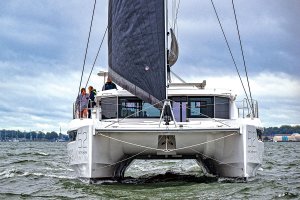
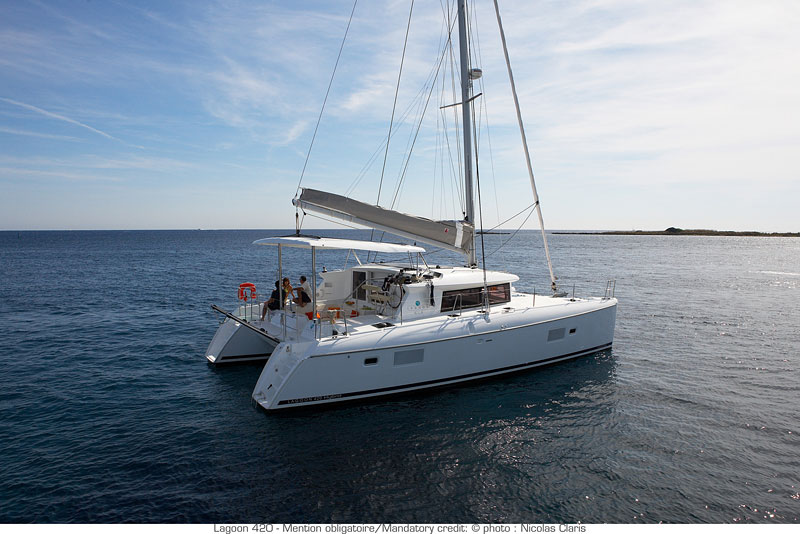
It’s too early yet to see where the future of electric drive in sailboats is headed, but Lagoon has taken a bold step with the Lagoon 420 Hybrid, its first production sailing cat that marries a diesel generator and electric propulsion motors. In other respects, the 420 delivers what the world’s biggest catamaran builder always does: a comfortable ride in well-appointed surroundings. In the saloon, Lagoon’s trademark vertical windows create tremendous volume, with headroom all around and an undistorted view. Protected by eyebrows, the windows also limit how much solar heat enters the accommodations.
Lagoon offers an “owner” version, in which the port hull is a master suite, with the bed aft, an office/lounge amidships, and a large bathroom with separate shower forward. The “charter” version has a queen forward, with a shower in the bow, a queen berth aft, and two head compartments separated by another shower. In both versions, the starboard hull has the two-cabin arrangement. Throughout the boat, the joiner work, while not fancy, retains traditional yacht features and a sense of having been handmade.
A sliding door opens from the saloon into an enclosed, comfortable cockpit where it’s two steps up to the aft deck and a couple more to the side decks. The helm station is to starboard, with a bench seat for two from which the helmsman can see clear over the deckhouse. All sail controls lead there, including traveler lines and reefing lines, so the pilot can operate the boat alone if need be. The electric winches will aid in recruiting volunteers.
All this convenience comes with a couple of trade-offs. Choosing the most secure route from deck to cockpit hasn’t been made to be intuitive, but it will doubtless become automatic with familiarity. Raising the boom to clear the rigid “bimini” roof and give the helmsman standing headroom also raises the sail plan’s center of effort, which, perhaps in turn, restricts its area when meeting a heeling-moment target for stability. Lagoon’s unique deckhouse design also provides solid handholds for getting around the boat. Flat side decks offer firm footing, too, and a centerline platform provides secure access to the anchor-roller support to which the optional detachable roller-furling reacher attaches. This platform is the top of the center component of the hull’s gull-wing configuration, which Lagoon’s design team developed to split waves before they can slam into the underside of the bridgedeck. Powerboat wakes in Miami’s Government Cut proved a useful test, with positive results, of the effectiveness of the concept.
Under power itself, the Lagoon 420 Hybrid behaves differently from its diesel relatives, and it sounds different, too. While the generator rumbles quietly and evenly behind the forward cockpit seating, short bursts of silent power replace the growls of diesels being gunned; torque from the electric motors is instant and produces an immediate effect. Top speed was 7.5 knots. Lagoon estimates that at 75-percent power on both motors-about 6.5 knots of boatspeed-the 420 Hybrid can run “silent” for two hours.
Sailing performance was undoubtedly slowed by the 19-inch-diameter propellers on our test boat. Designed to turn freely when sailing, the props are big so they can regenerate electricity, starting at about 4.5 knots. It took us 10 knots of wind to reach that speed, even with the reacher set, but once it overcame that threshold, the boat became more responsive, reaching at 7 knots when the wind spiked to 12.
As well as providing power for propulsion, the generator delivers AC for the boat’s “hotel” services and to run the battery chargers for both the propulsion batteries and the 12-volt house batteries. Where a catamaran of this size has three diesels (including the generator), the 420 Hybrid has only one, certainly reducing the maintenance schedule.
The Lagoon 420 Hybrid offers a taste of the future in a cruising catamaran along with the other well-established qualities and characteristics we’ve come to expect from its builder.
Jeremy McGeary is a CW contributing editor.
Lagoon 420 Hybrid Specs
LOA 41′ 4″ (12.61 m.)
LWL 40′ 4″ (12.30 m.)
Beam 24′ 7″ (7.50 m.)
Draft 4′ 2″ (1.28 m.)
Sail Area (100%) 809.4 sq. ft. (75.19 sq. m.)
Displacement (light) 25,842 lb. (11,720 kg.)
Water 105 gal. (400 l.)
Fuel 79 gal. (300 l.)
Engines Two 8-kilowatt electric drives
Designer Marc Van Peteghem and Vincent Lauriot PrÈvost
Sailaway Price $433,000
Lagoon America
(410) 280-2368
www.lagoonamerica.com