
Tristan Bridge in Australia
I was excited to return to Cheva_l, our Outremer 55 catamaran, which was waiting for us in Australia. Months had passed since our family had laid _Cheval up and returned to California so I, along with my 10-year-old brother, Ethan, and our 7-year-old sister, Cheyenne, could go back to school.
The entire east coast of Australia was waiting for us to explore, and my heart skipped a beat now that we were back on board. We set sail north from Mooloolaba, just north of Brisbane, stopping at Fraser Island before arriving at Tin Can Bay.
A chill hung in the air, and thousands of whitecaps sprawled recklessly along the surface of the water. Cheyenne stared ahead, a small grin playing at the sides of her mouth. She was excited for what was about to happen: feeding wild dolphins. “This is Mystic, an endangered indo-pacific dolphin,” said our local guide as she waved a hand to the smiling mammal. Ethan and Cheyenne stood speechless. I waved my fish in the water, bribing the dolphin to come closer. A row of brown teeth closed around the bait. With a tug, it was gone.
We worked our way up the coast to Cape Capricorn. Going ashore, we managed to heave the dinghy up the beach, far enough so the tide’s lapping tongues couldn’t reach it. The huge sand dune loomed feet away from me like a giant wall stretching to the sky. Ethan gave me a look, I nodded, and we charged up. We ran up the 45-degree angle with the hot sun beating down on us. The wind spit sand at us. Then we were at the top, with a view of the anchorage and the mountains towering over the hills that lurked beneath.
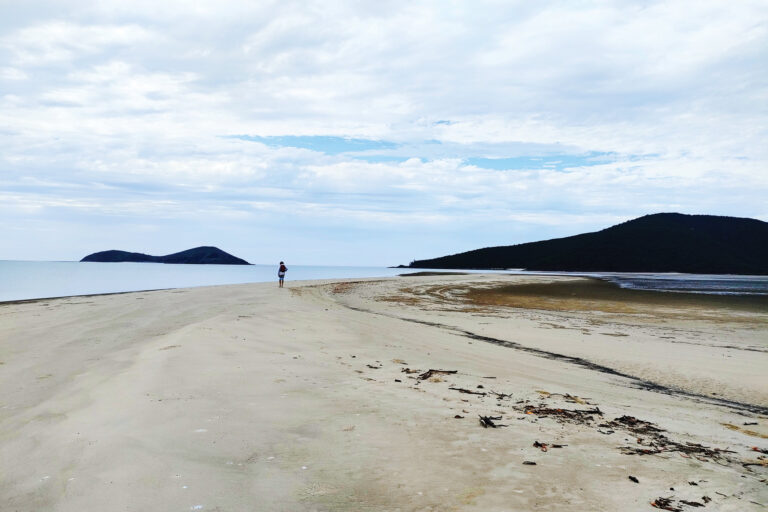
Continuing north, we hugged the coast until we hit the Cumberland group and the anchorage in the Percy Isles, with its gorgeous white beach. Here we found that a small shack had been assembled; objects of every sort hung across its wall, keepsakes cruisers had left for others to look upon. Time had left many battered and torn. Each object was signed with the name of a boat, and some had poems written on them. I remember our family sharing chuckles as we reminisced about past trips, and we left a burgee hanging proudly against the wall marking our latest sailing adventure.
The Cumberland group, lying on the outskirts of the Whitsundays, share many attributes with neighboring groups, but there’s a quietness in the Cumberlands that marks them as different from their island cousins to the north. Tourists without boats have a limited ability to get to the Cumberlands, and as a result, they’ve been protected from the hectic activity of the Whitsundays. Occasionally, we saw a fishing boat or a fellow cruiser sailing past, but the anchorages were always empty and peaceful. A lot of the stops offered protection from the trade winds that often blew strongly, and we were never disappointed.
Leaving the Cumberlands in our wake, we moved into the Whitsundays, the most popular area on the entire east coast. When we arrived, the clouds sagged with darkness, and a seemingly never-ending wind chilled our skin. Tongue Bay, a fair anchorage on the east side of Whitsunday Island, swarmed with boats. It was just a resting point for the racing boats now in charter; their real destination was Whitehaven Beach. They moved so quickly that they missed what lay right around the corner, Hill Inlet, the most photographed area in the Whitsundays. Despite the stormy weather, we drove our dinghy around the headland. Swarms of rays darted away from us. We motored through dozens of channels, making our way through the banks of sand, and we watched the scrambling shapes of crabs below and gulls screeching away into the sky. The turquoise water remained turquoise even without the sun to enhance it. The beauty made a lasting impression.
Just farther north is Hook Island, and on the east coast lay the famous anchorage of Manta Ray Bay, known for its snorkeling. It wasn’t long before I was again crashing into the coldness of the sea. I flicked myself up with my fins, the sun shooting small piercings of light through the surface.
“Straight in,” said Dad, pointing toward the reef. We nodded and moved on, each of us making desperate strokes to lead the group. Ethan gave a small shout, and I checked to see what was wrong. I found out moments later. A jellyfish tentacle had wrapped around my leg, too, giving me a nasty sting. My voice echoed across the water as I yelled to Dad to tell him what had just happened. He met my gaze with a worried glance, and then before I knew it, Ethan and I were rushing back to the boat. We each clenched our teeth and grimaced as we swam. The distance seemed doubled as the painful stinging slowed us both down. Cheval was our sanctuary. We quickly made it up onto the transom and studied our wounds. A red streak ran across my leg. The pain would last for several days.
After that, we enjoyed a smooth sail to the outer reefs. We were beam-reaching in wind that never rose above 15 knots. It almost went by too quickly. In fact, it did. It was time for us to start heading back.
The forecast predicted a favorable weather window, so we took advantage of it to make time heading south. With luck, we hoped to make it to the shelter of Fraser Island once again. Our original plan to hop slowly south was swept away with the favorable winds. It hurt me to see the islands we’d spent so much time on zoom past in the long hours we dedicated to getting south. We often woke up early in the morning, just after midnight, and sailed until sunset, spending short nights in anchorages and then moving on. This schedule let us cover much ground, and we quickly managed to sail the distance south that took us many wonderful months to cross on the way north. The days were often tiring, but Ethan and I usually got good nights of rest after helping Mom and Dad get under way each day.
The reality of how little time remained on our trip left us to think, “We should spend each moment to the fullest.” So we did, gradually moving back down the coast, stopping at Fraser Island. But we were always headed to the waiting black hole in the distance, the end of the trip. It was strange seeing the places we’d already visited, almost like going back in time, but we also discovered new places, wishing for the one thing we lacked: more time. We took time for granted when we were heading north, but now that our days were numbered, it stood in our way. Less than two weeks remained.
“Time flies when you’re having fun” proved for us to be all too true. Almost six months had passed in what seemed like a week. We laid up Cheval in Mooloolaba once again, a small but fit marina for protecting her for the season. Tears filled our eyes, and regret tore at our stomachs. I’d miss Australia and its variety of wildlife, unique scenery, and friendly people. This trip had painted for us a vivid picture of wilderness unlike any other. For six months we’d blend back into the crowds of California, but there was no doubt that we’d again find ourselves back in Australia and ready for another adventure on board Cheval.
I was already excited.
Tristan Bridge was 11 years old when he wrote this story. He and his family sailed Cheval_ tens of thousands of miles through the Mediterranean, the Caribbean, and the South Pacific before heading to Australia and New Zealand. Each year, they lay_ Cheval up for the cyclone season and return to California.This year, they’re cruising aboard Cheval_ in French Polynesia._