Pagan Charm
Twisting through the mangrove forest between the Broad and the Harney rivers deep in the Florida Everglades, the narrow creek known as The Nightmare is the sort of place that only an idiot (or two) would try to explore by sailboat. The name, I imagine, was bestowed by the poor fellow who found it, mapped it, and then fled to Montana, bug-bitten and stark raving mad.
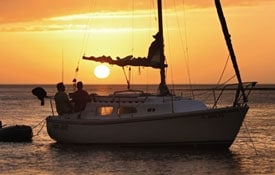
The Nightmare first caught my eye last February as an old friend and former crewmate, Steve Cannon, and I leaned over three sweat-stained charts of the Everglades National Park trying to muster a plan. We were at the Keys Fisheries Marina, a backwater basin in Marathon, halfway down the Florida Keys, where a stone-crab fleet docks and a waterfront fish market serves up the world’s freshest claws. Spread out on the dinette table of Pagan Charm, the 26-foot Balboa sloop we’d chartered for seven days, the charts depicted one of the last great American wilderness areas accessible to a shoal-draft cruiser, with seven navigable rivers slanting southwest into the Gulf of Mexico, tear-drop shaped hardwood-covered hammocks carved by the Shark River Slough, and thousands of mangrove islands clustered at the river mouths. Fancying ourselves explorers, we tried to make sense of the maze, but the stone crab, cold Budweiser, and Florida sun soon brought out our true nature. By lunch hour, I’d proposed that we never leave the slip.
Six-foot Steve kept whacking his head on the Balboa’s low coachroof, but with each new lump, he seemed only to like the boat better. Designed by the late Lyle Hess of Bristol Channel Cutter fame, the Balboa sails well, has ample storage, and meets the most important prerequisite for Everglades sailing: a pencil-thin draft, 22 inches with the centerboard up. Recently restored by Pagan Yacht Charters owner Billy Cooper, Pagan Charm still had its original dinette, which featured a six-color world map from its year of construction, 1972, laminated into the tabletop. The distraction proved too much for Steve.
“Look, here’s Angola,” he said. “And here’s East Germany! Makes you kind of miss the Cold War.” He slid a chart out of his way for a better look.
Give Steve a subway map, much less one of the world, and his mind will careen for hours, so I let him be. I didn’t have much faith in our charts anyway. The cartographers’ notes implied only a fool (or two) would trust the soundings. Large swaths of mangrove and sawgrass were stamped as “unsurveyed.” Among the many waterways that the mapmakers left blank was a thin corkscrew creek that held my gaze.
“Mmm, The Nightmare,” said Steve, looking over my shoulder. “Sounds delightful. Brings to mind our holiday in Transylvania. Flat tires, ankle-deep mud, and eating raw spaghetti because the stove fuel was gone. One of your better meals, that was.”
Georgia born and bred, Steve has a Southerner’s knack for storytelling, and he recalled details of our bike trip 20 years earlier that I’d wholly forgotten. Honest almost to a fault, he’s a good person to fill in the blanks–no sugar-coating, no holding back. And this makes him an ideal sailing companion, for on a long night watch, he tells the most fascinating tales about people I’ve met and the places I’ve been.
The Beach
A light westerly finally pried us away from Marathon, and we set out for the 19-mile run north across Florida Bay to Cape Sable’s East Cape, an expansive, pillow-soft strand that marks Florida’s southern tip. As green Florida Bay cast tiny rainbows with each slap of the hull, I had a moment of deja vu from 1989.
Sixteen years ago, Steve and I bought an old 32-foot Atkin ketch together, and along with Theresa, whom I later married, we cruised the West Indies for nearly three years. But three’s a crowd, the saying goes, and in Venezuela Steve concluded that he’d be happier in a boat of his own. Soon enough, he was headed across the Pacific in a 21-foot sloop, while Theresa and I stayed behind to rebuild the cruising kitty. As much as I looked forward to saner living arrangements, Steve’s leaving was a reminder that real life, alas, is nothing like a beer commercial. Some things do come between best friends.
After a five-hour sail due north out of Marathon across Florida Bay, we reached East Cape in glassy calm an hour before sunset. A 20-mile-long stretch of dunes shaped by centuries of great storms, Cape Sable is one of the few features on the Everglades coast that you can distinguish from offshore. The broad beach curves into three sandy points: East Cape, Middle Cape, and Northwest Cape. The Shark River, the tip of a funnel that drains the Everglades’ sweet water, opens just to the north into Ponce de Leon Bay.
In the prevailing southeasterlies, the waters off East Cape can be bouncy, but that evening our cove was a tableau of reflected clouds. “Looks like we’re the only people on the planet,” said Steve, already in the dinghy, a spinning rod in tow.
Once ashore, with one eye watching the water for rolling tarpon, we walked northwest as ankle-high waves scalloped the shore. The beach was powdery gulf sand, with coquina shells, sponges, and the occasional whelk strewn along the high swash line. The air was so still we could hear the swoosh as a line of pelicans pumped their wings and glided past.
The Shark and the Harney
Before dawn the next morning, a cool breeze blew off Cape Sable, and we reached north around the corner to the Shark River, arriving just as a more insistent northerly took hold. Sailing wing and wing, we threaded the well-marked channel up the Little Shark River until it intersected the Shark, where the wind receded over the tall mangroves. We furled the genny and carried on upriver under outboard while I produced a box of cassettes that I’d dug from my basement for the occasion. It was the same battered collection that had accompanied us through the Caribbean. After a lively debate, we finally settled on a Crosby, Stills, and Nash mix that included “Southern Cross,” a song that’s launched a thousand Pacific dreams, including our own.
“Eighty feet of waterline and a downhill run,” said Steve with a laugh, finding a spot in the sun in the cockpit. “Man, I could have used that outside of Pitcairn.” Steve paused to let the thought sink in, then plunged into his story of the Great Pacific Storm, one of my favorites. After 36 hours of surfing before a gale on his way west out of Pitcairn Island to Tahiti, Steve is finally driven below by exhaustion, where he collapses on the cabin floor. Deciding that any attempt to heave to will be suicide, he leaves his fate to a homemade windvane strapped to the stern of his tiny Elsie Rose. For seven hours, she lurches and hums down Southern Ocean rollers until Steve can take the helm again. But when he finally returns to the cockpit, he realizes that the windvane is doing better than he ever could, so he goes back below and calmly picks up a book.
“Point is, I was lucky, just plain lucky,” Steve said at the end of his story, “and if someone gave me a choice between 80 feet of waterline and luck, I’d take luck any day of the week.” But from the look on Steve’s face, I could see the wheels were still turning. “Then again, if you’re lucky enough to own 80 feet of waterline, you’re already pretty damn lucky, so I guess I’d take the waterline.” His logic–I had to admit–was flawless.
Just before sunset, the Shark River opened wide beneath huge buttonwood trees, and we dropped the anchor in Tarpon Bay, a mangrove-fringed lagoon where the Shark and the Harney converge. According to local fishermen, the bay’s tannin-rich water turns the silver gamefish bright gold, a phenomenon that occurs in few other places. In search of these fairy-tale fish, I trolled the bay in the dinghy, then worked a surface plug along the prop roots. I’d made only a couple of casts when the smell of frying onions drew me back to the boat, where Steve chopped and stirred over the single-burner stove. After crossing the Pacific in a Mini-Transat sloop, Steve is a master of one-pot meals.
Soft Aground
In an amber mist the next morning, we descended back to the Gulf of Mexico with the falling tide on the fast-flowing Harney. We timed our exit for slack low tide, as the channel from the river mouth to the gulf was tricky and unmarked, with a sharp dogleg south along the coast. Just when the open gulf loomed, something seemed not quite right.
Going aground in the Everglades is a strange sensation, as the boat never really stops moving. The bottom is a deep, slowly decaying layer of marl that has the consistency of pudding. (If you’re not careful, you can step out of your boat in two feet of water and suddenly sink in up to your neck.) So if you’re fiddling with the tape deck (as I was), or lounging on the foredeck dreaming about Tahiti (as Steve was), you can thump merrily along without even noticing your keel is plowing through muck.
Eventually, the boat crept so slowly that even an idiot (or two) could see we were stuck. Steve and I both peered over the side. Though the water was less than three feet deep, neither of us could see the bottom. Extrication was easy–we pulled up our centerboard and were on our way–but all traces of smugness vanished. From there, we studiously followed the weed slick marking deep water and eventually reached open water.
“So much for eyeball navigation,” said Steve with a shrug. “Although it might help if our bold skipper watched where he was going.”
Yes, it was just like old times.
By midday, we were clear of the coast, and the wind clocked predictably to the northeast. Conditions were perfect for Pagan Charm, and we reeled off a tremendous 22-mile reach to the northwest corner of the park. As clouds gathered over the mainland, we slid past Pavilion Key, hitting six knots with the help of tidal currents that parallel the coast.
That evening we anchored at Kingston Key, at the southern edge of the Ten Thousand Islands, a constellation of mangrove islets separated by oyster bars, grass flats, and deep, winding channels. Their hummock-like appearance is no coincidence. At the end of the last ice age, these were giant sand dunes, heaped by wind and waves. Today the highest pieces of land are huge shell mounds left by the Calusa Indians, an extinct tribe that controlled this stretch of coast for nearly 2,000 years before the Spanish arrived. Some of the mounds cover up to 150 acres and rise 20 feet above sea level.
Not wishing to break the wilderness spell, we resisted the urge to take the boat into Everglades City, site of the park’s northern headquarters, or to the nearby island community of Chokoloskee. Now famous for backcountry fly-fishing, Chokoloskee marked the edge of the Florida frontier at the turn of the 20th century. Life then revolved around Ted Smallwood’s Store, an Indian trading post that catered to the Miccosukee and the small population of outlaws, former slaves, hermits, and homesteaders who retreated to the swamp after the Civil War.
Preserved as a living museum, the store still appears much as it did that infamous day in 1910 when a hastily assembled posse of men and boys gunned down local businessman Edgar J. Watson at the boat landing. Watson, who was widely feared, was suspected of harboring a fugitive wanted for murder. Both the suspected killer and the victim, a woman known as Big Sal, worked on Watson’s plantation on the nearby Chatham River. (Watson was also rumored to have killed several other people during the preceding years, among them Belle Starr, the Wild West’s outlaw “Bandit Queen” romanticized in gazettes of that time.) Witnesses at Smallwood’s that day said that Watson raised his shotgun and pulled the trigger first, but his wet shells misfired. Watson’s life and its violent end is the subject of a semifictional trilogy by author Peter Matthiessen, beginning with Killing Mister Watson. Most locals, descendants of the shooters among them, regard it as an embellished but fairly honest account of the times.
“It seems that any time Mr. Matthiessen had the chance to spice it up, he did,” said Ben Loudeman, an amateur historian and sailor who now works at the store. “But he does a great job of recapturing what it was like to live here in the early days, when it truly was a frontier town.”
Watson was but one of a long line of fringe characters–mostly bootleggers and drug smugglers–who found the Ten Thousand Islands a handy place to operate outside the law, even into the mid-1980s. Today in Smallwood’s store you can buy a video of a third-generation Everglades City native, the late Loren “Totch” Brown, fondly recalling the good ol’ days of moonshining, poaching, and hauling marijuana. (One scene in Central America shows Totch, appearing to be near retirement age, looking about and leading a mule train loaded with pot destined for Florida.) In the eyes of many locals, the pesky Feds and their catch limits, not a lack of morals, drove the fishermen to poaching and smuggling. Civic pride, not to mention the local economy, suffered a measurable setback in 1983, when the FBI rounded up 125 people–about two-thirds of Everglades City’s population–on drug-smuggling charges. One of them was the chief of police.
“A lot of those people are getting out of jail now, so we might expect things to get exciting again,” one local man told me later.
The Watson Place
Having reached the northern edge of the park, we turned around the next day and headed south. (Getting north early, we’d reasoned, would insure that a strong northerly wind, frequent in winter, wouldn’t pin us down.) By noon we reached the mouth of the Chatham River, within striking distance of the old Watson Place. Pagan Charm’s almost-brand-new outboard picked that moment to go on strike, so we found ourselves gamely tacking around Chatham Bend and into Storter Bay. With our grounding episode a good 24 hours behind us, we were feeling cocky again.
Once anchored, we piled fishing gear, an ice chest, and spare fuel into our doll-sized seven-foot inflatable dinghy and began the two-mile ride up to the Watson Place, a 40-acre shell mound where some believe as many as six murdered victims of “Bloody” Watson are buried. According to some accounts, Watson was able to reduce his overhead after the harvest by killing his laborers instead of paying them.
“And here I am complaining about lousy health-plan benefits,” cracked Steve, when I told him the story.
We’d made it about halfway up the river when two escorts joined us. One dolphin flanked the port side, the other took starboard. They repeatedly surfaced within an arm’s length of the dinghy, looking at us eye to eye.
“If I’m not mistaken, they’re laughing at us,” said Steve, whose pants were already sopping.
“Just keep your weight in the center,” I ordered as another wave washed over my feet. It’s hard to keep a sense of humor when you’re bailing.
Our new friends followed us for about 15 minutes, finally peeling off when we crossed a shallow bar near the Watson Place. A few minutes later, we were tied at the dock, wringing out our clothes and swatting mosquitoes, who’d clearly been expecting us.
The Watson Place is one of the few dry-land campsites on the Wilderness Waterway, a popular, 100-mile route between Everglades City and Flamingo that draws paddlers, small powerboats, and, in their wake, stealthy, well-fed mosquitoes. Beyond the dock lies a small clearing surrounded by a buttonwood forest where sugarcane once grew. The foundations, along with the iron cauldron used to boil the cane juice into syrup, are about the only obvious signs of Watson’s presence. The scene reminded me of expatriate outposts I’d known in Central America and Southeast Asia, remote if not lonely monuments to people who felt out of place and out of time–or, like Watson, who were trying to escape their past.
The Nightmare
The next day, we beam-reached south along the coast in a brisk easterly from Chatham Bend to the mouth of the Lostmans River, where I repaired the outboard (clogged carburetor) and we anchored for the night. We just barely squeaked across First Bay at midtide the next morning. Wilder, and tougher to follow than the Shark River, Lostmans took us deep into Everglades cruising. We passed at least a dozen alligators, most of them lurking at the edge of the mangrove. Osprey circled overhead, and at a bend in the river two bald eagles took turns guarding their nest. Three big bays–Second Bay, Third Bay, and Big Lostmans Bay–opened up, and we were able to briskly reach across them with the centerboard halfway down. Above us, billowing clouds hung motionless in the sky, casting shadow islands on the water.
By late afternoon, the Broad River opened wide, and our goal, The Nightmare, lay just around the bend. The trees parted to reveal a narrow gap, and throttling down, I nosed our bow in. At first, we could see sky through The Nightmare’s canopy, and we sailed through without a scrape. But soon the branches began closing in, and I steered with one eye on the masthead, weaving around the limbs. We were headed into the current, which gave me enough control to avoid the worst snags.
At the narrowest point, a 12-foot gator, the biggest we’d seen, slithered from a side creek and disappeared. Soon after that, things began to go bad. My hand was no match for the maze. Leaves and shoots and stems rained down on Steve, and the board briefly hung on a root. We had to turn around. But where?
“Here’s another fine mess you’ve got me into,” said Steve, as he hung over the side to push us off the trees. I watched for the gator while he warped us around.
We’d gotten in, so we could get out–at least that was the theory. But with the following tide, the game was different. I had to time each dodge well in advance, and even then, it took several quick thrusts of reverse to edge around a few turns. An hour later, we emerged sweaty, bug-bitten, and with our nerve ends fried. Except for a few leaves on the foredeck, the Balboa was no worse for wear.
That evening, anchored back on the Broad River, I watched as flocks of white ibis returned to roost in the trees around us. Though not the great flocks of warden Bradley’s day, they streamed by for two hours in groups of 10 or more, cruciform silhouettes against the sky. As darkness came, the full moon rose from the river, casting a silver glow over the landscape. We fell asleep to the strange grunts of ibis as they carried on a running commentary through the night.
After spending our last night in the Everglades at East Cape, we sailed into Marathon on the heels of a locomotive norther, breathing 20 knots of wind under our collars and sending the Balboa surfing down sharp-edged waves. Sliding through the breakwater at the fisheries marina, we bombed into our slip under bare poles. Billy Cooper of Pagan Charters was there to take our lines.
“Looks like you had an adventure,” he said, brushing a few twigs, remnants from The Nightmare, from the scuppers into the water.
Indeed we had. From Cape Sable to the Ten Thousand Islands, the Everglades had been unusually kind. Thanks to a drier-than-normal winter, one of my biggest fears–becoming the main course of a weeklong mosquito feast–never came to pass. More than anything, the experience reminded me of the magic of small-boat cruising. Because of–not in spite of–our stout little Balboa, we had one hell of a trip. And years from now, when my memory fades, I trust Steve to tell me all about it. An able navigator and a steadfast friend, he’s a good man for filling in the blanks.
Darrell Nicholson, the former senior editor of Cruising World, has slid into the editor’s chair at Offshore magazine.