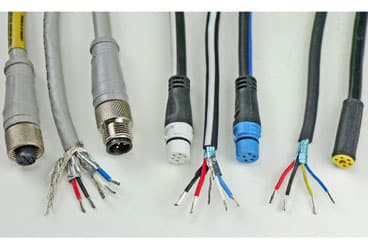
Courtesy of Ben Ellison| |Stripped back cable from Maretron (above, left) and Raymarine reveal similarities: White and blue wires carry data; red and black wires are for power.|
For some of us more elderly sailors, just getting a wind gauge in the cockpit was a big deal; reasonably accurate at-a-glance apparent-wind direction and speed was a significant upgrade from neck-wrecking Windex pointers and overrated ear-lobe anemometers. But a sailboat skipper really wants wind data everywhere. What if your boat could have as many different wind displays-dials and/or graphics-as the crew could possibly need for trimming perfection, a wind rose overlaid around the helm plotter’s boat icon for situational awareness, and the same data delivered to, say, the performance software the offwatch likes to fool with on the nav station computer?
And what if the masthead wind sensor easily networked with the GPS, a knotmeter, and heading sensors so you could select among readings for apparent, true (relative to boat), and ground (relative to Earth) wind on any of those displays? And finally, what if the various components of this system could be sourced from multiple manufacturers according to your personal criteria, be they accuracy, style, durability, or price?
That’s the promise of the National Marine Electronics Association’s 2000 data-sharing standard, and I’m here to tell you that it makes all of the above quite possible, and more. NMEA 2000-compliant sensors and displays can share not just such familiar data messages as wind, depth, and go-to waypoint, for example, but also a growing list of more esoteric items, including fuel-flow rate, bilge-alarm status, and system-control commands.
Moreover, the standardized N2K plugs and cables containing the wire pair on which all this data travels also contain power wires bearing enough juice to run many types of sensors and some power-efficient instrument displays, further simplifying a boat’s wiring. And finally, various strategies are emerging that enable older electronics that use the original NMEA 0183 standard or such offshoots as Raymarine SeaTalkNG to marry a NMEA 2000 network, thus allowing a boat to evolve into the new standard.
Ah, but of course: There are confusions and complications. Many of the very manufacturers that worked together to develop the 2000 standard a decade ago appeared to get cold feet as it was actually introduced. My guess is that the original marketing premise-to make the then-prevalent mixed-brand “best of breed” helm concept work better-got torpedoed when new multifunction displays proved that one brand alone could own the whole helm. At any rate, some companies were slow to adopt N2K, while others used loopholes in the standard to create N2K variants obviously meant more to integrate their own devices than to plug-and-play well with competitors.
It really wasn’t until 2008 that NMEA 2000 became the dominant way to pass around succinct data messages. (Radar, sonar, and video are too verbose to use N2K, and while Ethernet is often the cabling employed, the overall connections remain proprietary.) So while most new multifunction displays, autopilots, instruments, and sensors support N2K, many of the folks who sell and install them are still inexperienced with the nitty-gritty. Which is one good reason why it behooves sailors contemplating new or updated electronics to learn some N2K details, even if they don’t intend to undertake their own installation-although in many cases, N2K makes that easier than ever.
Consider the weird profusion of available N2K cables. The NMEA itself based its plug and cable specification on an existing industrial standard called DeviceNet, specifically its Mini and Micro sizes. While garden-hose-thick Mini is more suitable for ships and megayachts, even Micro is waterproof, heavily shielded from electromagnetic interference, and very tough. Nonetheless, Raymarine and Simrad each designed its own proprietary cable system, SeaTalkNG and SimNet respectively, and some companies, including Garmin and Lowrance, came up with lighter Micro clones. The latter are plug-compatible with Micro, but their plugs are plastic, not metal, and none of these cables seem to offer Micro’s level of shielding and ruggedness.
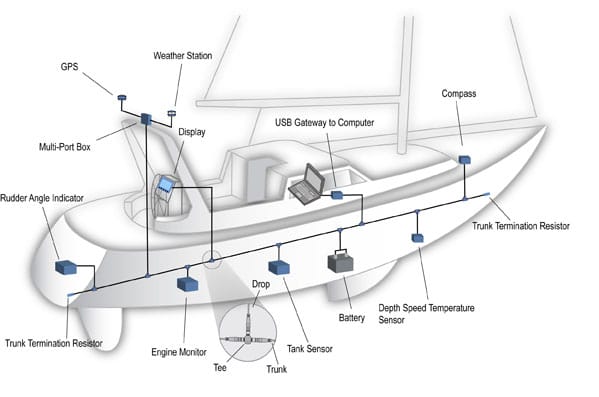
Courtesy of Maretron| |An NMEA 2000 trunk typically runs down the center of the boat (top) and can branch off to many devices..|
So it’s good to know that all N2K devices from the brands above work well with industrial-quality Micro cable. You can chop a plug off a SeaTalkNG or SimNet cable, connect the four active wires to those in a standard cable, and the data and power will flow fine. Better yet, you can get patch cables that perform the same task. Micro-size field-attachable plugs and connection boxes are available, which-along with other useful install accessories such as bulkhead connectors and right-angle plugs-are more reason why you might go with the standard cable design.
But I’d be remiss not to mention the good features of SeaTalkNG and SimNet gear. The latter cabling is exceptionally thin and light, so much so that some weight-conscious sailors consider it, at least, for the run up the mast to a wind whirly (preferably Simrad’s own). The SeaTalkNG system uses heavier-gauge power wires than the various Micro-size cables, which is quite important (see “The N2K Power Story,” below). This gear is also color-coded to avoid confusing a network’s backbone with its drops, what SeaTalkNG terminology calls the “trunk” and the “spurs,” respectively. Additionally, Raymarine and Simrad, along with Furuno, take daisy-chaining liberties with NMEA’s physical-network rules. That’s to say that some devices from those brands, particularly instruments, have two N2K-type ports on the back so they can be easily strung together side by side. NMEA prefers that each device be T’d off the backbone separately or via a distribution box so that the failure of one device won’t prevent the flow of data and/or power to another.
I think that NMEA was overly cautious about daisy chaining. The fix for such a problem would probably entail simply swapping instrument plugs to remove the baddie from the chain. Besides, after years of testing all sorts of NMEA 2000 gear, I’ve seen very few failures of this sort. The root N2K technology, which is based on another industrial standard called CANbus, seems to be extremely robust. In fact, I’ve mixed cable types promiscuously, added and removed devices from live networks, and inadvertently failed to have the proper terminators (resistors) at each end of the backbone-all moves that wouldn’t commonly happen in civilian life. But none of these caused damage or more than minor data hiccups. (Visit my electronics blog via www.cruisingworld.com/0907panbo for the gory details of these tests.)
Nonetheless, I’d be darn hesitant to run anything but heavy-duty NMEA-certified Micro cable as the NMEA 2000 backbone in any boat that might eventually have more than a few devices T’d into it. I’ve seen enough NMEA 0183 data anomalies induced by electromagnetic interference-like an autopilot going whacky on one boat when you keyed the SSB and on another when you made toast (i.e., used the inverter)-to value shielding highly, especially when putting so much important data into one cable. And especially when that data might eventually include engine, bow-thruster, and/or windlass commands, all possible now or in the near future. Imagine how many wiring hassles such a command network could eliminate and what features it could enable-like your multifunction display counting anchor chain. But consider also how important that backbone will then become.
Besides, high-quality NMEA 2000 cable components-available from Maretron (www.maretron.com) and a few other sources, including Molex (www.molex.com)-aren’t much more expensive than the alternatives. The exception, I suppose, are the network parts that Garmin and Lowrance include with some of their N2K sensors and multifunction displays, which is laudable, but at most I’d use those cables in a serious N2K network for drops that are easy to troubleshoot and replace. As for Simrad and Raymarine custom plugs and cabling, it makes sense to use them if your electronics consist almost entirely of gear from one of those brands-part of the marketing plan, perhaps?-but if you intend to mix and match now or in the future, a standard backbone with patch cables is, I think, the way to go.
Now somewhere along the way here, you may have found yourself wondering how it is that marine-electronics manufacturers are apparently messing with standards established by their own trade organization. Well, such organizations only have so much power, especially when it comes to an open-interoperability scheme that marketing departments tend to view as a two-edged sword. It’s also true that it takes even well-intentioned engineers some time to get all the kinks out of such a standard.
For instance, NMEA 2000 includes optional provisions so that one manufacturer’s display can do simple calibrations, such as windvane alignment, on another company’s sensor. But, to my knowledge, no company has yet tried it. NMEA 2000 also makes it possible to have redundant sensors on the same network, but the implementation of that excellent feature varies hugely from brand to brand. These are the sorts of data-management details that I’ll cover in my September look at the available N2K wind sensors and instruments. You’ll learn, as with the cables and power feed, that while the basic NMEA 2000 data concept works well, there are, as usual, some nitty-gritty details to consider.
Ben Ellison is CW’s electronics editor.