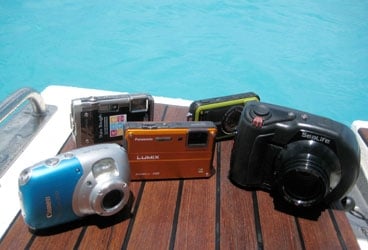
UW Cameras 368
I’ve always tried to shoot photos, both on the boat and while snorkeling, during the various charters and offshore passages I’ve been on. But the reality is, the non-waterproof cameras that I’ve carried have invariably succumbed to my abuse and the perils of salt and moisture-without even being submerged. I’ve never wanted to mess with fickle and expensive camera housings, and the various drugstore disposable waterproof cameras I’ve used have rarely yielded a decent photo.
But after researching waterproof cameras to test on a recent charter in Antigua and Barbuda (see “Sail, Swim, Submerge, Smile, Celebrate,” page 36), it appears that my onboard, underway, and underwater photo dilemma has been solved. The reality is that there’s a bunch of digital cameras that have all the features, functionality, and dimensions of a pocket-size point-and-shoot-auto focus, easy-to-see LCD screen, adjustable zoom-that are also waterproof to snorkel- and, in some cases, dive-friendly depths.
The stated criteria for this test were that each camera would be digital and capable of shooting both still photos and video, waterproof to at least 20 feet, have at least 10 megapixels of effective resolution, and retail for less than $500. Each camera I tested met and often exceeded these parameters. Most are also rated “shockproof” (able to withstand being dropped on a hard surface from a height of 4 to 6 feet), and one camera is designed to take pictures down to a depth of 200 feet.
My test procedure was as scientific as it could be, given that I’m a sailor and not a scientist or pro photographer. I used each camera, both underwater and above, and recorded my impressions, rating each for overall functionality and ease of use, the visibility of the screen underwater, and how truly waterproof the cameras appeared to be. I took pictures in similar conditions while snorkeling in about 7 feet of water.
I tested the Canon PowerShot D10, the Olympus Stylus Tough-8010, the Panasonic Lumix TS2, the Pentax Optio W90, and the SeaLife DC 1200. Just don’t ask me how I got them through airport security in my carry-on.
Canon PowerShot D10
The things I really liked about using the D10 from Canon were its buttons. The shutter button is big enough so that I didn’t need to feel around for it underwater, and it’s right where it should be, on the top right-hand side of the camera. I also liked the large, individual buttons on the back of the camera. Zooming in and out was easy; each function has its own large button that can be intuitively adjusted with your thumb. Other functions, such as switching from still to video mode, the flash settings, playback, and menu also have underwater-user-friendly buttons.
The shape of the D10 also stands out. Some of the other cameras are quite compact and square. The D10 has similar dimensions, but the lens protrudes a bit. It’s a subtle thing, and it may be necessary since the camera is equipped with an image stabilizer, which comes in handy when you’re bobbing around underwater. Its flash is also larger than those on some of the other cameras. The result is that it felt bulkier in my pocket than some of the others. The LCD screen is slightly smaller than the screens on some of the other cameras, but I had no trouble seeing it underwater, and I always had a good idea of the picture I was trying to take. The auto-focus also worked well.
Like most of the cameras, the battery and SD card are housed under one locking latch on the bottom of the camera, and the DC-in and AV-out (where you connect the USB cord to the computer) connections are under another, smaller latch on the side. It was easy to download the photos to the computer, but I did wonder how long the thin, rubber gasket on those latches will keep those areas truly waterproof. But, everything worked for this test, and it comes with a 1-year limited warranty.
Canon, (800) 385-2155, www.Canon.com
Pentax Optio W90
The Optio W90 from Pentax is slightly narrower-that is, more rectangular-than the other cameras, and while it’s a subtle difference, its shape actually makes it feel smaller than the others. Compactness is a good thing, especially when the camera is in your pocket or hanging from your wrist underwater. Maybe this was the reason that I liked the way it felt in my hand and, when all of the cameras were all charged up and laid out in the nav station, I found myself grabbing it first.
Conversely, while at first glance the LCD screen appears to be slightly bigger than the others, the actual visible image fills only most, not all of the screen. The image on the screen turns out to be slightly smaller than the screen images on some of the other cameras. The smaller screen-image size didn’t keep me from taking good pictures, but the bigger screens made it just a little bit easier to see what I was shooting.
Underwater, I had no trouble seeing the screen through my mask and zooming in tight. All the function and menu buttons on the back of the camera are on the small side (as with some of the other cameras ), except for the shutter button. It’s large enough, and I never missed a shot because I’d pushed the wrong button.
The latches on the battery and port compartments did a good job of keeping the water out, and the gaskets seemed up to the task, but the locking mechanisms on both latches were so small that I needed to use a fingernail with a coordinated slide of the latch to get them open.
Pentax, (800) 877-0155, www.pentaximaging,com
Panasonic Lumix TS2
In addition to the bright color and seemingly tough metal exterior of the Lumix TS2 from Panasonic, the other thing that caught my attention, even before I brought it overboard with me, was the camera’s Leica lens. The lenses on all of the test cameras are necessarily small, and I’m not enough of a techie to tell you the specific impact that a Leica lens can make, but Leica lenses have a reputation for clarity that you can see in the test photo above.
Shooting photos with the camera was easy and straightforward. The control buttons are not as big as on some of the other cameras, but they’re still relatively large and allow you to change settings easily. Moreover, the buttons are well marked, so I didn’t encounter any “Is the camera set properly?” problems, even when I was underwater or bobbing on the surface. The screen was plenty visible, and the zoom, controlled by a small rocker button just in front of the good-size shutter button, worked well.
I was impressed with the way the battery/SD slots and AV-out ports keep the water out. Both areas are sealed by beefy latches with a relatively stout rubber gasket that forms a tight seal around each compartment. I also liked the fact that they’re double-locking latches. They not only “click” tight; they also have a secondary lock that shows an area of red when it’s not completely sealed. Since it obviously only takes a drop of salt water inside either of those compartments to likely fry the camera, it was reassuring to know when the latches were locked and the seals were tight.
Panasonic (800) 405-0652, www.panasonic.com/lumix
SeaLife DC 1200
While all of the other cameras in this test were fairly well grouped together according to size, price, maximum depth, and overall functionality, they’re all pretty much regular point-and-shoot cameras that have been made waterproof. The SeaLife DC 1200 from SeaLife Cameras, on the other hand, was made specifically to be used underwater and to be watertight way deeper than the snorkel-friendly and relatively low-pressure depth of 20 feet specified by me for this test.
The DC 1200 is actually a camera and a housing, and though I’d previously been averse to using a housing, I shouldn’t have worried.
Compared with the other cameras, the SeaLife’s housing is necessarily bigger and beefier to withstand pressure at depths of up to 200 feet, but it was super-easy to deal with and wasn’t so big as to be a hindrance. The housing was a snap to open and lock shut, and the camera (similar in size to the others but not waterproof outside the housing) was made specifically to fit, and be fully operational, inside the housing. Since all of the function and menu buttons on the back of the camera are large and in line with large, well-marked, waterproof buttons on the back of the housing, it’s possible to switch from still to video mode or adjust any other setting without having to take it out of the case. Very cool.
The DC 1200 has the biggest LCD screen of all the cameras that I tested, and overall, it worked beautifully. If you’re only looking for a camera to take occasional photos while snorkeling and appreciate the compact size of some of the other cameras, then the SeaLife could be more than you need. But if you’re looking for a camera that’ll give you lots of flexibility and take fantastic deepwater diving pictures, the SeaLife may just be what you’re looking for.
SeaLife Cameras (856) 866-9191, www.sealife-cameras.com
Olympus Stylus Tough-8010
The Tough-8010 from Olympus is the camera I worried about the least before sliding it into my bathing-suit pocket and swimming ashore from the boat. Like most of the other cameras, it’s about the size of a pack of cigarettes and has a shockproof rating. But unlike all of the others, it also has a metal cover that protects the lens when the power is turned off and snaps open automatically when you turn the camera on, and there’s no lens cap to lose.
The Tough-8010 functioned like all the other cameras. The LCD screen was bright, the auto-focus worked well, and I always had a good idea of the photo I was taking. But as I tried one camera after another, it became apparent that size does matter when it comes to the control buttons, and on the Tough-8010, I found them to be on the small side. This isn’t a huge deal, but the smaller buttons required a bit more concentration and dexterity to make sure that the camera was set up properly. When it came time for me to capture the money shot, I occasionally had to make sure I was pushing the shutter button and not turning the camera off. Same for the zoom buttons on the back of the camera. They worked great, but I just had to look down to make sure my thumb was on the right button.
One thing I never wondered about on the Tough-8010 was its waterproofness. All vital components are housed beneath a single door-it’s beefier than just a latch-on the side of the camera. The gasket forms a tight seal, and the door has both a clasp that closes with a click and a completely separate knob that locks the door shut with a second click.
Olympus (888) 553-4448, www.olympusamerica.com
So What’s My Take?
After testing these cameras for a week in the tropics, I can honestly say that while they all exceeded my expectations, one didn’t stand head and shoulders above the rest. They were all easy to use, had similar functions, capabilities, and prices, and took sharp, high-resolution photos both underwater and on land. And the photos were easy to upload and organize on my laptop computer. When all the cameras were laid out on the table, I found that I grabbed the Optio, but that was due more to its size than anything more substantive.
The fact that all these cameras are relatively compact and shoot photos and videos just as well as my non-waterproof camera, while also being both waterproof and even shockproof in most cases, got me thinking: If you’re a cruiser, the right waterproof camera may be the only camera you’ll need.
Bill Springer is ****CW****’s senior editor and will never buy another disposable underwater camera again.
**
**