Copper Bottom Paint
The year 2011 may be remembered as the year when sailors started thinking differently about copper. After centuries of relying on toxic metals to ward off growth on the bottoms of boats, sailors are awakening to a new era of environmental consequences, greater regulation, and breakthroughs in science and paint technology.
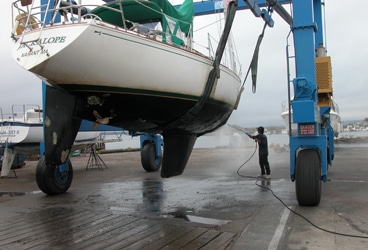
Together these are stirring up tried-and-true practices of dealing with nature’s desire to foul a hull. The days of mindlessly powerwashing hulls at a boat ramp and slapping on a fresh coat of copper paint are coming to an end.
As you prepare for another season on the water, you’ll face a bewildering number of choices—some of them complicated, some costly, some even philosophical. The need to kill, prevent, or clean marine fouling has been with us since the dawn of navigation. In the warm Mediterranean, Phoenicians tried pitch, tar, wax, and lead to prevent slime, worms, and barnacles. Copper emerged in Roman times as sheathing tacked to wood hulls, and it’s credited with giving Nelson a 20-percent speed advantage at the Battle of Trafalgar in 1805. The first paints containing copper and other heavy metals, including nasty mercury and arsenic, appeared in 1860. Mercury paint was still being used in Connecticut a century later.
In the 1950s, the paint industry perfected tributyltin, a cheap antifouling that worked great. It killed a broad spectrum of marine life, including algae slime, that copper wouldn’t touch. But within 20 years, tin was poisoning oysters, contaminating salmon, and wiping out marine life in marinas where boats congregated. Long story short, tin paint is now banned in many countries.
During tin’s phaseout, copper again became the pesticide of choice, though it was a third less toxic. A number of “booster” biocides, including drugs, were often added to make the paint more effective against slime. Cuprous oxide, a maroon-colored powder, makes up 20 percent to 75 percent of the weight of the paint. Once applied on a 30-foot sailboat, copper leaches into the water at the rate of about two pounds a year. (You can figure the rate for your own boat: it’s roughly eight micrograms of copper per square centimeter of surface a year.)
In the ocean, that’s a trifle. Various studies estimate that copper from paint adds 3,000 to 16,000 tons of copper a year to the ocean (mostly from ships), compared to the 250,000 tons attributed to natural land weathering. The rub comes in harbors where boats congregate. Sweden, Denmark, and the Netherlands have banned copper in some ports. In the United States, copper levels in some harbors have exceeded Environmental Protection Agency standards for toxicity—3.1 parts per billion in the water column—for years. However, little was done because there were more obvious pollutants and polluters. Within the last two years, however, copper’s time has come.
Florida has found 160 miles of estuaries contaminated with copper, including the Indian River Lagoon, an estuary of national significance and home to Port Canaveral. Geoffrey Swain, a professor of oceanography and ocean engineering at the Florida Institute of Technology, has measured high copper levels around 14 marinas and in the flesh of clams and oysters. In the 40-mile stretch he surveyed, Swain estimated that 1.7 tons of copper is released each year from sailboats, 2.1 tons from powerboats, and 1.4 tons from only seven cruise ships.
On Maryland’s Eastern Shore, NOAA found copper levels in the water of the lower Choptank River that measured four times the standard, with Cambridge marinas the likely source.
In Southern California, copper has been measured as high as 29 parts per billion in Newport Bay and 12 parts per billion in San Diego Bay, where 7,000 boats sit year-round in poorly circulating water. Studies estimate that in San Diego’s Shelter Island Yacht Basin alone, an estimated 2.5 tons of copper leaches from the bottoms of 2,000 boats every year.
Across the United States, this copper comes from two main sources: passive leaching from boats in the water, and powerwashing at marinas. Bottoms scrubbed by divers, a practice most common in California, contributes a fraction of the problem copper.
As might be expected, these copper violations have prompted action in places where environmentalism is strong and where bay and harbor cleanups have wide support. These actions fall into two categories: restricting copper-paint use by boat owners, and stopping marinas from draining wastewater into the sea.
Washington this year is expected to become the first state to ban copper bottom paint on recreational boats. In a state where salmon are sacred, government studies have shown that excessive copper harms a salmon’s sense of smell, giving predators an advantage. The issue came to a head last year when the Puget Soundkeeper Alliance sued five boatyards under the Clean Water Act (and settled for $80,000), prompting the Northwest Marine Trade Association to sponsor legislation that was to be filed in January to phase out copper paint entirely. This action will both reduce copper pollution and avoid more lawsuits against Washington’s 88 boatyards, said Peter Schrappen, the association’s director of government relations, who lined up legislative sponsors and guided the writing of the law.
“We think it will be a cost saver, and at the end of the day, sailors want clean water,” he said. The alternative—to install expensive wastewater collection systems and haul the water to a treatment plant—became law in Connecticut at the end of 2010 (following Maine and Massachusetts) and is hanging over the head of Maryland boatyards, as efforts to clean up Chesapeake Bay target all industrial sources, including boatyard powerwashing.
The Baltimore County Marine Trades Association considered a copper ban, but it pulled back after deciding that “there isn’t really a proven alternative to copper yet,” said Raymond Porter, a boatyard owner and the association president. He estimated that a water-collecting system would cost his 100-slip boatyard $80,000. Yet, as he watches clean-water enforcement move down the U.S. East Coast, he braces for a new day in antifouling.
In San Diego, based on studies showing birth defects in mussels and physiologic impairment of oysters, scallops, sea urchins, and crustaceans, state water authorities have given the port 15 years to reduce copper pollution by 76 percent.
Because there’s no single target, like boatyards, and copper is a widely used (and legal) antifouling, regulators are sponsoring paint tests in an attempt to persuade boat owners—and paint companies—to try alternatives. The 15-year window was chosen as the average time between bottom stripping, when paint changes could be made without extra costs to boat owners.
Eventually, though, a sea change is coming. “If you think about it,” said Leigh Taylor Johnson of the University of California Sea Grant Extension Service, “three out of four boat owners would have to go non-copper. The clock is ticking.”
Consequently, San Diego has become a test bed for tomorrow’s bottom paints. A two-year program tried out virtually every non-copper paint on the market and concluded that new zinc-based biocides and new slick paints without pesticides can match copper in price, life span, and fouling prevention. (See “Bottom Paint Simplified (a Little),” page 71.)
For their part, paint companies have anticipated the dethroning of King Copper with a blizzard of new paints. The paints are expensive to create and manufacturers have found it’s costly and time consuming to gain regulatory approval; several are still awaiting E.P.A. and California approval. And the new paints, say paint companies, often will require careful attention to application and maintenance—no more slapping on a new can and plopping the boat in the water.
“We defend the science of copper and the use of it, as do our sister companies. I don’t believe copper is killing our waters,” said Bob Donat of Interlux, the largest antifouling paint company. “But if California wants to ban copper, 100 percent completely, we’re prepared for that.”
Jim Seidel, Interlux’s assistant marketing manager for North America, added that as a whole, the paint industry was “trying to make all antifouling paints more efficient. If we can reduce the amount of biocide and still create the same level of antifouling protection, that’s a step in the right direction.”
Pettit’s sales of copper-free paints have doubled in the last two years, “but to be honest, they don’t hold a candle to the slowest-moving copper product,” said director of sales and marketing Don Zabransky. “Will it, over time? Yeah. We’ve been working in this direction for over a decade. The key is figuring out what your need is, then putting on the right paint to give you the coverage you want with the least impact on the environment around you.”
So what’s a sailor to do? There are 6 million boats in the United States, and at least half of them require antifouling paint. Antifouling is both an economic necessity and a nuisance. Some sailors solve the problem in the way that Zeehag, a recent poster on CruisersForum.com, does: He heads to Trinidad to use outlawed tributyltin. “Morally reprehensible?” he wrote. “Maybe. Functional? Yes.”
But for the conscientious sailor, the new paradigm will likely be “managing” copper use: More thought. More complex applications and maintenance. Higher initial costs, which means pushing environmental costs into the pockets of sailors themselves. We’ll all have to bear a bit of the burden.
In the worst scenarios floated to date, the complete phaseout of copper in bottom paints will occur within nine years in some locations. In the meantime, more products are coming, with less copper and more additives, all designed to gradually reduce copper pollution.
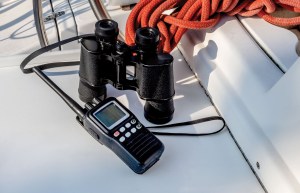
Today doesn’t mark the end of antifouling copper. But with a good pair of binoculars, you can watch it as it disappears over the horizon.
Jim Carrier owns Ranger, an Allied Seabreeze, currently berthed in Tunisia. A longtime environmental reporter, his writing is included in The Best American Science and Nature Writing 2010_._