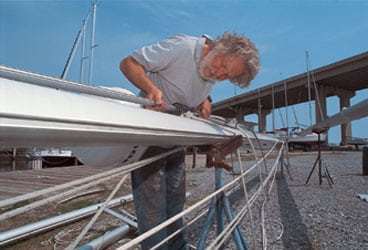
Jim Carrier working on mast
When I started sailing on Long Island Sound, the dream of owning a cruising boat seemed as remote as buying waterfront property. I was making $8,000 a year and sneaking peeks through yacht-club gates as though they were pearly. Brokerage ads in sailing magazines only extended the distance between me and my blue heaven.
Thirty years and a few raises later, I discovered modest, used “classic plastics” that in their day flew the finest burgees but now were available to middle-class dreamers. I cashed an annuity and, for $32,900, bought a 1970 Allied Seabreeze yawl named Ranger. Well made, beautifully shaped, she became for me a 35-foot magic carpet with which I could slip alongside a gold-plater, open a can of beans and a beer, and enjoy the same sunset view.
The surveyor, of course, found pages of flaws. I still have that first receipt for a $4 package of wood dowels in case of through-hull failure. Being a pack rat, I also kept the receipts for another $10,000 I spent during my first year of living board. Big-ticket items included new running and standing rigging and a new mizzen sail. My fondest receipts, though, reflected a yearning to sail over the horizon: a Yacht Boy shortwave receiver for single-sideband-frequency weather forecasts, charts for the Bahamas, and a used Monitor windvane.
I couldn’t afford to live plugged in at slips, so at times boating seemed more like camping. I learned to love 75 degrees, the temperature at which my old-fashioned icebox kept both leftover beans and beer. Still, the wind blew Ranger to Key West, Cuba, the Bahamas, and then to Alabama for three years of writing and civil-rights work. At a two-bit Montgomery marina, she tugged at her dock lines, reminding me that under the spreading greenish mold, she could still go. I vowed we would. Some day. Then came September 11.
My clearest emotion that day was a need to be alone. Saturated with twin-tower images, I retreated to Ranger and bleached, sanded, and varnished teak until a small section of bow stood out like one painted toenail. It was a meditation, of sorts. When all that we did seemed inconsequential, the revival of something old and substantial, a living vessel, was therapy. I got on my knees and brought her back.
As she emerged, so did a plan. I wanted to leave America-the-terrorized, to get on Ranger and head to the sea. We’d sail to Europe, float by Monaco and Venice, then take a grand canal cruise to Paris for a season near Notre Dame. To give me a deadline and some moral support, I signed up for the Atlantic Rally for Cruisers (ARC) Europe, which, on May 9, 2002, had simultaneous starts from Antigua, West Indies, and St. Augustine, Florida, the two fleets meeting in Bermuda and sailing loosely as one across the Atlantic by way of the Azores.
As audacious as the trip sounded, the required refit didn’t differ much from what any old-boat owner dreams of achieving: a seaworthy craft with upgraded systems, comfortable accommodations, and, of course, cold drinks and hot food. The difference in the equation was the transatlantic. Most skippers upgrade over time, fixing things as they age and adding would-be-nice features as they flip through catalogs before winter fires. Because the ocean amplifies any flaw, I needed to launch with all systems up and running. This compressed years of tinkering and window-shopping into six months.
The crossing would prove a rigorous test bed for equipment and workmanship. Soon, Ranger‘s refit list ran to four pages with 175 tasks, the workload so daunting that I’d often lie down on a bunk just to ponder it and wake up tired. Then I happened upon an American Sailing Association cruising text that recommended starting the process with two fundamentals: 1.) Keep water out of the boat. 2.) Make the boat go. With refreshing starkness, priorities immediately fell into place: 1.) Hull, through-hulls, drains, hatches, ports, and bilge pumps. 2.) Sails, rigging, hardware, electricity, fuel, engine. All else—including crew safety and care, navigation, and communication—would follow.
One of my best early investments was a $300 offshore seminar put on by Steve Black and Hal Sutphen for cruisers participating in the Caribbean 1500 rally from Virginia to the British Virgin Islands—three days of lectures from people who’d been there. Faced with bewildering choices, especially among a mind-boggling selection of electronics, I learned that what I really needed was a new suit of sails. What I didn’t need, they said, was a $4,000 marinized laptop computer. I came away with specific brand recommendations and—more important—reassurance that Ranger and I could sail offshore.
Back in the boatyard, emerging each day from the bowels of the vessel, I realized that doing a refit yourself isn’t like packing a parachute; it’s like sewing one. Taking apart and putting together—bolt by bolt, stainless-steel screw by endless wire—I began to know what Ranger was made of. When gusts jarred the rigging east of the Azores, I was glad I’d dug out and replaced all eight chainplates ($175), a known weakness in Seabreezes. Ditto, when a gale threw wads of water that struck like a ball peen hammer on Ranger’s four new Lexan ports ($110).
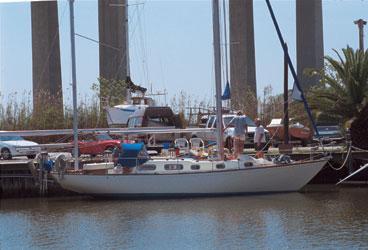
To meet the deadline, I hired $2,000 in yard labor, but contractors tackled what I termed “normal” jobs while my friends and I did the protracted, often creative, tasks peculiar to an old boat. Mike Englett, Darryl Cooke, Wally Wallace, Tony Barbee, and Mike McGraw were angels with grease on their hands. Still, it was stunning how the bills mounted, and I was shocked to learn, after adding up the receipts, that Ranger’s refit—which didn’t include any transatlantic costs or safety gear required by ARC—had so far cost $34,847, exceeding the purchase price of the boat.
The bulk of this I’d spent on hardware, electronics, and sails, followed by the electrical-system and galley expenses. I carried many spares, but with few exceptions (rigging cable, fittings, filters), most of Ranger’s redundancy was in the form of older items that had been replaced, such as the bilge pump and the alternator.
A few items could be ascribed to having eyes bigger than my needs. Nevertheless, I believe that six years from now, the bottom line would have been the same. And if I’d spent the equivalent $70,000 on a newer boat, it still would have needed upgrades before cruising to Europe. Just before departure, the insurance surveyor appraised Ranger as being “above average” at $53,500. That’s an inflated market price for a 1970 Allied Seabreeze. But to borrow a page from Enron, owning an old sailboat creates a price-versus-value calculus that’s, well, better viewed offshore, which was exactly where we were bound, with a crew of three, in the spring of 2002 as part of the ARC Europe fleet.
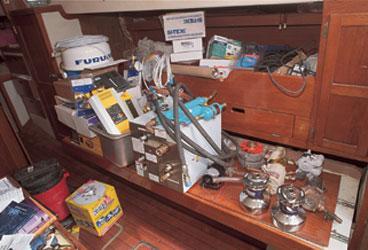
Stuff That Worked
New sails: My largest investment was $5,880 for new sails from Quantum Sails and Mobile’s Dabney Sailmakers—a main with three sets of reef points, and three jibs: 100 percent, 150 percent, and a hank-on storm jib. After 30 days of 24-hour sailing that ranged from dead calms to whole gale, plus a full week of 25-knot winds and 12-foot seas off Portugal, I can say unequivocally that nothing counts offshore like good sails.
Belowdecks autopilot: In place of the wheel, I retrofitted a tiller, which returned the feel of sailing and cleared out the cockpit. But the $2,300 Autohelm Sailpilot 5000 sailed Ranger to Europe.
New electrical system: With the possible exception of old drain hoses, nothing showed Ranger‘s 30 years and four owners more clearly than its electrical system—a greasy, corroded, and brittle rat’s nest with all kinds of things wired directly to batteries. I tore it all out, ran reels of 14- and 16-gauge wire, and installed new DC and AC distribution boxes, cabin lights, busses, and fused subcircuits. The $3,769 I spent on electrical parts included a $1,724 Jack Rabbit Marine power system with 125-amp alternator and smart charger. A tedious job, but it’s done for my lifetime.
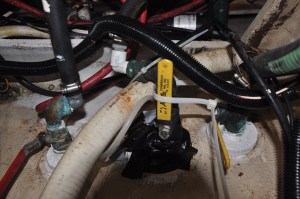
Upgraded fuel tanks: Had Ranger‘s Yanmar engine not quit 200 yards from the haulout marina due to fuel sediment shaken up by a Mobile Bay southerly chop, I might never have opened the fuel tanks to check them out. Oh, my word! Removing and cleaning the fuel tanks—scrubbing black varnish and dead algae—is one of the orneriest jobs in the yard, but what peace of mind it afforded me after the deed was done. I also spent $1,587 for an additional tank, a Racor 500 filter, line fittings, and a manifold with four-way valves (intake and return) for each tank.
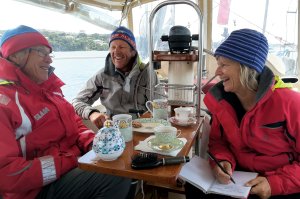
Propane stove/gimballed oven: This Force 10 three-burner range cost $1,260 including tank and safety valves. It took time to overcome the fear of propane—roughly the three minutes the new stove needed to boil tea water and the 15 minutes to bake cornbread. When first mate Wally Wallace handed up another hot meal—mashed potatoes, gravy, canned chicken, and steamed broccoli—the Atlantic Ocean receded. During the 1,800-mile Bermuda-to-Azores leg, three men ate three hot meals for 16 days using propane from a 10-pound tank.
Luxuries I Liked
Self-tailing winches: After years of rubberized squeeze-top self-tailer conversions on the original winches, the $1,440 I spent for a pair of Anderson self-tailers provided a great upgrade for solo watches.
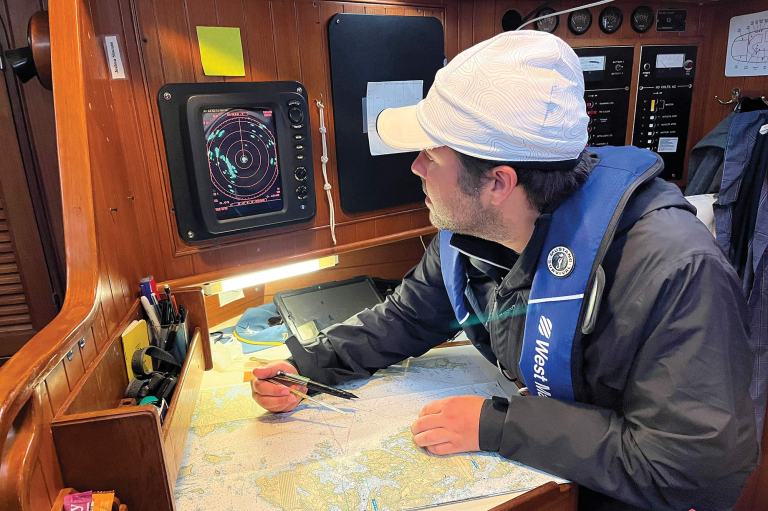
Radar: At the first glimpse of a ship on the horizon, we flipped on the $1,150 Furuno Model 1622 radar and tracked the blip across a 16-mile radius. I mounted it on a swinging arm so we could view it below or in the cockpit.
Galley foot pump: This $80 addition sipped water from a 45-gallon system, conserving tank water and enabling us to take half-gallon swabbings every few days with engine-heated pressurized water that ran to the head.
Satellite phone: A rented Iridium unit ($110 per month) and a $1,000 Dell laptop offered morale and safety boosts. With them, we sent and received e-mails, including weather forecasts and notes from family, and we called mothers on Mother’s Day and other boats in the fleet to report our position and commiserate. One boat answered cheerily, “Mike’s Pizza.” While I had dreamed of a custom-built navigation station, I kept the laptop in a waterproof case and set it up on the dinette table while the helmsmen held the phone outside.
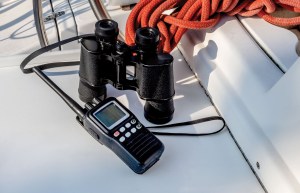
SSB/shortwave: Between my Si-Tex NavFax 200 single-sideband (SSB) with external antenna ($620 with Xaxero weatherfax software) and my trusty Yacht Boy, we were always able to tune in Herb Hilgenberg or other weather forecasts and advisories.
Fixed-mount GPS: Our Garmin GPS 162 ($400) with external antenna and 15-foot accuracy, mounted in the “nav station” (a tabletop), was terrific. Still, my 4-year-old, one-channel Garman GPS II did yeoman work under the dodger. I kept a spare handheld ($100) in the abandon-ship bag.
Three tools: a Dremel rotary tool ($120 kit), a cordless drill ($40), and, in the yard, a Porter-Cable reciprocating sander ($100).
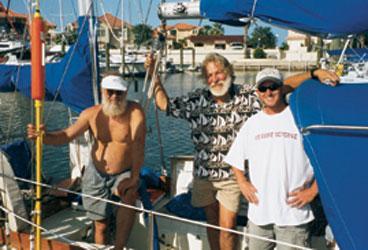
Crew of Ranger ready for the Atlantic
Stuff I Didn’t Need
Electronic charts: I had the Bahamas on a Garmin BlueChart CD ($140), and it was fun to watch the shore move across my laptop screen. I chose BlueChart because the CD could be loaded into both the laptop, for real-time navigation, and the GPS unit. But when I asked for an Azores/Portugal chart, Garmin reported its software didn’t include these stopover islands, so I went back to paper. Nobeltec (www.nobeltec.com), MapTech (www.maptech.com), and SoftChart (www.softcharts.com) provide this coverage.
Apparent-wind autopilot steering: This Raymarine ST40 Bidata and Wind System, with transducers, cost me $325, but I never got it dialed in. It was both fun and scary to watch the wind reach 40 knots, but the helmsman kept us trimmed.
1,000-watt hard-wired inverter: I could have saved the $725 I spent on the ProSine 1000 and used an old ProWatt 300-watt plug-in unit that I carried as a spare.
Monitor windvane: Call it autopilot atrophy, but I simply never used it during the crossing. Without another ocean ahead, I’ll probably remove this expensive (bought used for $2,400) redundancy from an otherwise gorgeous stern.
Mounted searchlight: On a pitching sailboat, a plug-in handheld spotlight is handier and cheaper than the $250 model with remote control that I purchased and installed.
What Caused Trouble
Corroded electrical gear: Despite all of our caulking, water got in everywhere, due, I think, to the old boat’s joints working at sea and a relatively low freeboard. Large waves that hit Ranger activated hydrostatic strobes and set off engine warning buzzers. During one squall, water poured through a forgotten hole and cascaded over distribution boxes, busses, and a Heart Interface Link 10 Battery Monitor, frying it. Batteries began to drain. I remounted busses higher and disconnected meters that wouldn’t dry out.
Aluminum centerboard: This is a nice tool to reduce weather helm in bay waters, but it became a nightmare in heavy rolling. Even cranked up tight, the banging inside the trunk was frightening and sleep-depriving. And with it, we waged an endless and expensive battle with corrosion.
The Refit Goes On
Cosmetics: As much as I wanted to sail Ranger in Bristol fashion into Bermuda, the toerail teak remained mostly gray, the cabin walls were patched but not painted, and the counters remained dingy yellow. Alas, the nav station—my Starship Enterprise dream corner—remained a tabletop, a bolted-on GPS, and radios stuffed in a book space.
A new bottom: Thirty years of bottom paint had left a mottled surface with too much water in the hull. Out of time and money, I slapped on some copper paint and took off. When she dries out in Portugal, we’ll tackle it, maybe.
Refrigeration: To satisfy a long-delayed yearning for cold beer and frozen steaks, I bought a $2,310 engine-driven Technautics holding-plate system and ended up carrying it uninstalled to Portugal, a victim of priorities. I plan to insulate the old box and install it before I get to Monaco. The prince might ask for ice in his cocktail when he comes aboard.
Jim Carrier is the author of seven books, including The Ship and the Storm: Hurricane Mitch and the Loss of the Fantome (2000; McGraw Hill, $25). He left Ranger in Lagos, Portugal, as a base for future European cruises, with Spain and the Med in his immediate sights.