PGHurricane368
Although I have been sailing all my life– growing up in the Netherlands, I can remember using my brother’s diapers and a bamboo spar to construct a rig for the family dinghy– it wasn’t until my wife, Joan, and I moved to Houston last year that I lived in an area prone to hurricanes.
After we purchased our Bristol 40 Joan II, joined the venerable Houston Yacht Club, and settled into our slip, I began learning all I could about hurricane preparedness. I read up on how to prepare the boat, consulting the club’s hurricane plan and gleaning heavy-weather mooring tips from books and web sites. To get sufficient warning, I bookmarked www.nhc.noaa.gov, which tracks tropical storms in the Atlantic, and www.tidesandcurrents.noaa.gov, which models expected wind and tides in Galveston Bay.
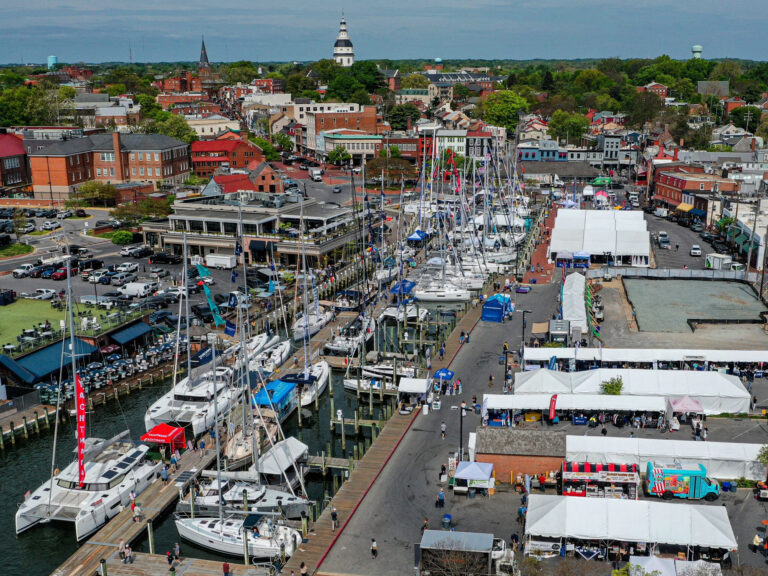
With the 2008 hurricane season approaching, I began my preparations by determining where to keep the boat in the event of a hurricane. Houston Yacht Club was destroyed by Hurricane Alicia in 1983 and is located right on Galveston Bay. I consulted other club members and surveyed a number of other marinas, concluding that my current slip was as safe as anything available.
We serviced the engine, filled the fuel tank, emptied most of the water tank, and readied sails and equipment for quick removal. After replacing all worn lines, we fortified the existing mooring arrangement with extra spring lines and extra lines at the bow. Using heavy chain around the pilings, we secured the lines, covering them with plastic hose at possible friction points. We outfitted cleats, windlass, and primary winches with backing plates, checked seacock connections, and replaced the bilge pump and switch.
By Thursday, September 11, it was obvious that only luck would shield us from a direct hit, as forecasts were predicting the eye of Hurricane Ike to pass within a few miles of the club.
To reduce windage and prevent damage, I removed the bimini, dodger, and covers and secured these items down below.
The most complicated part of my preparations was figuring out how the mooring situation would change with the predicted 14-foot storm surge and 80-knot winds, which would be shifting from north to south as the hurricane passed. We adjusted our existing mooring lines so they could move freely up the pilings without floating off the tops at high water. We also attached long lines to distant anchor points: a sturdy bush and the bulwark of the breakwater. We tried to distribute the load of the lines between deck cleats, windlass, primary winches, and mast.
We rode out the hurricane at our house, which is about 20 miles from the club. (Authorities had ordered the evacuation of the area around the club.) The storm brought heavy rain, thunder and lightning, howling wind, and pitch darkness. Power transformers were exploding all around us. We were well prepared with water and flashlights and even managed to get in some sleep.
After the storm, we were without power for a week. The frustrating part was to be without communication. Rumors from the club started to come in via SMS text messages, and the reports weren’t good: “Worse than Alicia.” “Complete destruction.”
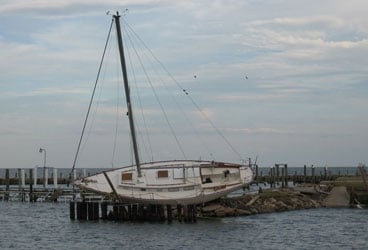
When we were finally able to return to the club on Monday, we found yachts on the lawn and in the parking lot. No Joan II anywhere. Our friend Cliff found his Desiderata still moored and afloat but mangled by its neighbors. Many boats had sunk. Others were floating in their slips as if nothing had happened. Two or three boats with all their sails on and no preparation at all were unscathed. Finally, someone pointed out Joan II resting atop the breakwater. Imagine this picture: nothing left of the club’s piers and pilings, debris everywhere, ripped-up asphalt, sunken motorboats, and at the very end, high and dry, Joan II.
I can only infer what happened during Ike. I figure the mooring pilings and docks gave way quite soon. Judging by Joan II’s relatively undamaged topsides, I’m guessing the long lines kept the boat more or less in place. In the damaged slip, some of the lines had broken. The woven ones fared especially badly.
With the northerly wind and the storm surge, Joan II must have been floating 12 feet above normal water level, taking all the waves coming in from Galveston Bay. When the wind veered to the south after the eye had passed, the boat must have drifted (as planned) to the breakwater that lies to the the north of the slip. Unfortunately, the line wasn’t long enough to let the boat come down on the far side of the breakwater (as planned), so the boat landed right on top. The keel must have been smashing on the rocks for about two hours before the boat came to rest with the falling tide.
Heavy rain and waves must have entered the vessel. The boat doesn’t seem to have sprung any leaks except for where the seacock flange of the toilet outlet sheared off. Water must also have come in through the galley sink because it was full of debris.
Joan II actually looked pretty good on the outside– scratches on the topsides, dents in the toerail where lines had chafed, rudder off the rudder pin, hull slightly bent in where the boat came to rest. The mast was still standing, so we hoisted our flags to keep the spirit of good hope alive.
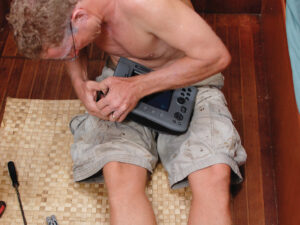
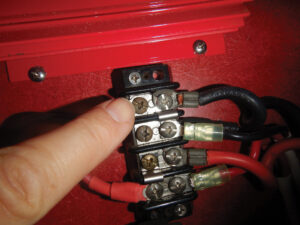
Inside was a terrible mess. The stringers had come loose where the hull was resting on the breakwater, but the bulkheads seemed to be in good shape. Up to the level of the chart table stood a pool of bilgewater, ingress through leaky windows and hatches, battery fluid, sand, slime, and dissolved toilet paper. The charts and books in the cupboards had turned to pulp. Electronics were a corroded mess. With the help of my wife, daughter, and a friend, it took us three days of hard work at an uncomfortable angle to get everything off the boat, cleaned, dried, and stored at home.
Now begins the long process of insurance claims, adjusters, surveyors, salvage companies, and shipyards. It will be months before we’re back on the water. The boat will have to be removed by a floating crane before being transported to the shipyard on a trailer. We don’t think there’s any structural damage, but we’ll have to take a close look. At the very least Joan II will need a good cleaning and revarnishing, and the engine will have to be serviced.
Here’s what I learned:
Take the preparation checklist seriously. Every item has its purpose. Don’t think too long over the necessity of each, just do it.
The surge is far worse than the wind. It floats boats above the pilings and opens up the port to incoming waves.
The biggest risk, in my view, is from other boats, including boats that work loose and go on a rampage and boats that are moored close together and start rocking against each other, catching masts. The solution seems to be to moor your boat with as much free space around it as possible.
There’s also the risk that mooring lines will not keep the boat in place. The surge makes it impossible to trust the pilings, unless they are specifically designed for hurricanes– tall, steel, and well anchored. At Houston Yacht Club, many pilings just pulled right out of the bottom. Mooring lines will move up and off if not secured. But secure to what? Most parts of the infrastructure are not going to withstand the storm. I had considered attaching a long line to the pump house near our boat, but the pump house ended up 300 yards away!
Woven lines– the kind used for halyards and sheets– are absolutely useless as mooring lines. Mooring lines need to be undamaged, spliced, and oversized. Any line that gets stuck and starts chafing will break in short order.
In hindsight, I would have moored in the outer harbor on long, new lines made fast to the breakwater. Another strategy would be to anchor, but unless you have really heavy ground tackle, I don’t see how that would work near a lee shore. The Florida tactic of hauling the boat and parking it at a yard might be the best alternative.
Change to gel batteries. Battery fluid is nasty stuff.
Close all openings and use duct tape on areas you know will leak– sinks, toilets, and other inlets, even when the seacocks are closed.
Count on everything getting wet. Empty the boat after every season and discard anything you haven’t used. Consider vacuum-bagging manuals, documents, and clothing. Toilet paper is the most horrible stuff when it starts floating around.
Review your insurance. It’s important to define what type of coverage you want. If you’re counting on “old for new,” you’d better pay for it.
Getting a professional survey is also a good idea. I’m glad I had Joan II surveyed, as I now have a document of the state of the boat before the hurricane.