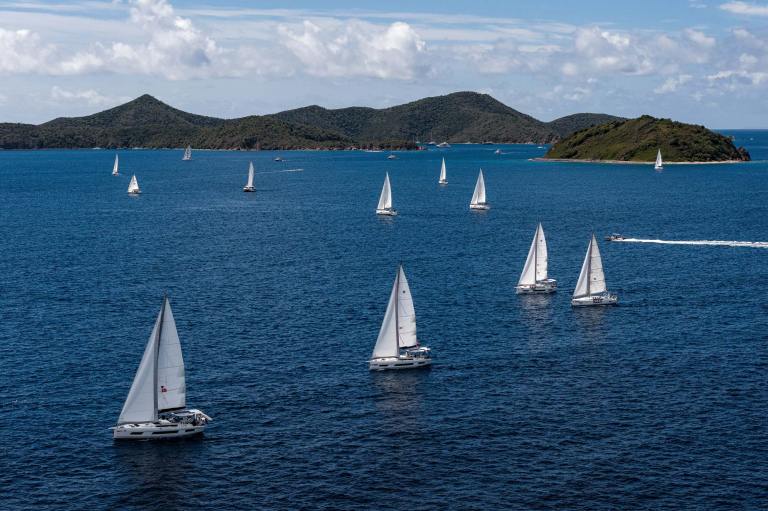
A field of two dozen boats new to the U.S. market, four distinguished judges, 10 days of evaluation, and miles of taped conversations were the pillars of Cruising World’s 2005 Boat of the Year contest held during the United States Sailboat Show in Annapolis, Maryland, last October. A nomination round in advance of the contest whittled a field of 41 entries down to 24 boats, which were then grouped into six categories defined by size, price, design, and purpose. The categories included three for production monohulls (under 40 feet, 40 to 45 feet, and over 45 feet), one for midsize performance cruisers, and two for cruising multihulls (40 feet and under, and over 40 feet).
Of the 24 nominated boats, eight received awards: one from each of the six categories, plus two special awards for Best Charter Boat and Best Value, drawn from the entire field. Finally, two category winners received the ultimate awards for Best Domestic Cruising Boat and the Best Imported Cruising Boat of 2005.
Adhering to a tight schedule and dodging heavy boat-show traffic, the judges climbed aboard the nominated boats and measured angles and distances, scrutinized dark corners, dived under floorboards, and squeezed into tight spots to get the complete picture. Throughout the contest, they remained focused on safe shorthanded sailing in a cruising (neither fully crewed nor racing) context, even when they evaluated the more performance-oriented boats. Before the dockside walk-through, the judges asked each builder to define the target for which the boat was designed. Among other questions, they asked each builder to categorize the boat as inshore, coastal, near offshore (island-hopping), or true bluewater. The judges used these and other yardsticks as they went about evaluating each boat. If a boat’s builder deemed it a “coastal cruiser,” for example, the judges were less demanding about finding good sea berths and copious tankage; by contrast, a boat sold as a go-anywhere passagemaker better have these, as well as good dinghy and life-raft stowage and a host of other things.
“Do they start with a vision and build a boat that goes with it, or do they start with a boat and try to find customers for it?” veteran yacht designer, boatbuilder, and BOTY judge Bill Lee asked. In the best boats, design was consistent with the builder’s marketing message; in those boats, construction, performance, and equipment most closely matched their target audience and intended use.
Of course, a vital question on any boat is its price, and that can shift by as much as 40 percent depending on what’s included after the hull. For fair comparison, Bill worked out a sailaway price based on a deal signed in October 2004 that included U.S. East Coast delivery, basic electronics, refrigeration, 110-volt shore power, electrical anchor windlass, bottom paint, commissioning, and working sails. This required adding in some items or backing out others that might be standard on some other boats. It’s a bang-for-the-buck equation; or, as Alvah Simon suggested: “If you spend a lot of money, you expect to see a certain density of quality and good thinking that adds up to good value.”
Construction method and application were on Steve Callahan’s list of judging priorities. He considered safety, market demands, and the execution of such important details as the hull/deck joint. He also looked at performance and handling under power, and found he’s getting sold on Flex-O-Fold propellers, which were used on many boats. “They’re a bit less powerful in reverse than solid props, but they don’t walk as much, which is great for motoring backward in a straight line.”
Another question the judges considered was “commercial viability,” which includes production volume, dealer structure, and manufacturer or dealer backup in the United States. “If someone invests in a new boat, it’s fair to ask, ‘If something happens, who’ll be around to take care of it?'” said Tom Prior, an avid cruiser and sometimes delivery skipper who earned his place on the BOTY panel of judges by winning an essay contest announced in Cruising World’s January 2004 issue. Tom’s perspective helped calibrate the panel’s evaluation to serve the most important side, the consumer.
After the dockside inspection, the judges boarded each boat for a second time to go sailing. They maneuvered under power and sail, deployed the anchor, reefed the main, steered with the emergency tiller, and sailed all round the compass. GPS and noise meters quantified the judges’ sensations, which had been honed by thousands of ocean miles and decades of messing about in boats.
After each day of sailing, the judges discussed and evaluated each boat individually, a process that encouraged and produced several spirited exchanges. Within categories, some of the judges’ debates lasted hours. However, when all was said and done, the votes for the two overall winners, imported and domestic, were unanimous. Although vastly different in style and purpose, each boat was found to be the clear frontrunner in its class and a terrific execution of its stated design intent. In other words, both boats did exactly what the manufacturers said they would do, and they did it better than all their rivals.
Special Awards
Before we get to the overall winners and the categories, let’s take a look at the boats that won our awards for Best Charter Boat and Best Value.
As we said earlier, choosing the best cruising boats required judging from the perspective of a couple or a family–a shorthanded crew. But well-designed and -executed charter boats are a bit different. They must accommodate several couples in nearly identical comfort. Measured by that standard, the new Lagoon 440 had no peers.
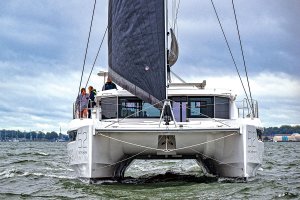
Just how big can a 44-footer get? Our judges got one possible answer looking down from the lofty flybridge of the 440, surveying the four corners of the catamaran empire beneath them. With a payload capacity of three tons, she won’t set speed records, but she’ll woo the comfort crowd and charter companies. Alvah considered the Lagoon a possible sabbatical cruiser for people who need a break from the rat race: Knowing that it holds value adds to its commercial viability. He gave high marks for nonskid, netting, ports, pushpits and pulpits, lifelines, handhold positioning, the number (eight) and size of the cleats, two anchor rollers, the workability of the anchoring system, and the nav station’s size and setup. Tom called the galley “commercial grade” and was fascinated by the spacious interior, the accommodations, heads, showers, and storage. “My wife would move into this boat, permanently,” he concluded his thoughts.
Bill noted that the boat sailed in five knots of wind and that it tacked and jibed easily under only the main. He liked the easy access to the large flybridge, which he predicted would become a favorite hangout for leisure purposes along with the forward and aft cockpits. Steve found that “motoring was very smooth and responsive” and felt the boat had good ergonomics throughout. Said Alvah, “The builder hit the market with a clean, slick, well-engineered, well-built boat that’s consistent in concept. And you can have one hell of a party. It made me think of mai tais and daiquiris.” Lagoon said it has a backlog until 2006, with a few 440s being put into charter over the next year at The Catamaran Company, TMM, and Sunsail.
A second special award, one that’s been given since the first Boat of the Year contest Cruising World hosted in 1994, is for best value. So how much boat can you get for the buck without trading away performance, quality, or comfort? The sweet spot for this category was the topic of a long discussion before the panel arrived at the Jeanneau Sun Odyssey 40.3–a boat that comes in at $195,000, according to our contest formula, or $220,000 kitted out. Steve found the 40.3 “a fun boat to sail that handled very well and was very smooth under power. Reefed down, it had very good balance, pretty good speed, and maneuverability.” He also liked the traditional shaft-drive engine and aluminum toerails for outboard sheeting. Tom thought “this was a good boat and could be a charter candidate. There’s a lot of room in the aft cabin.” Alvah’s safety check noted good nonskid, nine deck hatches, wide and smooth chocks, stout cleats, and two anchor rollers. “I found it was a lot of fun to sail, and I felt very comfortable,” he remarked. “I think there’s a lot of value for that price.” Another plus in the eyes of the judges was the warranty: one year on all gear, and five years on structure and osmosis damage. Jeanneau uses Harken hardware and other widely recognized brand names, so gear can be serviced and exchanged around the world.
The Overall Winners
This year, for the first time in the running of Cruising World’s Boat of the Year contest, judges were asked to award prizes to two overall winners–one to a U.S.-built boat and one to an imported vessel. Though the judges were instructed that each boat didn’t have to win its category (which had been a rule in past contests), as this year’s deliberations played out, the two winners did happen to be unanimous winners in their categories.
When The Moorings decided to replace its venerable 3800, the longtime charter company contracted with speed merchants Morelli & Melvin, the designers of Cheyenne (née PlayStation) and the Gunboat 62 (winner of last year’s BOTY innovation award), it was fair to expect radical changes. Enter the Moorings 4000, built by Robertson & Caine in Cape Town, South Africa, the winner of the 2005 Cruising World Best Import award.
The 4000’s curved topsides, her huge, convex side ports, and a hardtop bimini with sliding hatch signal that she was redone from the inverted bell shape up. Co-designer Gino Morelli calls it a “tulip shape” that features an outward step in the hulls, which is still rare in cats but more common in trimarans. “It boosts the volume and livability inside at very little cost,” Steve said of the hull form. “And it has structural advantages, almost like a chine ridge, which adds stiffness.”
The 4000 is bigger and sails better than her predecessor; according to Morelli, it’s lighter by 4,000 pounds. The hulls also have a shallower forefoot, rocker, and a mini keel designed to be exchanged without hauling the boat. “It tacked really well with just the main in light air,” Steve said of the boat’s maneuverability. Under power, she managed about 7.5 knots at 2,500 rpm, and, thanks to her saildrives, she did it quietly. Meant for the tropics, her design provides open spaces, a large cockpit table, and an indoor/outdoor bar at the sliding door of the saloon.
But the boat’s most remarkable feature was sailing-related. “The sailhandling center by the helm should become an industry standard,” Bill noted. And Alvah loved the safety aspects: “By bringing the sail controls all to one spot, you take a lot of the stress out of handling the boat in rough conditions when sailing shorthanded.” Missing handholds and bad ergonomics, his pet peeves, were pleasantly absent. “It felt safe moving around, and every time I put out my hand, there was something to grab.” Tom was pleased with the interior arrangements and the engine-access hatch at the top of the transom steps. “You can drop right in there and work around the edges.”
The 4000 is offered with a four-cabin/two-head layout for charter or with an owner’s version that’s sold as the Leopard 40. R & C expect to have 30 boats built by the end of 2005. “I think it’s so good because it’s a true second-generation boat,” Bill said. “They started with a list of everything that could be improved on the [older] boats, then re-engineered from scratch. And they did a really good job with it.” Congratulations to Robertson & Caine and The Moorings.
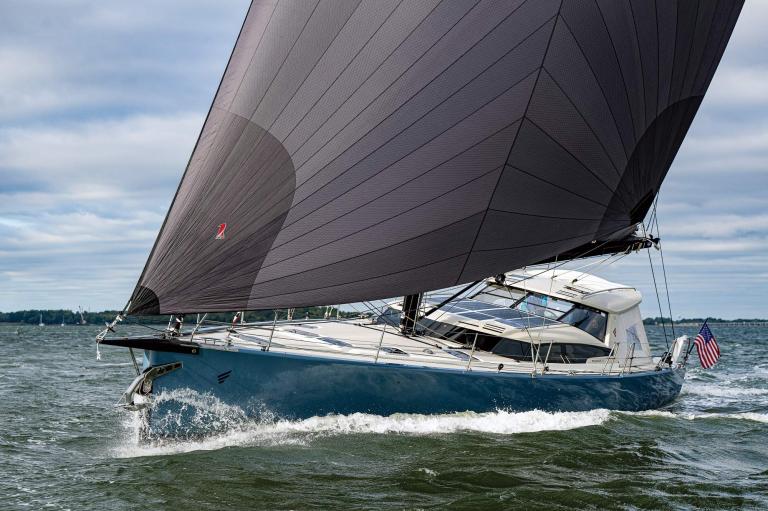
Finally, from America–from Maine, in particular–came the one boat the judges liked the most, the Sabre 386, the Cruising World Domestic Boat of the Year. Bentley Collins, Sabre’s marketing manager, introduced it as “the best possible performance cruiser, not heavy-duty bluewater, but looking for owners who’ve sailed for 15 years or more. It’s intended to appeal to sailors who need to sail upwind properly.” Designer Jim Taylor successfully translated vision into appearance, detail, and performance. “Sabre made a boat with slightly smaller volume, which almost always results in a better sailing boat,” said Bill.
With satisfaction, judges noted such details as good dorade vents, heavy-duty rubrails, 27-inch lifelines on four-bolted stanchions, gasketed and latchable lockers, and sturdy handrails. Steve found the high quality of construction to his liking, especially Sabre’s conservative approach to the hull/deck joint, which is glassed over and through-bolted every eight inches. He said, “The company is mixing traditional aesthetics with modern gear–from the carbon rudder to tweakers on the jib tracks, and it works really well.” Below, Tom found “great engine access front and rear, a stand-up shower, lots of room to stow stuff, Oceanair all over the place, and cedar-lined lockers.”
Bill defined three universal go-slow features that detract from any boat’s performance: shallow-draft keels, fixed three-bladed props, and in-mast mainsail furling. He noted that even though the Sabre had two of these–a four-foot-11-inch shoal keel and a fixed prop–her functionality and looks were still matched by performance. A 10-knot breeze pushed her to weather at a satisfying six knots in flat water and let her flirt with seven knots on a beam reach. Safety guru Alvah, not one to be easily impressed, offered this assessment: “I found a lot of check marks on my list in the “very good” and “excellent” columns. Sabre uses a lot of big plates and nice gear. It was missing the cleat in the anchor locker, but for $20, you can fix that. The boat felt and performed like a big boat, yet she’s only 38 feet, so it’s not intimidating.” Under power, the vessel behaved equally well, motoring along just under seven knots at 2,500 rpm. Bill summed up their impression of the Sabre 386: “She’s a class act.”
PRODUCTION CRUISERS UNDER 40 FEET
In the category that comes closest to what we might call an entry level are four boats that range in size from 33 to 38 feet and in price from $100,000 to $195,000. Of them, three are built in the United States (the Beneteau 343 comes from Marion, South Carolina, though her builder’s corporate headquarters are in France); the Dufour 385 is imported from La Rochelle, France.
The smallest boat in this category is the Hunter 33. Billed as a boat that’s fast and extremely responsive, one that’s meant to feel more like a sportboat than a cruiser, the 33 hit many of its design objectives. Priced around $100,000, the 33 would be ideal for a family who wants good value in a versatile coastal cruiser and Wednesday-nighter, Alvah reckoned. Steve praised the 33’s handling characteristics under full sail and main alone or under power, where it proved to be responsive and very maneuverable.
The Beneteau 343 follows a popular trend that increases interior space with a raised coachroof and incorporates panoramic deck lights for more ambient light down below. She looks and feels large for her size and offers unrestricted visibility and movement without dodger or bimini. The test boat had a full-batten main, a folding prop, and a six-foot-one-inch deep-draft keel–in other words, none of Bill’s three go-slow factors. Consequently, she delivered six and a half knots of boat speed on a beam reach in 10 knots true. The 343 also turned heads with a steering column that swivels 90 degrees to clear the passage through the cockpit.
The biggest in this class of production cruisers was the Dufour 385, the midsize model in what Dufour calls its “three-digit” series, which is the cruising heir of Dufour’s former “Classic” line. The boat has an exceptionally large cockpit and is the only boat in its class with twin helms, another solution for opening the cockpit passage from the transom to the companionway. The traveler was placed on the coachroof, quite typical for cruisers, but at the expense of a dedicated dodger coaming, which makes retrofits more difficult. The test boat came with a furling main, a fixed prop, and a five-foot-nine-inch keel; still, she happily delivered boat speeds of four and a half knots in a light morning breeze.
The Hunter 38 surprised the judging panel on several counts: first, by meeting her design objectives so well, and finally by performing so well under power and sail. She was presented as a family boat that offers ease of sailing for a couple or for new sailors, a cruising boat meant to handle coastal and moderate offshore conditions. We tested the owner’s version, which intrigued Bill: “The aft cabin was very well done for a 38-foot boat. I liked the passageways on both sides because it really helps the ventilation.” Labeled through-hull fittings, clustered in one area, big double stainless-steel sinks, settees that function as sea berths, and an optional Bose sound system indicated how well Hunter is tuned to the wants and needs of its clientele.
Above deck, the 38 garnered high marks for a well-conceived anchoring layout that features a Simpson/Lawrence windlass, twin anchor rollers, and a cleat for the anchor rode. “Chocks and cleats were fine, and the emergency steering was very good; the [deck] flow was good; the handholds were good,” noted Alvah. Steve liked that “the boat was incredibly maneuverable both under power and under sail.” The traveler on top of the bimini arch kept all sail controls close to the helm and out of the cockpit. Some judges wished for larger overhead windows in the bimini to improve visibility and sail trim. The three-point Bergstrom & Ridder rig with a large main and a small blade jib made sailhandling easy with a shorthanded crew.
The boat we sailed had all three speed-inhibiting features–in-mast furling, a fixed three-bladed prop, and a five-foot shoal keel–yet she hustled along at a steady six knots on a beam reach in 10 knots of true wind. For several years, BOTY judges have noted the growing influence of Hunter’s in-house designer, Glenn Henderson, and nowhere has his sailorly touch shown through more clearly than in this boat. For these and other reasons, the Hunter 38 wins this year’s award for Best Production Cruiser Under 40 Feet.
PRODUCTION CRUISERS 40 TO 45 FEET
The boats in this category range from $200,000 to $280,000. Three were imported: the Bavaria 42 Cruiser from Germany, the Impression 434 from the Elan yard in Slovenia, and the Jeanneau Sun Odyssey 40.3 from France. The Catalina Morgan 440 was built in that company’s Florida yard.
The Impression 434 by Elan, the first model of their cruising line, made its U.S. debut at Annapolis. Like all other Elans, she was designed by Rob Humphreys. The Impression was perhaps the most distinctively styled entry, featuring a simple, comfortable, and bright interior that had good visibility to the outside through panoramic deck lights and oval ports in the topsides. Her high freeboard made for dry sailing; at 24,000 pounds, she had the highest displacement in her class with a 202 Disp./L ratio. The judges cited the three-bladed fixed prop, a five-foot-three-inch bulb keel, and the roller-furling main as reasons why she took a tick longer to accelerate out of tacks than she might have with a folding prop and a standard main. Bill liked the large cockpit with dual steering and the center-console table. His admiration of the large aft cabin with dual access and standing headroom on the side was shared by another judge, who must have remembered his wife’s preferences as he uttered sotto voce: “May she never see this.”
The Bavaria 42 Cruiser, another U.S. debutante, was presented as a coastal cruiser and weekender for the “second-time owner,” a boat for customers with previous sailing experience. The judges noted styling and upholstery, the two large head-and-shower compartments, and the dual-wheel cockpit with a center-console table and GPS repeater screen. Steve pointed out the well-sized tangs and swages on the standing rigging, while Bill noted good engine access and the stylish opening ports. Forward visibility through the dodger windows was good, but the smallish overhead bimini windows obstructed the view of the sails from the helm. The boat proved fast under power, hitting roughly eight knots at 2,500 rpm, but was a step short of its potential under sail with a shallow-draft keel, a fixed prop, and a furling main.
Jeanneau’s Sun Odyssey 40.3 solidly impressed all four judges. The company defined it as near-offshore capable, e.g., for the Bahamas and the Caribbean. In a breeze that was consistently over 20 knots, she was well behaved under furled jib and main while maintaining swift progress on all points of sail. Aggressive pricing, solid performance, and proper attention to details made the SO 40.3 a strong category contender and the winner of this year’s Best Value award, drawn from the entire fleet.
The dockside walk-through on the Catalina Morgan 440 and designer Gerry Douglas’ briefing left no doubt that this boat was explicitly designed and built for a particular market. “As cruising couples mature,” said Douglas, “they often anticipate spending longer periods aboard and possibly doing some distance cruising when retirement and lifestyle changes permit.” In dozens of ways both large and small, the 440 answered its brief. “The builder does a lot of things to make its clients feel at home on the boat,” Steve observed.
With 30 1/2-inch lifelines (among the highest in the fleet), handholds on the coachroof, bulwarks along the deck, gas springs on the hatches, lounge seats in the saloon, and an optional washer/dryer that vents overboard, the Catalina Morgan 440 is, above all, a comfortable sailboat. Alvah was impressed with hardware and ergonomics. “This was one of the few boats that actually got it right, all the way forward on deck, all the way forward below.” He liked the Maxwell windlass with vertical rode drum that can be rigged to hoist a dinghy onto the foredeck. Tom was pleased with the large battery capacity and maintenance access in the back of the boat. Her handling and sailing performance in very light air was found to be better than expected, with a full-batten main on a Leisure Furl system.
Other highlights in the judges’ notes included the sturdy capped rubrail, the safe exit from the cockpit onto the side deck, room under the cabin sole, and generous tankage. A 62-foot mast for the Intracoastal Waterway and a four-foot-11-inch shoal keel for the Bahamas are more proof for the close match of product and vision. In terms of defining a particular target and meeting it thoroughly, Bill thought the 440 “was a pretty bold thing to pull off.” For all these reasons and more, the Catalina Morgan 440 earned the title Best Production Cruiser 40 to 45 Feet.
MIDSIZE PERFORMANCE CRUISERS
All builders like to consider their boats as performers. Still, there’s a class of boats–call them cruiser/ racers, call them performance cruisers–that stands a notch above production cruisers, with more emphasis on speed, precision handling, sail controls, and rig adjustment. Because lighter boats are faster boats, performance cruisers often employ the latest layup technology and deck gear, which is reflected in their prices. Our Midsize Performance Cruiser class features five boats that range in size from 37 to 45 feet and in price from $240,000 to $335,000. Four were built abroad: the Finngulf 37 in Finland, the X-40 in Denmark, the Saga 409 in Canada, and the Beneteau First 44.7 exclusively in France (not South Carolina). The Sabre 386 was built in Maine.
The Finngulf 37 was the smallest and lightest boat in this class. The test sail was conducted in a blustery 25-knot breeze and lumpy seas. With a reef tucked in and a partially furled jib, the judges dialed in the comfort zone and had plenty of fun doing it. Steve commended the boat’s handling under sail and power, even in a significant chop. Bill emphasized the safety of a keel-stepped mast and liked the emergency tools stowed under the top companionway step. Alvah, the man on the pitching bow, also liked the performance, but he had difficulty deploying the hook because of design conflicts with the furling gear. The boat was shown with the double aft cabin, including a dedicated sea berth, full-batten main, a folding prop, and the six-foot keel.
Delivered from Ontario on her own keel was the Saga 409, a Tony Castro design that was noted for its many cruising-oriented details: a pushpit that extends beyond the transition from cockpit to sidedeck, 30 1/2-inch lifelines, good dinghy storage on the foredeck, a keel-stepped mast, padeyes to attach jacklines, a folding cockpit table with sturdy stainless-steel tubing, and a traveler arch. The Saga received positive mentions for a well-organized fuel-storage locker in the cockpit, a 10-inch sump, two usable sea berths in the saloon, and an emergency grab bag in the life-raft locker. Areas to improve included the installation of the large deck lights and a nav table that’s big enough to hold paper charts. The boat was shown with a five-foot-10-inch shoal keel, a three-bladed Gori folding prop, and a conventional full-batten main.
The Bruce Farr-designed Beneteau First 44.7 was the largest boat of the class, a prototypical cruiser/racer, appealing to experienced sailors who may not want to race flat out but still like to click off daily runs that are beyond the norm. The boat we sailed was equipped with a folding prop, a full-batten main, and a seven-foot-two-inch shoal-draft keel. Bill liked how Beneteau built a sweet-sailing boat with an uncored hull. Steve found the boat was “easy to handle with superb maneuverability,” although he missed places to hold on to or brace against under heel. Alvah praised the functionality of the setup on this privately owned boat, but he would have preferred lifelines higher than 24 inches. Tom pointed out backup foot pumps for galley water and envisioned chartering the boat for some spirited sailing. With a breeze in the low teens, the Beneteau First 44.7 delivered eight knots on a beam reach; sailing to weather, she tacked through 60 degrees apparent.
Launched in Denmark last spring, the X-40 made her first U.S. appearance at the Annapolis show. Billed by X-Yachts as a performance cruiser with bluewater creds, the X-40 is the smaller sibling of the X-43 and X-46. Like her sisters, she’s built in polyester sandwich with a galvanized-steel grid laminated into the hull to absorb rig and keel forces. The interior, featuring matched grain throughout most of its wood surfaces, is several notches above the standard fare. Bill and Steve found evidence of X-Yachts’ racing heritage in the Admiral’s Cup mainsheet system, the single-hoist attachment point in the structural grid, and control lines that are partially hidden on the cabin top. Alvah took issue with some of the light gear on the boat and the 24-inch lifelines, which he considered in need of an upgrade for bluewater sailing. The X-40 also proved that a performance cruiser can have a remarkably neat and practical stowable dodger.
The Sabre 386 rose to the top of her class, which was packed with strong contenders, on her way toward winning the overall award. On the merits of consistency, quality, and the fulfillment of her promise as a boat with solid performance on all points of sail, she won her category hands down. From recessed genoa tracks to water filters under the sink and cedar lining in the lockers, the attention to detail was exemplary. The 386 shuns ephemeral styling trends for a classic look. Yet maintenance shouldn’t take on classic proportions because time at the helm takes priority over time at the yard. “Retaining traditional, well-proven construction and aesthetics while incorporating modern elements, Sabre has achieved terrific balance,” Steve concluded.
PRODUCTION CRUISERS 45 TO 50 FEET
In the category of the fleet’s largest cruisers, we sailed four boats ranging in price from $365,000 to $630,000. Three of the boats are imports: the Dehler 47 from Germany, the Grand Soleil 50 from Italy, and the Jeanneau Sun Odyssey 49 Deck Saloon from France. The sole domestic boat in this category, the Island Packet 445, was built in Largo, Florida. Two of the boats, the Grand Soleil and the Dehler, could have been classed as “performance cruisers” if enough boats had entered this particular class and size range.
The new Grand Soleil 50 was an “out-of the box” entry, sailing for the first time here on the day of the test. In the day’s fading light, the largest boat of the contest displayed Italian grace–uncluttered, teaked out, and sporting a beautiful new suit of UK Sailmakers Tape Drive sails. Steve loved the motion of the boat and its expansive decks that could easily accommodate dodger and inflatable, but he missed foot braces in the cockpit and convenient bilge access. “The deck flow was the best of all boats,” commented Alvah, though he would’ve preferred to see a safer pulpit and lifelines higher than 24 inches. Bill called her “fun to sail and pretty.” As a boat for experienced owners, the GS 50 hinted at good cruising speed, doing close to seven knots in a dying breeze with a six-foot-eight-inch shoal keel and a fixed three-bladed prop.
The Jeanneau Sun Odyssey 49 Deck Saloon is the smaller sibling of the Vitorrio Garroni-styled 54-footer that was introduced last year. Available in two different layouts, each with a cabin that can convert from one large to two small spaces, the version we sailed came with the owner’s stateroom aft and two convertible cabins forward. Tom liked the optional generator’s installation down low and the watertight collision bulkhead aft of the anchor locker. Alvah found lots of good gear and ideas throughout but wished for better ergonomics at the workstations. Molded toerails and stainless-steel rails around the dorade vents provided safety and a nice touch. However, rubrails and overhead handholds in the cabin were conspicuously absent. Despite a five-foot-seven-inch shoal keel and the roller-furling main, this Sun Odyssey sailed at more than eight knots on a beam reach in 15 to 20 knots true.
The Island Packet 445 was presented as a boat that emphasized cruising in comfort and safety to the Bahamas and beyond. The boat continues the Island Packet style and design philosophy that’s found such a solid following, and it builds on the center-cockpit ideas that Island Packet first explored in 2002 with its 485. Coincidentally, the 445 was also the only center-cockpit boat in this year’s test. Staggering headroom, and near-commercial-size tankage under the cabin sole (260 gallons for water, 160 gallons for fuel, 55 gallons for waste) plus a bulletproof rig with a Hoyt staysail boom and lots of solid gear indicate that designer Bob Johnson intended this boat to venture far afield. The judges liked the quality of construction material and many of the boat’s details that suggest a steady evolution. Particularly remarkable are Island Packet’s warranties: three years stem-to-stern, and 10 years on the hull.
Designed by Judel/Vrolijk & Co., the new Dehler 47 has a performance pedigree and, as the judges found, solid cruise appeal. By company definition, the boat is a performance cruiser leaning toward comfort and luxury. Down below, Tom found lots of lockers, nice seats with stowage underneath, and a wet locker right at the bottom of the companionway. With its drop-down transom flap and zip-away dodger, the boat intrigued the designer in Bill Lee. “I thought it sailed very nicely. It was a mix of good racing and cruising ideas.” Steve felt right at home in the cockpit. “It was easy to deal with the traveler and mainsail and all the basic sail controls on the boat. Under power, it performed extremely well.”
Dehler uses a monocoque construction technique: hull and deck are joined and laminated while still in their molds, and all systems, tanks, and machinery go in through the hatch afterward–a boon for the owner who keeps the boat long enough to oversee refits later. Alvah commended the quality of workmanship throughout the boat, pointing out such details as the sliding hatch and the captive Lexan boards in the companionway. But he was wary of the hydraulic hideaway anchor, a $9,500 option. “I found that a bit complex. There are no rollers, no chocks, and no way to anchor the boat unless that works,” he said. The $630,000 price tag makes the Dehler 47 a boat for upscale clients who love to sail. Steve summed up his impressions: “I think it’s a big version of a boat that would appeal to me. Sails nicely and handles very well.” His colleagues agreed and awarded the Dehler 47 the prize for Best Production Cruiser 45 to 50 feet.
MULTIHULLS 40 FEET AND UNDER
In the smaller of our two multihull categories, we had a remarkably close contest: all three entrants were catamarans between 38 and 40 feet, all are priced between $300,000 and $320,000, and all were built in South Africa.
The Admiral 38 was defined as an owner’s boat, “a semicustom vessel for retirement cruising.” It was the only entry with a rotisserie oven. Her bridgedeck saloon was very bright, due to gargantuan skylights in the cabin top. This arrangement moved the jib tracks to the side deck, which increased sheeting angles. The traveler was mounted on the targa wing to reduce cockpit clutter; however, the controls had to be cranked like a winch to move the car, which made it difficult to blow the main quickly. Admiral Yachts said it builds roughly a dozen boats a year and has a backlog until 2006.
The Maxim 380 was presented by Bill Hirst, its U.S. distributor, as a cruiser for “mere mortals,” one that was originally designed for charter in the Voyage Yachts fleet but is now being developed for private owners. Indeed, this Alex Simonis-designed cat shares many traits with other Voyage models. The 380 got the judges’ attention for some unusual details. It had a four-burner stove, a rare occurrence in this year’s contest. The customary davits were replaced by a derrick that telescoped out of the boom’s aft end, so a RIB could be lifted onto the chocks on the aft platform. Alvah liked the reefing arrangement, the double halyard, the windlass, and the anchor roller. Steve found the Maxim 380 easy to maneuver under power. As with the Admiral, the judges took issue with the cumbersome traveler control that had to be cranked both ways. Maxim Yachts says it builds up to 12 boats annually and hopes to sell two units of this model per year in the United States market.
The runaway winner in this class was the Moorings 4000, the boat that was most consistent with its design objective and did so many things so well. Bill applauded the fact that she wasn’t a stretched makeover of the old 3800 but designed and engineered from scratch. Gino Morrelli and Pete Melvin have used their experience in the performance-multihull game to come up with a bigger yet leaner boat that will perform well even when loaded with a full complement of crew and gear. Not only is the boat a staggering two tons lighter than the 3800; her weight distribution is better, too. The hook is deployed on a bridle, directly from the anchor locker, which cleans up the foredeck, reduces weight, and increases safety. The rockered hull shape promotes maneuverability and is flared out above the waterline to increase interior space. Saloon and cockpit are linked by an extendable bar, emphasizing the boat’s purpose as a tropical party platform.
But most important, the 4000 set a new standard for functionality and safe shorthanded sailing with a helm station that put all sail controls within arm’s reach of the skipper. Restricted visibility under the bimini, the judges’ recurring complaint on other boats, was addressed with a sliding hatch so the driver can clearly see the sail trim. Alvah found “good workmanship and good ergonomics throughout, good workstations, and good safety features.” Steve summarized the panel’s impression of the Moorings 4000: “It’s a very good execution.”
MULTIHULLS OVER 40 FEET
In the final category, we sailed four catamarans that ranged from 41 to 46 feet and from $355,000 to $425,000. Three of the boats are imports (the Aeroyacht H42 and the Lagoon 440 are from France, and the Dolphin 460 is from Brazil). The Maine Cat 41 comes from Bremen, Maine.
With its simple tiller steering, the Aeroyacht H42 instantly put the judges in touch with the fun of multihull sailing. Once comfortably lodged in the molded driver seats of this production cat, they were in no hurry to leave because they liked the small-boat feeling. The H42’s retractable daggerboards are slightly canted inwards for improved lift. Built in polyester sandwich at Edel’s facilities in Normandy, France, the boat is offered with five different interior layouts. However, the panel thought the boat’s finish didn’t quite measure up to the top standard, an observation that may be offset by the boat’s attractive price. The Aeroyacht H42 is rated Category 1A Offshore and backed by a five-year structural and three-year osmosis warranty.
The Dolphin 460 was the biggest cat in this contest. Her U.S. importer, Phil Berman, defined the boat as a luxury performance cruiser. Built of Divinycell PVC foam and fiberglass vacuum-bagged in polyester resin, this Dolphin is the first one in the builder’s nine-year history that’s been adapted particularly with U.S. standards in mind. More traditional in design than the Maine Cat, the Dolphin garnered points for its protected stern steps, which promote easy boarding from a dinghy on the hull’s inboard side; a mainsheet system that effectively eliminates a traveler; and a standard set of North 3DL sails that are worthy of the boat’s option of a rotating carbon mast (built in the yard’s own autoclave). The owner’s version we sailed had a “home office” in the starboard hull, and the autopilot’s remote could be connected at the saloon table for fully protected steering with excellent visibility.
When the judges stepped on the Lagoon 440 for the dockside walk-through, they realized that this is quite possibly the largest 44-footer they’ve been on. She was defined as a “20/20 boat,” optimized for operation between 20 degrees north latitude and 20 degrees south. Designed both for private owners who love to sail with lots of friends and for the charter trade, she features a spacious flybridge, multiple cockpits, and a gigantic interior. “They put a lot of boat on the water with consistent construction quality from stem to stern,” Alvah said. The Lagoon 440 was a strong runner-up in its category and walked away with the prize for the 2005 fleet’s best charter boat.
The most passionately discussed nominee was the Maine Cat 41. Dick Vermeulen, designer and builder, defined the boat as one that allows owners “to cruise farther offshore, in greater comfort, and with a larger payload-carrying capacity” than that allowed by the Maine Cat 30, of which some 54 have been built since 1997. “Our owners typically cruise for several months of the year and range from Maine to the Caribbean,” he said. “They require a simple boat with a totally protected helm that shows excellent performance on all points of sail.”
The panel loved Vermeulen’s vision of a convertible catamaran with a hard top and soft sides, to say nothing of the boat’s exceptional craftsmanship and performance. In the blink of an eye, the zippered roll-down curtains change the bridgedeck from an open patio into an enclosed cockpit and vice versa. “The midship wheel inside is an interesting solution to the steering problem,” remarked Bill, referring to common designs that range from bulkhead-mounted helm stations to those found at the exposed aft end of some boats. The Maine Cat’s helm is situated centrally in the cockpit, with horizontal 360-degree visibility. Steve found “so much that is right, really high-class modern construction, and first-class equipment. It handles extremely well.” Alvah commended stainless-steel work, four-bolted stanchion bases, and handholds. “It was well made, comfortable, and easy to sail, and there were very good workstations, all logically separated. Everything was labeled, and it all worked well.” Tom loved the spacious galley in the port hull. “Very easy to work, a lot of storage, eye-level refrigerator, four-burner stove, microwave, two sinks, both really deep and square. Like being at home.”
Other notable features included a self-tacking jib and solar panels (440 watts) on the hardtop. A few items the judges wished they’d seen were a dedicated life-raft locker, an emergency steering system, and better drainage from the cockpit. And all judges wished for the better visibility of the top-notch sails from under the bimini. But all of these items can be addressed, and given the boat’s exemplary design and execution, the judges enthusiastically named the Maine Cat 41 the Best Multihull Over 40 Feet.
Dieter Loibner is Cruising World’s newest associate editor.