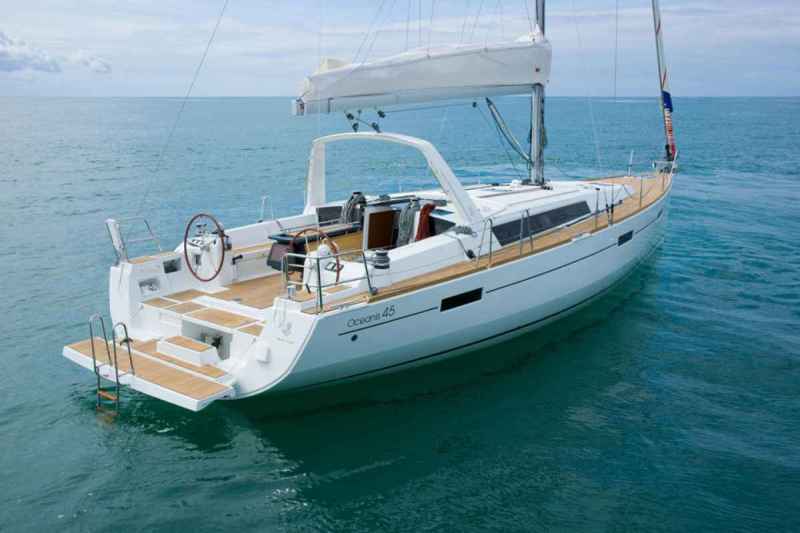
All the new Bavarias have them. So do the latest offerings in the Jeanneau Sun Odyssey and Hunter lines, as well the subjects of this review, the 2012 Beneteau Oceanis 41 and 45. We’re talking about distinct hull chines, at one time, due largely to fabrication matters, an exclusive feature of metal boats. The design feature began turning up in fiberglass production boats, though, when Beneteau introduced its redesigned First models, and later the company carried it to its Sense line. It turns out that a chine—in the case of the new Beneteaus, a subtle, angled crease, almost halfway up the freeboard, that runs continuously for the full length of the hull—can do more than make a welder’s life easier.
In fact, when cutting-edge yacht designers embrace them—and few fit that description better than the French naval architecture collective Finot-Conq, who collaborated with interior stylists Nauta Design on the 41 and 45—they’re clearly worth a closer look.
Let’s first address the obvious: If a chine allows a builder to extend the beam farther outboard, even by just a few inches, the resulting increase in interior volume over several dozen feet can be significant. And a voluminous hull form will certainly accommodate more beneficial stuff (wider berths, particularly forward; better storage; generous floor plans) than a narrow one.
Interestingly, however, during our Boat of the Year testing last fall, the sheer capacity of the boats proved to be a double-edged sword. Except for their lengths, the 41 and the 45 that our judges inspected were virtually identical boats (the 45 does have more interior options, which we’ll address in a moment) with the exact same layouts on deck and below. But largely for proportional reasons, our panel preferred the smaller of the two yachts.
BOTY judge Ed Sherman summed up the prevailing sentiment: “When I went down in the cabin of the 41, I immediately felt more comfortable than on the 45. The dimensions were such that I knew that if I got in rough seas offshore, everything was manageable, and there were good handholds throughout. It just felt good. The spacing was right on the money. And it sailed beautifully.”
View a complete photo gallery here.
__
Indeed it did, and the same could be said of the 45, which brings us to the second, less apparent advantage of a chined hull: It theoretically promotes better stability, particularly when sailing on the breeze. In the past, many production boats that carried their beam well aft—and boy, do these Beneteaus fit that bill—were susceptible to round-ups and steerage problems when overpressed upwind with too much canvas. However, we sailed both new Oceanis models on breezy Chesapeake Bay days with steady winds in the mid-teens, and they both handled and performed superbly.
First up was the 41. The twin, low-slung Goiot helms provided instant feedback, and the boat trucked to weather with a fully unfurled main and slightly overlapped jib set on a generous double-spreader, fractional, high-aspect rig. Hard on the wind, the boat notched 7.1 knots and later topped off at 8.4 knots when cracked off to a beam reach. Control was not an issue. At all.
“Now that was fun,” said Alvah Simon, reluctantly handing over the wheel so another judge could have a go.
It was even breezier when we boarded the 45, with puffs in the low 20s. Upwind, sailing slightly overpowered, we rolled up the main and jib to about 90 percent of their total sail areas and were rewarded with a mannered boat making nearly 8 knots. (Side note: I’ve never been a huge fan of furling mainsails, but I gained a new, unexpected appreciation when we blew the outhaul to roll in the sail and the boat snapped to attention, completely tamed and depowered, all from the comfort of the cockpit.) Once off the breeze, with an attendant drop in apparent wind, we couldn’t resist unfurling everything once again to press on full sail and registered 9.3 knots on a screaming beam reach. The chine, the judges agreed, felt just fine.
Though Beneteau’s synergistic, joystick-controlled Dock & Go system is an optional feature, Simon found that the combination of the Yanmar diesel, with a conventional bow thruster—the setup on our test models—provided excellent tracking and maneuverability in both reverse and tight quarters; the judges (all of whom, admittedly, are expert boathandlers) agreed that they’d prefer to put the funds for that not insignificant five-figure Dock & Go package toward other equipment or into the cruising coffers. Less cocky sailors will be perfectly happy with the Dock & Go.
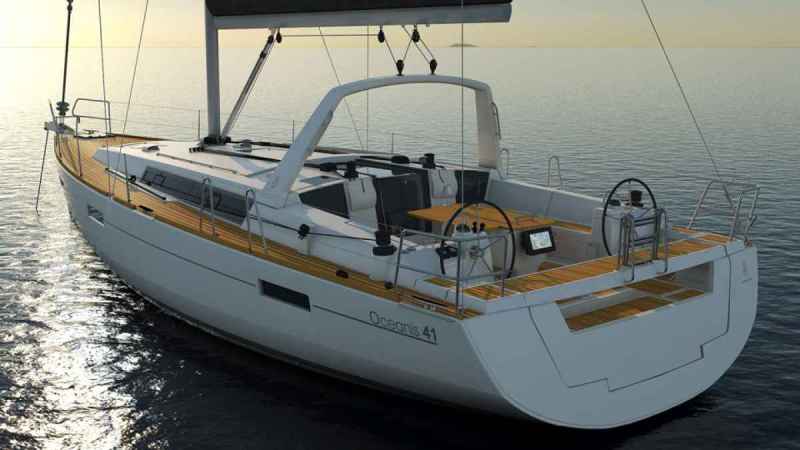
As I mentioned, the Oceanis sister ships, particularly topside, are two peas from the same figurative pod. The designs have two focal points: wide cockpits, which feature very nifty, electrically operated fold-down transoms for swimming and boarding and big central tables that house large, pivoting chart plotters and optional fridges; and central mainsail arches that slope aft over the companionway and serve as the anchoring points for the mainsheets.
The arches, with good stainless-steel handholds along their aft edges, will serve as strong foundations for rugged dodgers and biminis. But their utility doesn’t end there. Having stationed the mainsheets over the cockpits (they’re led forward along the boom to the mast, then aft to a dedicated winch on the cockpit coaming), the designers have pulled off a handful of neat tricks.
First, they’ve eliminated the need for a traveler (the rigid boom vang now serves that purpose) while maintaining sheeting angles toward the end, not the middle, of the boom, which provides better torque and load distribution. Next, the absence of the traveler has opened up the center of the boat, into which have been incorporated sets of quite civilized companionway steps at 45-degree angles, as opposed to death-defying ladders descending below. And finally, the entire arrangement has allowed the spars to be stepped farther aft, which translates to rigs that are better balanced with easily managed, 108-percent overlapping headsails.
In the main saloon on both models, a very clever “navigation” table that slides fore and aft the length of a straight settee to port opposes the central wraparound settee and dining table to starboard. When all the way forward or aft, the moveable console serves as a good work station; when centered, it can be used as a nice breakfast nook or cocktail table with dedicated seats to either side.
Both of our test boats—two-cabin versions with a double cabin forward and another aft to starboard—shared another unusual feature that got high marks from the BOTY judges. Just aft of the L-shaped galley at the foot of the companionway, to port, is a dedicated, walk-in pantry/workroom, with loads of storage, which includes a separate door leading to a gargantuan locker that can also be accessed topside from a cockpit seat. For extended cruising, everyone agreed that this was a very smart, handy, efficient use of space.
Of course, not everyone will use either the Oceanis 41 or 45 for long-range, shorthanded voyaging, which is why Beneteau has offered several different accommodation plans in each. On the 41, owners can also opt for three double cabins, with either one or two heads. On the 45, the tri-cabin layout has provisions for either two or three heads. Thanks to that extra beam forward, there’s also a four-cabin model with a pair of separate berths in the bow and a straight-line galley to port, in lieu of the sliding table, which seems like a logical layout for charter work.
Built in Marion, South Carolina, to Beneteau’s usual exacting standards, the solid-fiberglass hulls encapsulate an internal grid that’s bonded and tabbed to the main structure and serves as the framework for the attached keel, mast step, chain plates, engine, and so on. The resin-infused deck incorporates a balsa core. The entire structural package is covered by a five-year warranty.
All in all, though, both these new Oceanis models earned solid marks across the board from our panelists. In other words, the judges really liked these boats. And so do I.
Beneteau Oceanis 41
LOA 40′ 7″ (12.38 m.)
LWL 37′ 1″ (11.54 m.)
Beam 13′ 9″ (4.20 m.)
Fin draft (deep) 6′ 9″ (2.05 m.)
Fin draft (shallow) 5′ 1″ (1.55 m.)
Sail Area (100%) 821 sq. ft. (76.3 sq. m.)
Ballast (deep) 5,071 lb. (2,300 kg.)
Ballast (shallow) 5,527 lb. (2,507 kg.)
Displacement 18,624 lb. (8,448 kg.)
Ballast/D .27
D/L 151
SA/D 18.7
Water 151 gal. (570 l.)
Fuel 53 gal. (200 l.)
Holding 21 gal. (80 l.)
Mast Height 64′ 0″ (19.50 m.)
Engine 40-hp. Yanmar with saildrive or POD 60 Dock & Go
Designer Finot-Conq; interior by Nauta Design
Price $220,000
Beneteau USA
(843) 629-5300
www.beneteauamerica.com
Beneteau Oceanis 45
LOA 45′ 5″ (13.85 m.)
LWL 42′ 1″ (13.05 m.)
Beam 14′ 9″ (4.50 m.)
Fin Draft (deep) 7′ 1″ (2.15 m.)
Fin Draft (shallow) 5′ 9″ (1.75 m.)
Sail Area (100%) 1,007 sq. ft. (93.6 sq. m.)
Ballast (deep) 6,190 lb. (2,808 kg.)
Ballast (shallow) 6,693 lb. (3,036 kg.)
Displacement 21,048 lb. (9,547 kg.)
Ballast/D .29
D/L 126
SA/D 21.1
Water 151 gal. (570 l.)
Fuel 53 gal. (200 l.)
Holding 21 gal. (80 l.)
Mast Height 68′ 11″ (21.01 m.)
Engine 54-hp. Yanmar with saildrive or POD 90 Dock & Go
Designer Finot-Conq; interior by Nauta Design
Price $290,000
Beneteau USA
(843) 629-5300
www.beneteauamerica.com
Herb McCormick, CW’_s senior editor, directs the magazine’s Boat of the Year program. Twin wheels and the award-winning fold-down electric transom are strong features. Several interior options provide style and comfort. The Beneteau Oceanis 48 is part of _Cruising World‘s 2013 New Boat Showcase. Read a review here.