Long before he designed two winning America’s Cup yachts or a thoroughbred for the king of Spain, and long before his designs racked up dozens of top finishes under the I.M.S., I.R.C., and I.O.R. rules, Rolf Vrolijk would pal around the waterfronts of northern Europe with Michael Schmidt. It’s been more than 30 years since the designer and the boatbuilder first collaborated on an Admiral’s Cup yacht that quickly became a local legend and spurred the careers of both men.
In 1993, Schmidt took over a centuries-old boatyard in Greifswald, on the Baltic coast of the former East Germany. This was just three years after German reunification; since then, the shop that Schmidt acquired has grown to become that country’s second-largest boatbuilder. And since 1999, the designer and the builder have themselves been reunited in the creation and the development of Hanse Yachts.
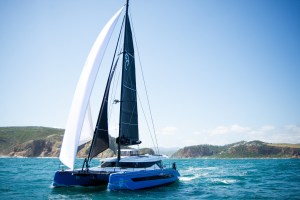
Last fall, I and two other Boat of the Year judges sailed the Judel/Vrolijk-designed Hanse 375 off Annapolis, Maryland. Within the Midsize category, it was the best-sailing and easiest shorthanded boat we tested. “It’s like a dream,” said BOTY judge Ed Sherman after sailing the boat.
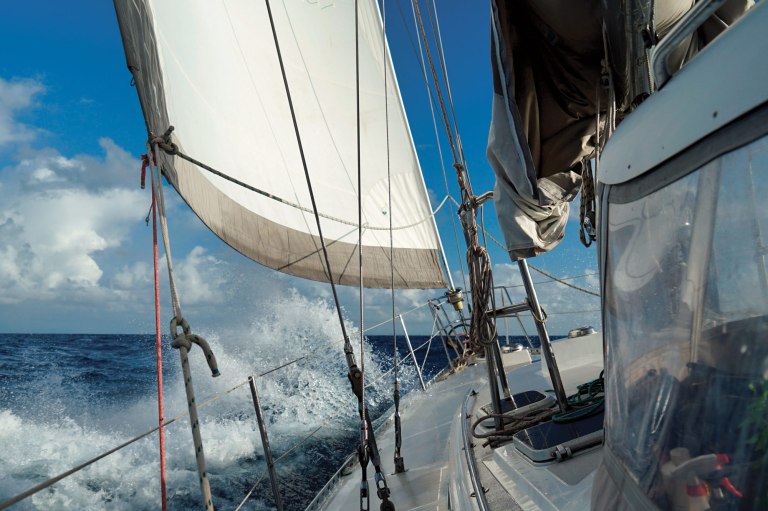
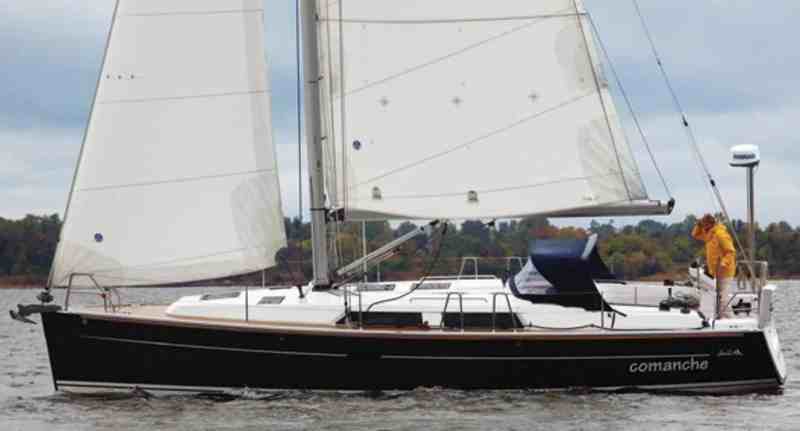
Like other Hanses, the 375 is defined by a long waterline and low wetted surface, ample sections aft, and a relatively high-aspect keel and rudder. In short, the 375 spins on a dime. The sail plan is mainsail driven, with a fractional headsail set up on a curved track for self-tacking. It’s a feature we’d seen on other boats, but none so successfully as this. “The self-tacking jib actually set,” said BOTY judge and long-distance voyager Beth Leonard. An optional Dutchman boom brake made for effortless jibing, all hands-free. Perhaps the most pleasant attribute that the judges appreciated under sail was the fine quality of the steering. The single helm was butter smooth and responded convincingly. Dual helms are an available option.
In a dying breeze after a wet frontal passage, we sailed the boat on the Severn River in 6 to 8 knots. It’s a special thing in air that light to post boat speeds of 5.3 knots and to tack through 85 degrees. This was a boat that made you feel that you could slip out of the dock and tack singlehandedly through the mooring field all afternoon under perfect control, then head out to open water and romp giddily.
For all the boat’s warranted superlatives under way, we found some of the workmanship behind the scenes to be careless. For example, we shared the dealer’s regard for the boat’s structure, including the fully tabbed and laminated bulkheads and furniture. Tabbing does produce a strong structure and minimizes the creaking that sometimes occurs on boats that don’t have tabbed-in furniture and bulkheads, but we did find one area where bare electrical wiring had been glassed over. Elsewhere, we saw an excess length of live wiring simply coiled up and dropped down into the boat, where a yard worker had then sprayed gelcoat over it. The judges also found unsealed plywood edges in the galley that could cause swollen locker boards down the road.
I’m also not a fan of the boat’s outward-opening ports, which can cause ankle bites and grabbed sheets. Hanse representative Martin van Breems counters by saying, “A wave crashing on an inward-opening port pushes it open. Thus, it can be prone to leaking, while outward-opening ports seal tighter when a wave hits them. Another benefit is that no residual water comes in when an outward-opening port is opened. And these ports can be left open for ventilation even in moderate rain without letting any water in. This is really useful in the Caribbean, where there are frequent rain showers.”
Meanwhile, the very fine entry of the 375 certainly contributed to the lovely feeling we had sailing the boat, yet it left little acreage on the foredeck for the multiple tasks of anchoring and setting a gennaker off a sprit. The sprit works beautifully. However, the bow roller is canted off to one side and could make hauling the anchor up in a 30-knot blow more difficult than if the roller were led straight back.
The hull structure is a sandwich construction of E-glass and vinylester resin, laid up by hand, with foam core below the waterline and balsa core above. For the record, vinylester’s the good stuff: It resists osmosis and bonds more thoroughly than polyester.
On deck, such hardware as winches and genoa tracks are tapped into aluminum plates that have been laminated into the composite part. This is a fine solution, so long as you keep the gear properly bedded so salt water will be prevented from migrating down to where the stainless-steel fasteners and the aluminum plate meet.
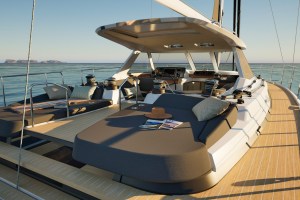
The interior layout, with a double berth aft and a V-berth forward, is simple and clean. With its open, L-shaped galley and limited tankage, the 375 isn’t really designed to be a long-term liveaboard boat, but it should function well as a cruiser or racer. Good handholds overhead and outboard lend a feeling of security under way. The white surfaces of the cabin are set off by mahogany trim and produce a simple and traditional look; African espruda or American cherry are optional.
“Of all the boats we sailed during BOTY,” said Ed Sherman, “without question I enjoyed sailing the Hanse 375 the most. It’s a singlehander’s boat, and it’s very easy to manage.”
Tim Murphy, a Cruising World_ editor at large and a veteran Boat of the Year judge, is based in Portsmouth, Rhode Island._
Specs
LOA 37′ 3″ (11.35 m.)
LWL 33′ 0″ (10.05 m.)
Beam 12′ 4″ (3.75 m.)
Draft (shoal) 5′ 3″ (1.60 m.)
(deep) 6′ 5″ (1.95 m.)
Sail Area (100%) 1,134 sq. ft. (105 sq. m.)
Ballast 4,773 lb. (2,165 kg.)
Displacement
(light ship) 15,873 lb. (7,200 kg.)
Ballast/D .30
D/L 197
SA/D 28.67
Water 86 gal. (324 l.)
Fuel 37 gal. (140 l.)
Mast Height 58′ 3″ (17.75 m.)
Engine 27-hp. Volvo
Designer Judel/Vrolijk & Co.
Price $190,000
Hanse Yachts
(978) 903-0380
www.hanseyachts.com