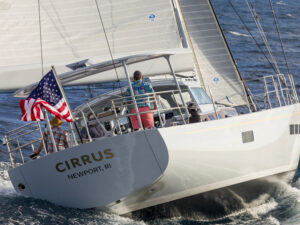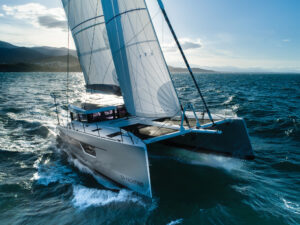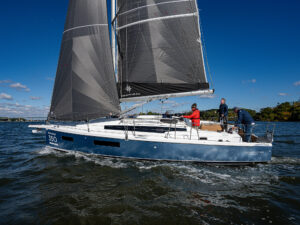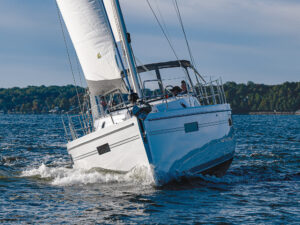
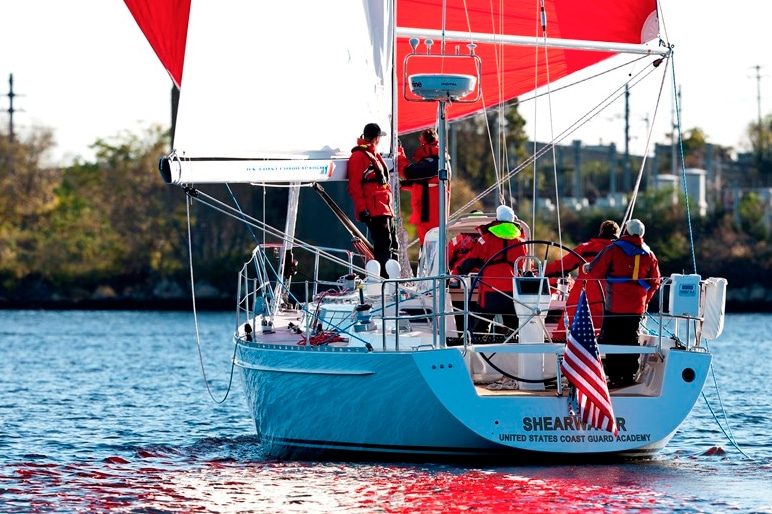
If I were a third my age, I’d sure consider applying to the U.S. Coast Guard Academy, if for no other reason than to sail as much as possible on its new 44-foot training boats. Unlike many designs that are inching ever closer to becoming full-blown aquatic condos, luxurious on the dock but untenable offshore, the new Leadership 44—designed by David Pedrick and built by Morris Yachts—blends real advances in naval architecture and boatbuilding over the last few decades with practical features proven by centuries of seafaring (see the Leadership 44 photo gallery). These boats will replace the four 45-year-old Luders yawls that the academy previously employed, meaning that now every cadet will experience an up-close-and-personal taste of tides, fog, heavy weather, and boathandling while also receiving a dose of leadership training.
Despite providing near-Grand Prix performance, the design team was also asked to incorporate a forgiving nature. By most modern standards, the Leadership 44 isn’t radical. At 26,000 pounds, the boat isn’t an ultralight, although it’s a couple of tons lighter than the U.S. Naval Academy’s 44-foot trainers and features an updated yet nicely balanced hull form with a wider transom and stiffer quarters. The Leadership 44 also carries enough sail, and is light and spry enough, to feel fully powered up in 10 knots of breeze, accelerating quickly and tacking effortlessly under fingertip control, thanks to the big wheel and high-lift appendages. It can reel off 8 knots under power at very modest rpm. At the same time, although far from a heavyweight, the boat still feels very surefooted, with enough mass to bully through seas or carry forth when a novice helmsman waggles in and out of the slot.
Allen Kruger, who’s been managing the project for the Coast Guard, notes that when the 44 is in the hands of Coast Guard cadets—many of whom have no prior experience with yachts—the sails are unlikely to be properly trimmed all the time and that the hull will likely knock a few docks. Pedrick’s design office specified a robust foam-cored glass layup, and it even considered the possibility that the boat might run very hard aground, supplying the aft upper section of the keel with a crash box that should absorb excessive loads rather than fracturing the hull, a common issue with boats with deep fin keels. This boat will forgive mistakes, but its very lively nature will also provide immediate feedback, helping to tune the crew into the oceanic world. For those who may someday require Coast Guard assistance, it’s reassuring to know that those in command will be familiar with the nuances of handling a boat under sail.
Details of the boat are highly pragmatic. Designed for a crew of eight, it features a quartet of straightforward amidships single bunks, a quarter berth, and four folding pipe cots forward. For racing, the crew will likely fold the pipe cots to provide sailhandling space; offshore, the watches can hot-bunk amidships, where motion is minimized. The head also is nestled usefully next to the companionway, so the crew on duty can duck below without foul-weather gear dripping everywhere or otherwise disturbing the off watch. A large oilskin locker in the head, and the dampened motion there, will both be appreciated.
The chart table is actually big enough for a real chart, a near rarity these days. The engine cover is nicely rounded, with multiple access hatches and a totally removable lid. Deck-gear backing plates and fasteners are exposed and accessible, not hidden by headliners. Winches are less centralized than usual these days, minimizing the rat’s nest of lines in the cockpit; halyards, for instance, are handled closer to the mast. Dual life-raft cradles reside under a transom seat, perfect for security and availability. On deck and below, handholds are liberal. Treadmaster nonskid provides very sure footing. There’s no topside brightwork to varnish, but the cockpit area features faux-teak surfaces—great for footing, but easier on knees and foul-weather gear when crewmembers scramble about. Below, however, the attractive yet functional cabinetry is accented with enough wood to make the boat feel like a racer of yesteryear rather than a cold, stripped-out shell.
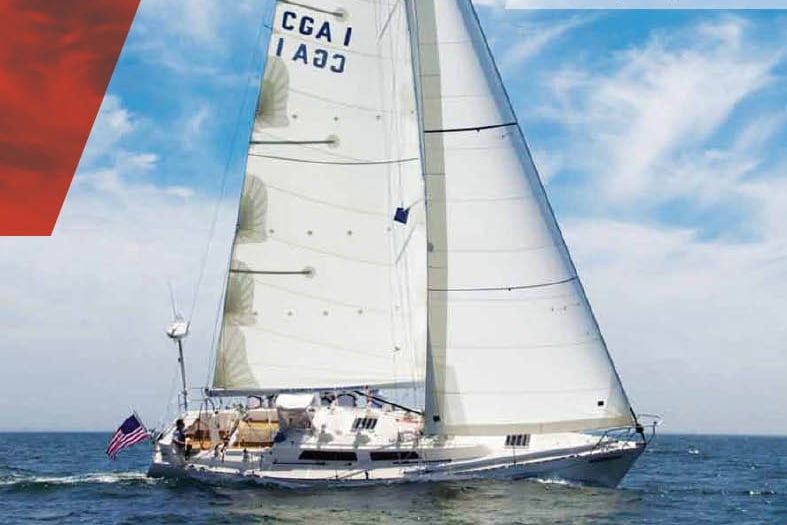
Morris Yachts was chosen from a roster of boatbuilders to deliver a solid, yet elegantly built, workboat. The commission began quite coincidentally, when Cuyler Morris’ son and Allen Kruger’s son were dinghy racing at the Atlantic Coast Optimist Championships. Kruger wasn’t sure if Morris Yachts would be interested in such a Plain Jane vessel, but according to Morris, “The timing was impeccable.” Due to the economic black hole that’s eaten up many a boatbuilder in recent years, the project allowed the company to rehire a number of workers, and it also allowed Morris to tackle a new approach without compromising the firm’s reputation for quality. In the end, the Coast Guard chose Morris not simply based on price per unit but because it offered the best blend of quality and value.
And should one question the timing of the U.S. Government commissioning yachts, rest easy: Your tax dollars continue to be spent elsewhere. The non-profit Coast Guard Foundation and the Coast Guard Academy Alumni and Parents associations are closing in on their $5.5 million fund-raising goal, permitting a more holistic, value-based approach than is typical for a government contract. Shearwater, hull number one, was launched in June; another seven will be delivered through 2012.
The Leadership 44 will likely be a contender during its full-on racing schedule, and it appears especially suited to such offshore events as the Bermuda races. The Coast Guard fleet will certainly see more ocean in a year than many boats will manage over several decades. I’m not surprised that there’s already talk about Morris developing a model for sailors who may enjoy more comfortable berths, a wine rack, and a flat-screen TV but whose primary interests lie in making passages efficiently while reaping real fun and fulfillment from the very act of sailing itself.
Leadership 44 Specs:
LOA 44′ 6″ (13.59 m.)
LWL 38′ 7″ (11.79 m.)
Beam 12′ 6″ (3.84 m.)
Draft 7′ 3″ (2.25 m.)
Sail Area 1,383 sq. ft. (128 sq. m.)
Ballast 10,000 lb. (4,535 kg.)
Displacement 26,000 lb. (11,793 kg.)
Ballast/D 38.5
D/L 200
SA/D 25.2
Water 130 gal. (492 l.)
Fuel 50 gal. (189 l.)
Holding 50 gal. (189 l.)
Mast Height 68′ 0″ (20.7 m.)
Engine 54-hp. Yanmar 4JH diesel
Designer Pedrick Yacht Designs
Price $800,000
Morris Yachts
(207) 244-5509
www.morrisyachts.com
The latest project for author and yacht designer Steve Callahan (http://stevencallahan.net) took him to Taiwan as the technical consultant for acclaimed director Ang Lee’s upcoming feature film,_ Life of Pi_.