Makemo atoll
The great thing about the French colonial empire is that it brought the gospel of puff pastry to the farthest reaches of the globe. Before the French made Polynesia a colony in 1880, you probably couldn’t find a decent croissant in the Tuamotus to save your life. Thank god, all that has changed.
On a Tuesday morning on Makemo, an atoll in the Tuamotu Archipelago, my husband, Peter, and I woke up and decided that we could do with a little breakfast. Option One would’ve been to make a smoothie out of the withered black bananas hanging from our stern, all 800 of which had ripened at the same moment during our recent passage from the Marquesas. But we looked out over the anchorage’s glassy surface and chose for Option Two: We packed a dry bag and jumped over the side.
Swimming to shore was like paddling through an aquarium. Multicolored reef fish hovered around gnarled coral heads, and giant clams the size of my foot smacked their iridescent blue lips. The water was turquoise, transparent, and clean. When it got shallow, we switched to our sandals and waded ashore, the bleached-white coral fragments crunching under our Tevas. Wiggling into dry clothes, we embarked on Operation Breakfast Deliciousness. Just how much butter, eggs, and calories, you may ask, is it possible to consume before 9 o’clock in the morning?
The answer is lots. By the time we arrived at the Boulangerie Makemo, the croissants and pains au chocolat were already arranged in warm little rows, like newborn babes in a nursery. We started with four pains au chocolat, then moved on to croissants slathered generously in soft cheese and Nutella. Then we bought three baguettes to go, in the interests of future snack-making.
As any cruising princess will tell you, pain au chocolat isn’t the main reason for sailing to the Tuamotus. It may be rich, it may be fluffy, but in the final analysis, it’s just not possible to hang them around your neck and look gorgeous at a dinner party. For that, something else altogether is called for: black pearls.
In Europe and the United States, black pearls, which are cultivated in the Tuamotus, can cost thousands of dollars each. I once helped a girlfriend try on a particularly sumptuous black-pearl necklace in a jewelry boutique. The pearls were approximately the size of hamsters, and when she draped those silver orbs around her neck, she looked like a movie star. There was just one hitch: The necklace cost $48,000. That pricey bauble would’ve made Dick Cheney look like Elizabeth Taylor.
But in the Tuamotus, you can buy black pearls directly from the fishermen who cultivate them at a fraction of the export retail price. When Peter and I first arrived in Makemo village, we weren’t exactly sure how to go about striking a deal. The whole enterprise felt vaguely shady, like we were college kids in Tijuana looking to score weed. Luckily, I speak a little French. So when we bought some sodas at the local magasin, I struck up a conversation with the guy next to me. Like many Polynesians, Tomas was a big man, with broad shoulders, a thick head of black hair, and wide cheekbones. But I wasn’t shy. As every cruiser knows, if you want to make friends with a sailor, you just flirt with his boat.
“That’s yours?” I asked Tomas, gesturing toward the glossy-yellow cigarette boat parked on a trailer beside the store. “Wow!” I burbled. “She’s gorgeous.” He grinned, and then I swooped in: “So, ahh, do know where I can get some, you know—pearls?”
“I might, “ he said, sizing me up. “Why don’t you go for a walk and come back in an hour or so.”
Peter and I returned to find Tomas waiting with his eldest son in the shade of a palm tree. Before them on a concrete table was a small, white package. Tomas carefully unwrapped the pearls.
The first thing you need to know about black pearls is that they aren’t black. They come in a marvelous assortment of colors, from pink and purple to green, silver, and gold. Some are almost as pale as white pearls, and one particularly gorgeous shade of green is what the French call aile de mouche—the wing of the fly. Tomas had about 50 pearls to show us, in diameters ranging from an eighth of an inch up to more than half an inch, the biggest ones resembling large, iridescent marbles. I wanted them all.
And this is the second thing you need to know about black pearls: They’ll turn you into a covetous troll. In order to go cruising in our 30s, Peter and I have done without a lot of material comforts. Our clothes are pretty ragged, and we don’t even have refrigeration on board. But one look at those beauties, and I knew my life would never be complete without a black-pearl necklace at my throat—preferably with matching earrings.
“I cultivated these myself,” Tomas told us with pride. “Each one takes nine to 18 months to grow inside the oyster, and you can only make three to four pearls with one oyster. After that, she’s a grandma. No more babies!”
We negotiated with Tomas—luckily I’m married to a hard-boiled New Yorker—and, for US$300 and a bottle of whiskey, we bought 20 pearls of various sizes, including a particularly wonderful one with stripes like a multicolored zebra. I could hardly restrain my glee. Mentally, I was going through my tattered wardrobe, picking out which rags would go best with my fabulous black-pearl necklace.
Surprisingly, pearls weren’t the only treasure uncovered that day. After two years of cruising, Peter and I have discovered that each time we take a moment to chat with local people and learn about their lives, we’re given an unexpected gift. Tomas asked his son to bring us three cold cans of Hinano, the local beer. We sat together in the dwindling sunshine, watching the shadows grow long.
“Have you been to the village of the ancients?” he asked. “Where our ancestors used to live?” Tomas scribbled a quick chart of Makemo atoll, then drew a straight line jutting directly out from the beach. “You can’t miss it,” he explained. “There’s a long reef that comes right out from land, blocking your way. You can tuck right in behind there and anchor for the night.” He picked up his beer and tipped it back. “Then, in the morning, explore the ruins.”
Evening was now coming on, and the light was growing dim. I had a pocketful of pearls, and in my hands I clutched a secret map that showed the way to an ancient village. Not bad for a Tuesday afternoon.
According to Tomas, the secret village was about halfway across the atoll, about 15 nautical miles away. The next morning, Peter and I woke up early to get ready for our adventure. My husband looked doubtfully at the scrap of orange paper with the chart of the Makemo atoll. “So we’re really going to use this to get there?” he asked as we made our plans. “Well, keep your eyes peeled, because it ain’t much to go on.”
No worries there. Everyone keeps their eyes peeled in the Tuamotus. Depth can change from 70 feet to inches in a heartbeat. Towering pinnacles of rock and coral jut straight up from the sea floor, creating a sort of navigational slalom course. This can be fun, provided you keep a good lookout and spot all the obstacles ahead of time.
Peter drove Seriea, our 36-foot Mariner ketch, while I perched on the bow pulpit, looking for watery hazards with my polarized sunglasses. We swerved through the coral, watching the coastline for tell-tale signs of an ancient village. I wasn’t really sure what to look for. After all, what materials could ancient Tuamotans have possibly used to build their homes? Palm fronds? Sand? Surely, not much of those materials could have survived for very long.
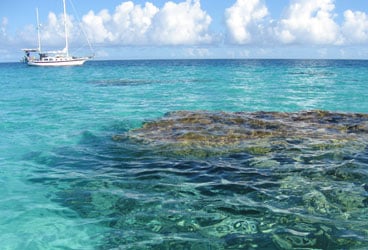
As we traveled away from town, houses grew scarce, until finally there were none. The coastline was pure, empty sand and forests of palm trees. The water passing beneath our keel was so transparent that I felt as though we were hovering in blue air. This is why people come to the Tuamotus. It feels like an untouched paradise, perched at the edge of the Earth.
Because of all the hidden hazards, we only averaged four knots, and by midafternoon we were both growing weary. “Wait a minute,” said Peter, pointing dead ahead. “What’s that?” I squinted into the glaring sunshine. There, not 500 yards away, a pale-blue line cut through the water, blocking our passage. It was a reef, jutting straight out from the beach.
“This has got to be it!” I squealed. “Quick! Drop the hook!”
Peter went forward to release the anchor, and on his signal, I threw the engine into reverse. So excited were we to have found our secret village, we hardly glanced at the quick, gray shapes darting around our boat. The anchorage was swarming with sharks.
By the time we cut the engine, secured the boat, and launched the dinghy, it was too late for an expedition to land. The ancient ruins would have to wait. I tossed impatiently in my berth that night, wondering what we’d find. Until well into the 19th century, after all, many Polynesians had been cannibals. Would we come across a cooking pot? The skulls of unwary adventurers? A lonely ghost perhaps, wondering what laptops and iPods were doing in his ancient island home?
The following day dawned gray and misty—perfect ghost-hunting weather. We packed our dinghy with a camera and lemonade and set off along the coast. Peter was careful to avoid the minefield of coral heads. Here, in depths of two to four feet, the water was as clear and still as a pane of glass. That’s when we noticed the sharks again. All around us, darting in and out of the coral and swooping right up to us like flocks of curious pigeons, were black-tipped reef sharks.
“They’re just little reef sharks,” Peter offered, trying to soothe me. “They won’t bother you.” Then his expression changed. “Wait a minute.” He turned off the engine. “What the hell is that?”
As a general rule, “What the hell is that?” isn’t something you want to hear coming out of your captain’s mouth. Following Peter’s gaze, I whipped around, just in time to glimpse a dark shadow, approximately the size of our dinghy, darting aggressively at our stern. That shark was definitely shopping for lunch. Before we had any time to react, the shadow changed course, finned off to port, and was gone.
“On the other hand,” said Peter musingly, “that was a gray shark. They can be very aggressive.”
I rubbed my rear end, grateful it was still in one piece. “Can we go to shore now?” I asked. “Please?”
Peter laughed, pointing the boat toward the beach. I squinted at the forest of palm trees, trying to discern shapes in the darkness between the trunks. And there, tucked in behind the trees, I saw a door. “The village of the ancients!” I called to Peter, who was concentrating on dodging sharks. “I think we’ve found it!”
Moments later, we pulled the dinghy ashore, and Peter and I crept into the cool, quiet shadows of the palm trees, letting our eyes adjust to the dim light. Before us, in a nest of coconut husks and fallen palm fronds, stood the skeleton of a house. Its design was square and straightforward. The roof had long since rotted away. There was a whispering sound in the leaves. I whirled around, but we were alone. We crunched our way through the forest, looking for more signs of human habitation. A spider web brushed sticky tendrils across Peter’s face. He grabbed a stick and waved it around, clearing the path before us.
In a little while, we came across the remains of stone foundations rising forlornly out of the forest rubble. They appeared to be made of the same rough concrete as the house, but a closer inspection revealed unmistakable signs of South Pacific origin: the cement had been mixed with chunks of dead marine life, so that fan coral and brain coral studded the remains of the wall, fossilized reminders of the lives that once inhabited this place.
After the foundations, there were no more human traces, but the forest was filled with life. Many of the desiccated coconuts scattered at our feet had neat, round holes carved in their husks, and the palm trees arching overhead had similar cavities drilled into their trunks. Had people left these traces behind?
Another rustling at our feet, and we had our culprit. A seashell the size of my fist was stealthily trying to make its way across the ground. “Look at this!” I called to Peter, picking up the shell. Two large, black eyes poked their way outside, followed by a pair of antennae. The crab extended a hesitant claw. Its carapace was the bright, shiny red of a toy fire engine. I offered a kiss, but it darted back into its shell, not amused.
After that first one, we saw crabs everywhere. They scuttled across the forest floor and clustered together, napping, in the roots of trees. “I’ll bet that’s what’s eating all the coconuts,” Peter suggested. “These are coconut crabs. They’re the ones drilling holes in the sides of the palm trees, too.”
We continued our walk, but for a while, it seemed that what we’d seen all that remained of the people who once lived here, in their homes made of sea life and palm fronds, fishing on the reef and sharing coconuts with the crabs. Then we found the cemetery.
By then, the skies had cleared. In a little sun-dappled clearing, we found a small collection of headstones. “Tuhiva Fanau, 1907 Pohe 1927,” read one, with a little seashell necklace carefully draped across it. Someone still tended this gravesite, after 80 years.
There were perhaps half a dozen graves in all. The markers we could read told us these people had died in the early part of the 20th century, all within a generation of each other. What a different life they would’ve known, living on the edge of this little coral atoll. They were the grandparents of the people we’d met in town, the modern French citizens riding new mopeds with warm baguettes tucked under their arms.
So these were the ancients. They wouldn’t have had pain au chocolat to be sure, and I’m sure they didn’t have a clue about iPods. But paddling these waters in their outrigger canoes, they would’ve kept a sharp eye out for the very same coral heads that we’d dodged that morning. They would’ve paddled a little faster when the gray sharks got too close. And I’ll bet they even had black pearls.
Looking at the satellite dishes in the village, you might be fooled into thinking that the Tuamotus have changed forever. But hop in your boat and get a little ways outside town. The ancient coral still bares its teeth. The black night is lit only by a ghostly moon. You’re still perched on the edge of an underwater volcano, rising thousands of feet from the depths of the Pacific. In many ways, Makemo is still wild. Only now, the puff pastry is so much better.
Antonia Murphy and her husband, Peter, crossed the Pacific in 2007, and they now live in New Zealand with their two children, Silas and Miranda. She’s seeking a publisher for her book about New Zealand, Rough as Guts_._