Replacing Batteries?
Because it’s been quite some time since Cruising World has taken a comprehensive look at the devices that make up an onboard direct-current power supply, we intend to do just that over the next few months. We’ll review what’s developed in the area of battery technology for cruisers and tell you what you should look for if you’re planning a simple replacement or an upgrade to the heart of your DC electrical system.
In Part II, we’ll dig into battery-charging systems and take a close look at what’s available in both engine-driven alternators and shore-power or generator-powered battery chargers for meeting the needs of the new types of batteries, such as lithium marine batteries, that are now available.
Finally, in Part III we’ll take stock of what’s new in the arena of alternative power generation. New solar panels and wind and water generators for the cruising sailor have made some pretty significant strides in the right direction over the last few years, so we’ll consider what’s available and tell you the things you’ll need to ponder if you plan to move in this direction with your boat.
Heart of the System
Batteries are at the heart of any DC electrical system. Your boat’s batteries are where any electrical power you generate gets stored for use on demand. This is an area of technology in which there’s been a huge amount of movement over the last 10 years, largely driven by interest in hybrid and full-on electric-propulsion systems in both the marine and automotive sectors.
“Green Tech,” as in electric propulsion, has been a prevailing phrase at every boat show I’ve attended for the last several years. New battery technology such as lithium-ion is one of the keys to making all of this hybrid “e-power” work for cars and boats. Eventually, proponents say, it will supplant “p-power” (as in petrofuels) for vehicles operating on land or in water. But are most sailors ready today for a new generation of battery technology?
And what about some of the interim battery types that are becoming increasingly popular, such as absorbed glass mat, gel-cell, and thin plate pure lead batteries? Let’s take a look at all of these so that you’ll be able to make an informed choice when you decide to replace or upgrade what you have or spec out a new boat.
The Lithium Option
Lithium-battery technology has been all the rage for several years, and for some compelling reasons. Lithium is one of the lightest of all metals and has an extremely high electro-chemical potential, which makes it a super-active ingredient for constructing batteries. We know that lithium batteries can easily achieve two to three times the current density of conventional batteries. But there are some really rough spots on this stretch of the technology superhighway.
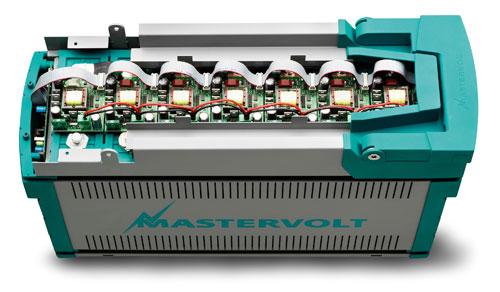
Lithium-ion batteries must be controlled internally by electronic circuitry that keeps the cells in balance under all conditions.
Perhaps you’ve heard about lithium marine batteries in laptop computers overheating and burning people’s kneecaps. This is caused by a phenomenon known as “thermal-runaway,” and controlling, or rather, preventing it is one of the major factors on which hangs the success of this choice of chemical battery component.
To address these lithium-battery issues, manufacturers have embraced lithium-ion technology over pure lithium devices. Battery makers have also given closer scrutiny to the actual chemical compounds used within these batteries.
Manufacturers have moved away from using lithium cobalt in the kind of larger battery sets that we’re discussing here, and every vendor now has its own take on the specific compound to use in its product mix. Some use lithium iron phosphate (Mastervolt, Genasun); others use lithium manganese (Torqueedo); still others, like Valence Technology, use lithium iron magnesium. Each of these variations has strengths and weaknesses in terms of actual stability and current densities, but all are considered much safer than the cobalt formulations. The list of compounds seems to grow almost weekly as more and more players enter the game and researchers make new inroads. In the end, this all centers on design choices that factor in current density potential vs. chemical stability and, ultimately, safety.
If we’ve learned anything about lithium-battery technology in big-battery marine applications over the last five or six years, it’s that regardless of what brand you select, a carefully engineered battery-management system is an absolute must to ensure safety. This means a typical boat owner can’t simply go out and replace the existing battery bank with lithium-ion substitutes. Even in cases involving a specifically designed management system, we’re still hearing, in fact, about the occasional catastrophic fire on boats running at the bleeding edge of battery technology. A particular problem involves early adopters of this technology; their boats may be running, based on what we now know today, with less-than-adequate systems.
Lithium-ion batteries, meanwhile, aren’t cheap. Entry level with this technology is presently in the $2,500 range, and that’s only going to buy you around 100 to 150 amp-hours of capacity. Because this is roughly equivalent to a single Group 31 battery that in a traditional lead-acid/flooded-cell configuration can be bought for around $100, you have to wonder why anyone would pay more.
Well, the battery makers will tell you that the cycle life of lithium-ion batteries is where the payback comes. This is all well and good, but the reality of this remains untested. It’s important to remember that battery-cycle life numbers used by all of the vendors are based on ideal laboratory conditions, not real-world applications with their temperature extremes, vibration, and possible glitches in the charging regimen.
Additionally, and not to be taken lightly, is the fact that all of the major players in this game will tell you that you must take a “systems approach” to enjoy the potential benefits of lithium-ion and to ensure safety with this technology. The components that make up these systems aren’t cheap and, in most cases, are going to require significant upgrades to such things as alternators, battery chargers, voltage regulators, and really anything associated with primary DC-power distribution on your boat. Approaching lithium-battery technology in any other way will be either dangerous or totally miss the mark in terms of the cost-to-benefit ratio.
So, despite all the advantages that lithium-ion battery technology offers—really deep cycling capability, extreme current density (more amp-hours per pound of weight and physical size), and the off-the-charts ability to recharge very rapidly—I see no place for this technology with the average cruising sailor at this writing. We need more time to let the bleeding-edge folks sort this out.
Upgrade Alternatives
So if lithium-ion batteries might not be the most sensible choice today for the cruising sailor who’s not in the market for a completely new DC system, is there anything out there that might be a good second choice?
Absolutely! I think the state of the art today for the cruiser can be found in one of two choices, either thin plate pure lead, which is actually a variation of an absorbed glass mat battery configuration, or one of the many A.G.M. choices available. Gel-cell batteries are also a lower-maintenance alternative to flooded-cell lead-acid batteries, but for the record, I’m not personally a fan of gel-cells, although they can be a great choice under the right circumstances. I say this because of the stringent recharge requirements they have, which I’ll discuss in a minute.
T.P.P.L. and A.G.M. batteries are technically not new technology—their patents date back to the 1970s—but they’ve evolved quite dramatically over time. Early on, they suffered from thermal runaway, just as we’re seeing now in some lithium-ion installations. (see “A.G.M. Technology Challenges.”) But engineers have found ways to work around the problems caused by too-rapid charging, and today, the technology is quite stable. Reduced gassing and engineered recombining of gasses inside the battery mean that water loss is minimized, and from what we’re seeing in the field, things are quite under control with the present iteration of these batteries.
But even so, in the A.G.M. realm, not all batteries are cut from the same cloth. One of the dirty little secrets among all battery manufacturers is that they most often use recycled lead in their plates; depending upon the amount and the exact electrochemical nature of the impurities in the lead content, ultimately battery-cycle life and longevity can be impacted.
A representative from Odyssey Battery, a company that uses the purest lead possible, explains it this way: “The Odyssey battery actually lasts up to six to 10 years, which is attributed to its manufacturing with 99.9-percent pure virgin lead. The U.S. Coast Guard has had 500 batteries in 50 Bollinger 87-foot Protector Class cutters since 1998 without a single failure to date. On top of all this, the batteries are maintenance free and won’t vent during normal operation due to patented technology to reuse internal gasses. It’s also the only battery to claim an explosion-proof design.”
I can personally attest to the U.S. military’s choice to specify these batteries because I’ve inspected a variety of its small craft, all with the Odysseys installed. My queries to the maintenance personnel in charge of these craft support the statements of the probably biased rep from Odyssey.
_
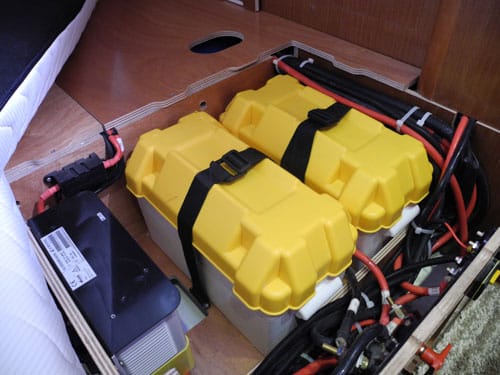
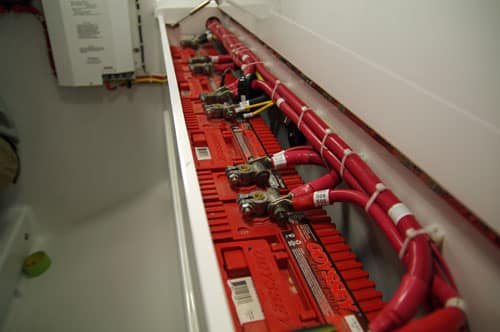
Odyssey T.P.P.L. batteries are lined up in a bank designed for the space available aboard this boat._
An additional attribute of the Odyssey T.P.P.L. design is that unlike other A.G.M. types, it’s far less finicky when it comes to recharging. Most A.G.M. vendors dictate a fairly precise regimen for each phase of charging, both in terms of time and voltage. Such a regimen requires programmable voltage regulators, battery chargers, and related equipment. While these requirements aren’t as strict as those associated with gel-cell technology, they are, nonetheless, something to concern yourself with if you plan to maximize cycle life and maximize the return on your battery investment. Gel-cells, for example, shouldn’t be exposed to more than 14.1 to 14.3 volts for any extended recharge period, depending upon manufacturer-specific recommendations. This renders gel-cells completely unusable on any boat with a standard alternator arrangement that utilizes an internal voltage regulator. These setups often have maximum voltage settings of 14.8 to around 15 volts and aren’t adjustable. So with those setups, you’re slowly destroying your gel-cell batteries every minute that you’re running your engine. This is the primary reason that I’m not a big gel-cell fan.
Another claim from the Odyssey and T.P.P.L. camp talks about the recharge regimen: “Charging the Odyssey battery is similar to a flooded battery. It’s not sensitive to charging like other A.G.M.s and the gel-cell batteries. In fact, the Odyssey battery has no restrictions on the inrush of current and will recharge in one-third the time of a conventional battery. This allows the battery to be utilized with traditional flooded chargers and typically doesn’t require replacing your current charger in many applications. Most marine three-stage chargers available today work very well for charging the A.G.M. batteries.”
Northstar, maker of the Energy 1 T.P.P.L. battery, also boasts of fast recharge rates but strongly recommends a temperature sensor connected to the battery charger to compensate for varying voltage needs at higher or lower ambient temperatures.
In a nutshell, this means two things: Engine run times to recharge batteries can be reduced, which most cruisers will greatly appreciate, and specialized charging equipment, either engine driven or supplied by shore power, isn’t a major concern.
One thing to keep in mind here, however, is that the rapid recharge rate and high current acceptance of these batteries can be a curse. Reports from the field indicate that the charging systems connected to these batteries actually need to be detuned a bit via a programmable voltage regulator and will need thermal control on the alternators to prevent the alternators from actually working themselves to death keeping up to the high current that these batteries can accept.
Another major benefit with A.G.M. batteries in general, and the T.P.P.L. variations in particular, is that they can be more deeply discharged than traditional flooded-cell lead-acid batteries without dramatically impacting their cycle life. With flooded-cell batteries, the rule of thumb has been that they shouldn’t be discharged beyond half of their capacity. Therefore, to size battery capacity, we’ve used as a benchmark a measurement of 50 percent of capacity, as measured in amps. In simple terms, if we were trying to maximize cycle life, we used only half of a battery’s amp-hour rating; a battery rated for 100 amp-hours really had only 50 amp-hours of usable current if you were concerned about battery longevity.
T.P.P.L. manufacturers, by contrast, claim that 80 percent to 100 percent of the capacity can be used and that the batteries will still deliver an acceptable cycle life. That, and the fact that their recharge rate is considerably faster than traditional flooded-cell batteries, makes them worthy of consideration. Add to it the T.P.P.L.’s minimized gassing probability, totally immobilized electrolyte, and its ability to be mounted on its side if necessitated by space constraints, and I think that a T.P.P.L. battery is an excellent choice for cruising sailors. The initial purchase price is a bit on the high side, but I can more clearly see the payback over time versus other choices, and the no-maintenance features really add appeal in cruising applications.
Other Retrofit Concerns
Beyond inherent safety, charging regimens, and real-world cycle life, you should consider several other issues before you pull the trigger on a whole new set of batteries that offer new construction and chemistry technologies.
Anyone examining the current crop of batteries will notice in short order that they’re taking on new shapes and sizes. As battery manufacturers learn how to maximize the current density in a given battery, shrinking the case has become a real option. Some batteries are now a bit taller but far more slender than batteries with similar capacities of a few years ago. This is all good news, because the end result of this incremental progress is that you can now carry more battery capacity while using up less real estate on your boat, a genuine concern for any space-crazed cruiser.
It’s clearly an improvement, but there’s a down side: Retrofitters must carefully examine their battery-storage areas to make sure that any changes in the physical dimensions of the batteries can be accommodated properly and in accordance with existing industry standards.
The American Boat & Yacht Council and the U.S. Coast Guard, for example, mandate that batteries must be secured so firmly that they can’t move more than 1 inch in any direction. The way I describe this to technicians in training programs I conduct is this: “Think of the boat actually doing a 360-degree rollover at sea. Will the batteries still be in the same location I installed them? If you can answer yes to that question, then you’ve installed them properly. If you’re not sure, look at the install again and figure out what needs to change to get it to that point. It’s the only guaranteed right way to do it.”
So the long and the short of it is that you may need to re-engineer your battery compartment a bit to accommodate the shape and size of some of the new batteries.
If your plans for cruising are going to take you to far-off places, you need to think ahead a bit to make sure you aren’t engineering in a future service problem. Odd-dimensioned new-tech batteries aren’t going to be readily available on a remote island in the middle of the Pacific, so finding a suitable replacement for your state-of-the-art dream battery could present a real logistical problem down the waterway.
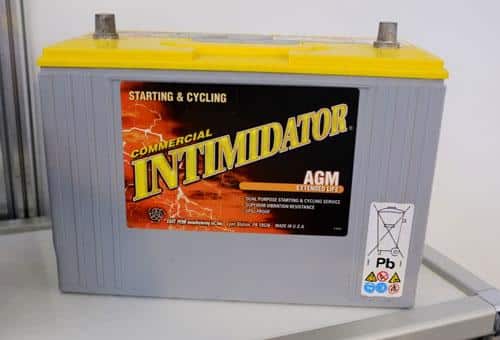
A.G.M. batteries are relatively quick to recharge and can stand frequent deep discharges.
Tried-and-True Technology
I’ve always been a fan of such high-quality flooded-cell batteries as the Rolls batteries offered by Surrette Battery, based in Nova Scotia. I’ve used them and received 10 years of service from them. But they’re heavy, they need to be serviced periodically, and they do have a liquid electrolyte in them that, if and when a battery case were to crack for any reason, would cause considerable damage to the inside of the boat. That said, if you don’t mind occasionally topping them off with distilled water and the fact that the electrolyte isn’t immobilized, these are really great batteries that come in a shape that can be matched pretty much anywhere in the world.
My conclusion? I think you must honestly evaluate your true needs and cruising aspirations before you can come to a decision on what batteries to buy. If price is the only issue, then traditional flooded-cell liquid electrolyte batteries without question are going to be the way to go. If you’re concerned about and truly need deep-cycling capability, and low to no maintenance is what you’re looking for—and you have the budget for it—I think the T.P.P.L. A.G.M. approach is the way to go today. As for lithium batteries, I’m on hold on this evolving technology until more questions are answered. It’s my hope, however, that the bleeding-edge folks out there will continue to use them so that we can all learn and see the technology mature to a point where it begins to make real sense from an economic standpoint. I just don’t think we’re there yet.
Ed Sherman is the educational programming director for the American Boat & Yacht Council.