cw_9606.jpg
It wasn’t supposed to end like this.
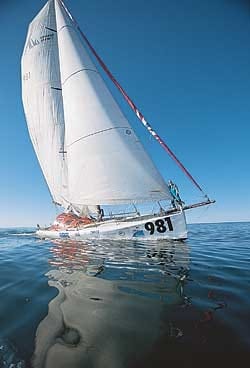
On May 5, 2003, I’d finished the Around Alone race. My Jim Antrim-designed Open 50, Everest Horizontal, had carried me to second place in Class II, and I was delighted. We’d performed far better than my own-or anyone else’s-expectations, and I was looking forward to relaxing a bit and planning the future, which I already hoped would include the 2006/7 Around Alone on an Open 60.
Shortly after the race, my good friend Rick McKenna and I decided to compete in the Bermuda One/Two, an event that runs from Newport to Bermuda solo, then doublehanded on the return trip. It was perfect; at just under 700 miles, it wasn’t too long, but it had enough challenge to get both of us excited. Everest was ready, and so were we.
The less said about my performance in the solo leg, the better. Due to obligations at home, I arrived in Newport three days later than I’d planned, less than two days before the start. There was a fairly extensive list to be tackled, including adding the safety equipment required for racing with two people on board. I added a Man Overboard Module and a Lifesling and did a long list of maintenance chores in two very late nights of work. I then slept through my alarm the first night of the race, went 25 miles in the wrong direction, and was beaten to Bermuda by Tim Troy’s Open 60, Margaret Anna, and Steve Pettengill’s Hunter HC50. Rick and I had some work to do on the return trip.
By the time Rick arrived, with less than a day to the start, the boat was ready to go. Before the race, there was a lot of discussion among the sailors about how to tackle the Gulf Stream on the way north. There was a large contrary meander in the Stream right on the rhumb line; the choice was to go east to a narrow spot in the Stream or west of the meander and get a boost from the Stream. Along with the bulk of the fleet, we chose the longer, potentially faster western route. This decision almost certainly saved our lives.
The sailing was fantastic. We had about 15 knots of breeze and were close-reaching at around 11 knots. Once we got the boat settled down, I plugged in all of our waypoints on my laptop; I used MaxSea all the way around the world and loved the precision it allowed in plotting courses. I then downloaded the latest weather forecast and overlaid it on our chart. It predicted that the weather would allow us to sail a close reach to the Gulf Stream, then head nearly on the rhumb line to Newport. The routing software backed up our plan. We were expecting a front to arrive at nightfall, bringing 35 knots of wind, still on a close reach. Everest reveled in these conditions, and Rick and I were both looking forward to a fast, breezy night.
Our time for calling in our position was 1900 Eastern Daylight Time; we contacted race headquarters on our Iridium satellite phone and learned that Margaret Anna was four miles ahead and slightly east of us. The wind was up to 22 knots, and we were still holding the full main and solent, or working jib. I checked the trim on all the sails and told Rick that we would be looking at putting in a reef when the wind hit 25 knots true. The boat was flying along at 13 knots with the autopilot driving. Nightfall was approaching, and I slipped into my Around Alone routine and started the engine to charge the batteries. With everything under control, I sat down under Everest’s lovely hard dodger and started to read The Miami Herald’s sports section. I remember thinking that this is about as good as an ocean race can get: great boat, great speed, great friend, everything under control. And then, suddenly, it wasn’t.
Mortally Wounded
Pounding on a close reach, Everest’s stiff carbon hull sounds like the inside of a drum, and I’d become used to it. So when Rick and I heard two sharp bangs, I looked up, but I was unconcerned. Rick asked, “Was that the keel?” I snorted derisively, “No, that’s not the keel,” and went back to my sports page. But Rick was right; it was the keel. Everest was mortally wounded and began to show it by heeling sharply.
When Everest hits a big puff of wind while sailing closehauled, she frequently overpowers the autopilot and rounds up. I assumed this was happening again, so I reached over and killed the autopilot and took the tiller in hand, trying to bring her back in control. No dice; the boat continued to heel over until the mast and sails were in the water. Rick was below and had to duck as cooking utensils rained down on him. I jumped below and killed the engine, then returned to the cockpit. The boat was well beyond 90 degrees of heel at this point, making it difficult to maneuver in the cockpit. I had on my safety harness/inflatable life jacket, as I always do when sailing shorthanded, so I clipped and unclipped my way to the transom for a look at the keel.
It’s hard to describe how I felt when I peered past the hull and saw that the 4,200-pound bulb was missing from the keel. I knew that Everest would never lie down like this, so I wasn’t too surprised. Almost a year of dealing with seagoing emergencies had taught me to deal with such situations calmly, but this disaster chilled me deep inside; we were going to have to abandon Everest Horizontal.
I got back to the cabin a lot faster than I made it aft; time was vitally important now. I told Rick that we’d lost the keel bulb and were going to have to call for help. Rick said, “Look over your shoulder!” I did, and I saw a most welcome sight. There on the distant horizon, lit like a small city, was a cruise ship. Under the companionway steps were two watertight boxes, one of which was loaded with flares. He handed me one box, and it was filled with emergency water packets. As he handed me the second, I asked him for a headlamp, which I’d gotten used to during the Around Alone race. It was getting dark, so reaching for a headlamp was instinctive. This, too, would prove to be a lifesaving decision.
As we lay there on our side, I pulled a parachute flare out of the flare box. I read the instructions and fired off the first rocket. The rocket exhaust filled the cabin with smoke, but we’d gotten off our first flare. I closed the box, then asked Rick for the EPIRB and the spare handheld VHF, both of which were right next to the companionway. But it was too late. Everest Horizontal finished her capsize and rolled upside down.
Later, Rick told me that as the boat started to roll over, I said, “Get out of here now!” I don’t remember saying this, but it was certainly what I was thinking. As the boat went over, I was unceremoniously dumped into the water under the cockpit. I was still tethered to the boat and had a death grip on the rope handle of the box of flares. I blew the quick-release shackle on my tether and started to swim under the boat aft. Twice the box of flares got hung up on ropes hanging down in the cockpit; twice I untangled the box. I wasn’t letting go of those flares. To my relief, Rick was bobbing in the water near the transom when I surfaced. I was never so glad to see another guy in my whole life.
Everest’s twin rudders provided a great place to perch. We each clambered onto the upturned bottom of the boat; Rick took the starboard (now port) rudder, and I took the other. We each swung a leg around our rudder and held on. Without a radio or EPIRB, it was critical to attract the attention of that cruise ship with flares. I switched on my headlamp and got to work getting those red, rocket-propelled parachute flares into the air. The headlamp was a godsend, as the instructions on the flares were printed in tiny black letters on a red background. I took off my glasses and put them in the box; they were covered in salt water and useless.
In South Africa, the Around Alone organizers had sent us to a very useful seminar at an offshore survival school at which, among other things, we were instructed in the proper way to fire the SOLAS flares that each boat had on board. While I didn’t have the chance to fire a red, rocket-propelled parachute flare, Bermudian entrant Alan Paris did, and he warned us about the kick of the rocket. The instructors showed us how to use the odd triggering mechanism and told us to fire the flares into the wind so they’d stay on station above us. I remembered their instructions as I got to work.
After the second flare, it was clear that the cruise ship had turned toward us, and our spirits lifted. It was getting rough; at one point, a wave swept Rick off the bottom.
“Hang on tighter!” I yelled at him as he swam back to the boat, providing encouragement where clearly none was needed. After firing off several flares, with the cruise ship coming our way, I started to wait about 10 minutes between flares. As it got closer, I started to conserve the SOLAS flares and fired off a mini-flare. What a mistake; the thing was incredibly loud and almost removed my thumb. As the cruise ship closed on us, we started to use handheld flares: white anti-collision flares and red handhelds.
Finally, the cruise ship was upon us. The boat came to an almost complete halt when it drew abeam of us. We were about 100 feet from the port side. We could see the decks and windows jammed with people looking down at us; dozens of flashbulbs were going off as people took photos. As we drifted slowly by the ship, we asked each other how the heck we were going to get aboard this behemoth. No word came from the ship, and we finally drifted aft of her.
Suddenly we heard a small diesel engine start up and shift into gear. A cheer went up from the ship, and we saw one of the ship’s lifeboats heading toward us-that was how they intended to get us on board! We got an idea of how rough it was when the lifeboat approached. On its first pass, it got thrown into Everest right next to Rick, who scrambled out of the way. The crew chief, who we later learned was Chief Officer Robert Kennedy, asked how many of us were on board. Each of us held up two fingers, and they got on with the business of getting us into the lifeboat.
I indicated that Rick should go first, and they approached his side of the boat. As they closed, again a wave threw them into Everest (the captain later told us that at the time that we were picked up, the wind was blowing 35 knots and seas were 8 to 12 feet). The lifeboat backed away once more, then approached slowly. The crew threw a life ring with a rope attached toward Rick; needing no encouragement, he dove off the boat and swam for the ring. Once he reached it, he was hauled into the boat. One down.
I’d been wearing my Mustang life jacket/harness for a year without ever needing to trigger it. I felt that this was as good a time as any to see if it worked, so I jerked the line to activate the jacket. It filled with a bang as the life ring was thrown my way. I dove off Everest and swam to the ring. I was hauled to the ladder on the side of the lifeboat; as soon as I was halfway up, hands grabbed hold of the straps of my life jacket and hauled me headfirst, like a dead mackerel, into the lifeboat. I got up from the bottom of the boat, thanked the crew, gave Rick a high five, and sat back, overwhelmed.
So happy was I to be alive and safe that I never even glanced back at Everest, the plucky, sturdy, swift, wonderful boat that had taken me safely around the world.
The lifeboat returned quickly to the port side of the cruise ship, Nordic Empress. Our crew quickly reattached the pulleys to the davits that hauled us in the lifeboat up six levels to the lifeboat deck. Here we had a moment of light comedy as we briefly stopped adjacent to the porthole of a passenger’s cabin just as its occupant, an apparently well-fed gentleman, stepped from the shower. We couldn’t contain our laughter at the shocked look on his face as he raised a towel to cover himself. A second later, we were lifted out of his view.
As soon as the lifeboat arrived on the boat deck, ready hands wrapped us in blankets and hustled us off to the ship’s infirmary. The ship’s doctor and nurses took our temperatures and blood pressures and asked the standard questions. Rick’s temp had dropped to a dangerous 92.6 F. Had our 90-minute ordeal lasted much longer, hypothermia would have surely set in. My temperature was near normal, and my blood pressure was typically low; the nurse bluntly told me, “You’re a freak.”
After being released from the infirmary, we were handed Royal Caribbean T-shirts, shorts, and sweatshirts and escorted to our private cabins. We were allowed free phone calls to family and friends at home. Although Rick tried to assure his wife, Germaine, that he was fine, she couldn’t stop crying. I found my daughters and ex-wife (and chief Around Alone supporter) Cheri on her cell phone at the Milwaukee Yacht Club pool. I could only imagine the stories being told around the pool later that evening.
We had a lovely meeting with the captain of Nordic Empress and his wife in their stateroom. There, we compared notes on our respective strategies from Bermuda. Nordic Empress had left Hamilton, Bermuda, some three hours after we left St. George. It turns out that we were both using oceanographer Jenifer Clark’s Gulf Stream analysis, and to save fuel, Nordic Empress was headed for the same cold eddy south of the Stream that we were on Everest Horizontal. Our westward course had placed us directly in the path of Nordic Empress, saving our lives in the process.
After our meeting, we were given the run of the ship: free drinks and food for the day-and-a-half trip to New York City. You really can eat all day on a cruise ship, but Rick and I weren’t all that hungry, nor, to my surprise, was I the least bit eager to overindulge at the bar. Everything around us seemed tinged with a distinct aura of unreality: the cruise ship under our feet, the casino, the bar, the food, our cabin-everything.
We entered our slip and docked in New York right on time; had we arrived even a few minutes late, the dockhands on shore would have been eligible for four hours of overtime pay. After a cordial and heartfelt thanks to the wonderful crew who saved our lives, it was time to re-enter the United States with no identification. For me, it was time to re-enter the world with literally nothing. Everest was uninsured; virtually everything that I owned was aboard her when she capsized: clothes, laptop computers, tools, mementos-everything. But we were whisked through customs and into the cavernous landing area before anyone else, there to meet Germaine and my girlfriend, Danielle. Later in the day, we’d fly home to Milwaukee, and I’d be reunited with my children and Cheri.
And I began to think about recovering Everest.
In Part II, in CW’s next issue, Around Alone sailor Tim Kent describes the dramatic recovery of Everest Horizontal. Noise abatement