For the past 40 years, I have been keeping a record of the global movement of sailing yachts by obtaining the number of arrivals in several key locations around the world. There has been a steady increase in those numbers, with probably the most significant being the number of Panama Canal transits by cruising yachts smaller than 80 feet. In 1984, there were 496. In 2024, there were 745: some 559 of them Pacific-bound, and 186 Caribbean-bound. Those figures were reflected in the 434 arrivals in French Polynesia in 2024, compared to 328 in 1987. The South Pacific remains the most tempting destination among world voyagers.
The only place with a marked reduction is the Suez Canal, which fell from 198 transits in 2000 to 50 in 2024. Among the latter, 42 were northbound and eight were southbound, undoubtedly because of safety concerns. Sailors prefer the safer route around the Cape of Good Hope, as shown by the numbers in Cape Town, South Africa, going up from 67 in 1994 to 232 in 2024.
High-latitude destinations have also seen a marked increase in activity. Roald Amundsen’s first westbound transit of the Northwest Passage was in 1906. In 2024, there were 17 sailing boats that transited that challenging waterway (11 westbound, six eastbound). The more accessible Arctic destination of Spitsbergen, Norway, recorded 55 small-boat arrivals in 2024 compared to four in 1990. On the opposite side of the globe, Antarctica saw an increase from eight to 26 sailboats in those same years. And yes, these were all private, amateur-crewed boats.
Today, I estimate there are about 10,000 boats undertaking a long voyage at any given moment. What is remarkable is that despite such a large number, the vast majority of voyages have a happy ending. Bearing in mind the many challenges those sailors had to overcome to bring their voyages to a successful conclusion, it is encouraging to see so few failures.
I have tried, throughout the years, to narrow down the most common factors that can contribute to the success or failure of a voyage. These are: the boat itself, inadequate funds, the inability to be self-sufficient, crew problems, unforeseen circumstances and an attitude that doesn’t match life at sea.
The Boat
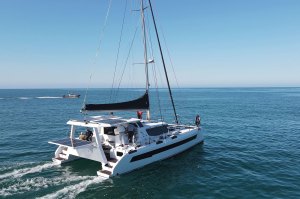
Deciding what kind of boat to acquire for a long voyage is often more difficult than deciding to do the voyage itself.
Making the wrong choice can seriously affect the quality and enjoyment of a voyage, and may even lead to it being abandoned. Many factors can make a boat unsuitable for a long voyage, and the most common is the boat being the wrong size. It could be too large for a short-handed crew, or too small for comfort, or have limited stowage, or be slow on long passages.
The fact that too large a size might be a handicap, especially with inexperienced crew, was evident in my research about several boats larger than 50 feet sailed by a couple alone. Many were forced to take on extra crew, a step that proved to be just as disadvantageous. As one sailor advised: “Don’t go for a bigger boat than you need just because you can afford it.”
Comfort has a bearing not only on the crew’s wellbeing, but also on safety. And the most essential consideration when choosing a boat for a long voyage is safety. Many boats are perfectly suitable for weekend sailing or short cruises, but may not be up to the demands of tough offshore conditions.
I recently surveyed sailors about the most important features that contribute to the quality and enjoyment of a voyage. Regardless of a boat’s size, the most desired features included a comfortable, sheltered watchkeeping position and an ergonomically designed cockpit with a hard dodger for comfort in hot and cold climates. Another desirable feature was shallow draft, because it extends the cruising range. Other features mentioned were good access to the engine room for maintenance, a compact and user-friendly galley, comfortable sea berths and a double berth for use in port. A well-thought-out reefing system was considered essential, with lines being led to the cockpit, ideally to an electric winch. Also important was easy access to the chain locker, with a vertical drop to avoid the chain getting snagged. A powerful and reliable windlass also made the list.
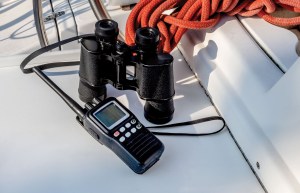
Most sailors in that survey had spent long periods in trade wind conditions, and several mentioned having easily handled downwind sails, such as a cruising chute or spinnaker. The four most mentioned pieces of essential equipment were a powerful autopilot, a reliable watermaker, AIS and a bow thruster. For communications, access to weather forecasts was top of the list, followed by efficient email and a satellite phone.
For sailors with limited offshore experience, these sailors also suggested a general awareness of electricity demands and renewable sources to keep everything on.
Crew
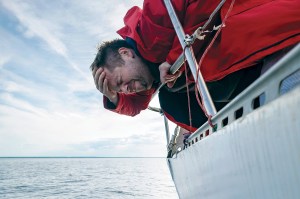
The owner of a boat that had sailed in the ARC and a round-the-world rally, and who’d had more than his fair share of crew problems in his long sailing life, was of the firm opinion that “nothing can spoil the pleasure of a voyage more than problems with your crew.”
His comments echoed my own feelings. More voyages have been abandoned because of crew problems than because of the wrong boat, gear failure or financial difficulties. As the organizer of cruising rallies, I have seen a surprising number of boats that experienced crew problems.
This reality may explain why most boats on long voyages are sailed by couples. While many of those voyages have been completed, the same is not true about boats crewed by friends, acquaintances or occasional crew alongside permanent crew. My advice to anyone planning to take on crew for a longer voyage, even for just one ocean passage, is to consider not only their experience, but also their physical condition, personal reliability and compatibility with other crew.
Health and general fitness should be given a high priority, whatever the age of the crew—and many long-distance sailors are no longer in their prime. This is especially true for long voyages where medical assistance will not be easily available. It is essential to get into good physical shape for an impending voyage. As a highly experienced skipper pointed out: “You must prepare yourself physically, but also mentally, for what can be a demanding way of life.”
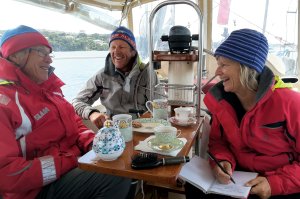
More than half the boats I surveyed were crewed by couples on their own, with only a few who occasionally took on additional crew. Several stressed that they preferred this arrangement, with one commenting: “The advantages of doing long passages as a couple are huge, provided both are fully competent. You only need one decent sea berth, watchkeeping routines are easy, and you haven’t got the responsibility toward other crew. Less is more. The more people in a small space, the more potential for problems. Modern technologies such as autopilot, windvane, radar and AIS have made it much easier to sail shorthanded. Although for watchkeeping, we would prefer to have at least one extra crew member aboard, the logistics of doing so, and the limited space available, convinced us that just the two of us was a better choice.”
For boats crewed by just a couple, it’s important to ensure that in an emergency, the other person would be able to deal with any essential tasks.
I must admit that for many years, I believed bad experiences with crew only happened on other boats. I was proven wrong after I stopped sailing with family members or old friends, and occasionally had to take on crew for some long passages. Some incidents were not serious, but when it came to unpleasant personality clashes, I was just as vulnerable as everyone else.
On our 6-year-long voyage on the first Aventura, the four of us sailed virtually all the time, with only a few exceptions when family members or close friends joined us for a few days. The happy atmosphere on board made me believe that this was all normal. It did indeed continue on Aventura II, but on Aventura III, after several months of sailing with me all the way across the South Pacific from the Marquesas to New Zealand, my wife, Gwenda, told me she was no longer keen on long ocean passages.
“I think it is important to know your interests and limitations, and in my case I have reached the point where I no longer enjoy it,” she told me. “Of course, I can do it if necessary because I’ve done it before, but if you don’t enjoy something, you are just a dead weight on the others.”
From New Zealand onward, Gwenda only joined me for cruising stages, so I had to continue the voyage with various crew, usually one or two. By the time I completed my third circumnavigation two years later, a dozen sailors had joined me. I am happy to say that with one exception, it all worked out well. The main reasons were threefold: I chose my crew carefully, briefed them extensively on what to expect, and—probably most important—had the experience to show them by example that I knew all there was to know about my boat and sailing it.
My challenging experience was on Aventura IV’s voyage, possibly exacerbated by the tensions of an Arctic expedition. Half the crew on my first attempt to transit the Northwest Passage had been family members, so I attempted to maintain a relaxed and happy atmosphere on board, being more tolerant of mistakes than I should have been. Some of the crew interpreted my behavior as a sign of weakness, and their condescending and disrespectful manner became hard to bear. In hindsight, that unhappy situation had some bearing on the decision to abandon that first attempt.
On my second attempt, I was quite firm with the crew. I stressed the fact that we were setting off on an expedition, and that in order to bring the voyage to a successful end, we needed to be disciplined and committed. We did complete the transit of the Northwest Passage, but the atmosphere on board was often tense.
Regardless of my own feelings at the time, I am certainly grateful to my crew for their role in making it happen. And those experiences taught me some valuable lessons about human nature. They also reminded me of the bitter comments from a sailor who had moved up from his smaller boat, which he had sailed with his wife, to a much larger yacht. Being forced to use a professional captain and crew, he attempted, just as I had, to maintain the easygoing atmosphere.
“It simply didn’t work,” he said, “and the answer is very simple: You cannot be loved and respected at the same time.”
Finances
No voyage should begin without adequate funds, not just for day-to-day expenses, but also as a reserve for emergencies. The situation is different from the days when it was possible to sail the world on a limited budget. For anyone planning a voyage now or in the near future, the most important change that has occurred is the cost of cruising.
Life on a floating home has become more expensive. There’s the high cost of insurance, marina and boatyard fees, formalities and cruising permits. The average annual expenses quoted by couples I surveyed on boats between 40 and 50 feet were $32,000 to $48,000. For couples on boats between 50 and 55 feet, estimated costs were $56,000 to $72,000. Most recently, I contacted 10 sailors in various parts of the world, from Japan to the Tuamotus, Sicily to the Caribbean. Their figures varied widely, from $25,000 to $60,000. The person with the lowest budget, a retired Brazilian airline pilot on his second circumnavigation, pointed out that to save money, “I do all the maintenance and repairs on the boat myself. We avoid marinas as much as possible. Also, we limit having meals ashore to maybe once every 10 days.”
A Danish engineer in early retirement sent me a breakdown of expenses on his two-year family voyage that included the Mediterranean, Canaries, Caribbean and Baltic. “The Balearics were the most expensive of the entire itinerary and, to our surprise, the Caribbean was the cheapest,” he said, “mostly because there are fewer marinas, plenty of wind to sail with no need to spend money on fuel, and the drinks are cheap.” His monthly averages were $4,500 in the Mediterranean, $2,800 in the Canaries, $1,800 in the Caribbean and $3,200 in the Baltic.
A Hungarian family on an open-ended world voyage with their two young daughters wrote, “French Polynesia, where we are now, is very expensive. We spend around $3,000 per month, which includes everything except unexpected boat repair expenses or equipment-replacement bills.”
Also on an open-ended world voyage was a Swiss couple with three teenage children who had kept a most fastidious record of expenses. The all-inclusive average annual cost of their as-yet uncompleted, seven-year voyage: $68,000.
An Australian couple, also on a world voyage, wrote, “Our annual budget is between $45,000 to $74,000. Those figures are all-inclusive. We estimate that 40 percent are boat-related expenses, with boat insurance alone taking up 15 percent of our total budget. The remaining 60 percent represent living expenses and include a return trip home every year.”
By comparison, the average annual expense quoted by an American couple on a completed 10-year world voyage was $52,000. That included all living expenses, marina fees, maintenance and repair costs, but not car rental or occasional flights home.
Self-Sufficiency
Many people have lost the ability to be self-sufficient in today’s world, when help is usually just a phone call away. Many sailors stressed that the opposite is required on a boat in the middle of the ocean, where you must be able to deal with any emergency yourself. Many skills are needed, such as the ability to repair and improvise, navigate without electronic aids, dive, give first aid in an emergency, or sail the boat if the engine is out.
To be able to deal with emergencies, the boat should carry a comprehensive set of tools, essential spares and backups for the most important equipment. There should also be a well-stocked medical chest and at least a basic knowledge of how to deal with a medical emergency.
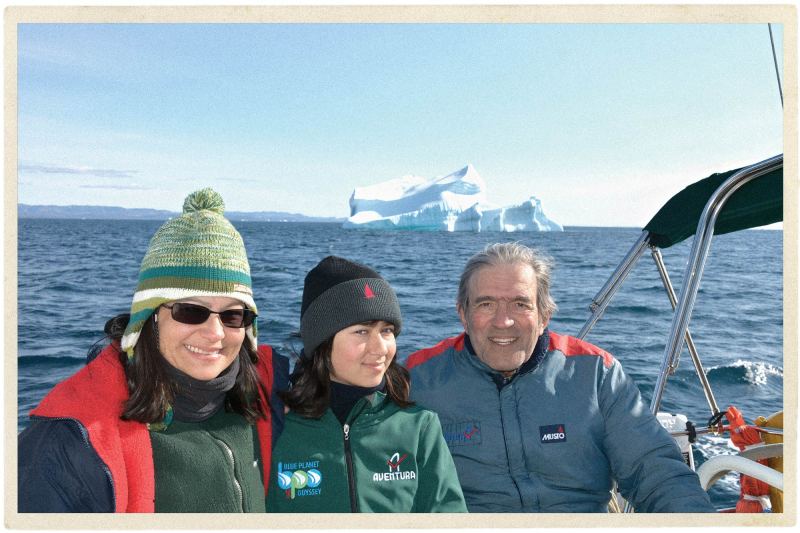
I learned the importance of being self-sufficient early in my sailing life. Having fitted out the first Aventura myself, I not only knew the boat well, but I also had acquired the skills and tools to deal with emergencies. On all my subsequent boats, I had a full set of tools and essential spares.
Being self-sufficient was significant during the pandemic, when practically every country on the popular cruising routes closed its borders to new arrivals. This unexpected situation caused havoc among sailors on longer voyages. They either had to postpone their plans or leave their boats unattended and return home. In some places, those who were allowed to stay had to remain at anchor and had difficulties getting provisions, fuel or medical attention. Several sailors abandoned their voyages.
In recent times, sailors were forced to change plans during the piracy crisis in the North Indian Ocean. Some voyages had to switch from the Red Sea to the Cape of Good Hope route. While the risk of piracy has abated, the uncertain situation in the Red Sea continues to make the latter route the safer choice.
Climate change also affects voyage planning. Among 65 sailors I surveyed, every single one of them said that while they were aware of the consequences of climate change, they would take that factor into account and would still be prepared to leave on a long voyage. All agreed that proper planning was now even more important than in the past.
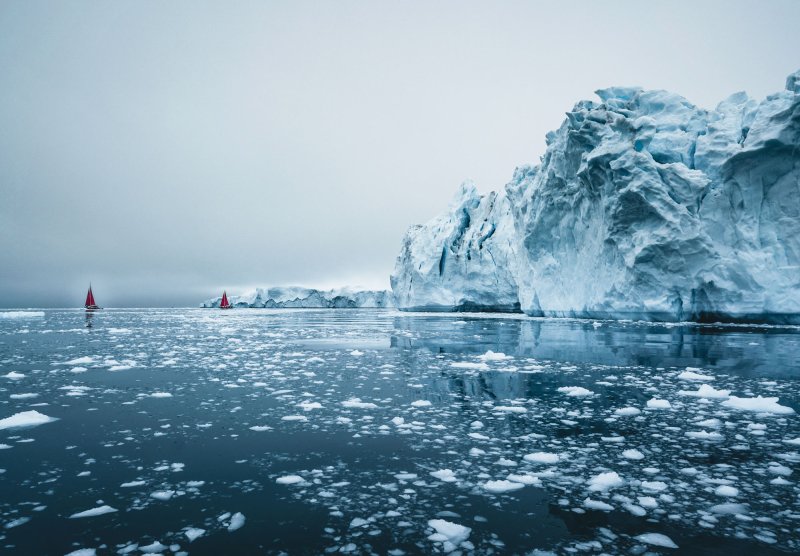
Indeed, with careful planning, tropical storm seasons and critical areas can still be avoided. Bearing in mind the changed circumstances, arriving in the tropics too close to the start of the cyclone-free season should be avoided, and a safe margin should be allowed before the end of the safe period. In addition, cruising during the critical period in areas affected by tropical storms should be avoided, and sailors who remain in a critical area, or who leave the boat unattended, should make sure that their insurance company agrees with their plans.
Most sailors have a positive attitude about this. Even a sailor who expressed some doubts about climate change said that whatever might be coming, “Even a bad day at sea is better than a good day in the office.”
The Right Attitude
Setting off for a life on the ocean is a major decision that entails a complete change of lifestyle and mentality. Leaving on a voyage in a sailing yacht because it is a convenient way to see the world is not a good enough reason to go. I have come across this kind of attitude among several sailors, some of whom were unwilling, or more often unable, to transition from a shore-based life to full-time sailing. This may not be a big problem on a relatively short voyage, but it can have serious consequences on a journey of several years.
In the final analysis, the ultimate success of a voyage does not depend on the boat, but on you and your attitude.
One sailor in my survey highlighted the crucial importance of mindset: “A boat is not the place to fix anything wrong with a relationship, whether it is with a partner, a child or a friend. If someone irritates you ashore, they will irritate you even more on a boat. Some people are not emotionally geared for life aboard. They are not wrong or misfits; they are just not boat people.”
In my 50 years of sailing, I have met many outstanding people, and invariably what made them stand out was their attitude. What I most admired was their profound respect for the sea. Being on the ocean came to them naturally, undoubtedly because they loved what they were doing. What they all had in common was that vital frame of mind, which includes courage, perseverance, determination and self-confidence. The age we live in has not changed those requirements in any way.
Alone on a small boat in the middle of an ocean, far from land and help, captains have their own destiny, and that of their crew, in their hands. Nothing can describe this situation better than the words of the poet William Ernest Henley: It matters not how strait the gate, How charged with punishments the scroll, I am the master of my fate, I am the captain of my soul.