Falmouth Cutter 34 368
Twenty years ago my wife, Diana, and I were slogging north along the rugged coast of Chile after a successful but difficult winter passage around Cape Horn. Huddled in the cockpit of our 31-foot plywood Golden Hind, Zenie P. II, without even the protection of a dodger much less a proper doghouse, Diana waited in ambush for me to appear on deck for my late-night watch. Her snowball was strategically aimed and well thrown. She then disappeared below without a word. I interpreted this to mean that she did not approve of the situation.Twenty years ago my wife, Diana, and I were slogging north along the rugged coast of Chile after a successful but difficult winter passage around Cape Horn. Huddled in the cockpit of our 31-foot plywood Golden Hind, Zenie P. II, without even the protection of a dodger much less a proper doghouse, Diana waited in ambush for me to appear on deck for my late-night watch. Her snowball was strategically aimed and well thrown. She then disappeared below without a word. I interpreted this to mean that she did not approve of the situation.
The next day, as we approached the docks in the river town of Valdivia, I purposely passed closely by the smallest cruising boat I could find. This was intended to be my silent retort: “Look, we’re not the only pint-sized vessel here.”
But my stratagem backfired, for once onboard the 28-foot Bristol Channel Cutter it was immediately obvious that despite being three feet shorter, it was a vessel far more suited to these waters and arguably superior to ours in every way.
Danzarin (Spanish for “dancer”) was a masterpiece of design by the legendary Lyle Hess and a showcase of execution by boatbuilder Bryan Gittins, a native Argentinean with Canadian citizenship.
We meet so many people in our travels that unfortunately many faces fade into the fog, but I did not soon forget Bryan. He was a handsome fellow with a quick smile and a mischievous sense of humor who spoke English with a musical lilt. But beneath his frolic was a philosophical man searching for a sense of place, a family of his own, and a meaningful niche in the pantheon of boatbuilders.
Bryan did not think of boat building as a way of making a living, but rather as a way of living. In describing his work he used a nomenclature more suitable for a lecture on ethics and morality. A wood’s grain must be “honest,” planks must be fastened “responsibly,” and a craftsman has a “sacred obligation” to perpetuate his or her skill and knowledge.
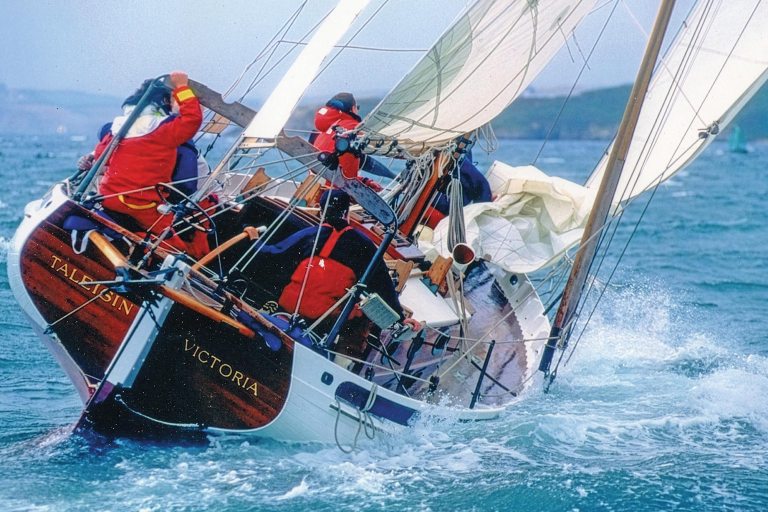
We sailed north, Bryan south. Several years later on the coast of Maine, we had the opportunity to meet Lin and Larry Pardey on their Lyle Hess-designed Taleisin. Larry expounded in some length about the virtues of Hess’ designs, but a few weeks later he let the 29-foot Taleisin do the talking in the Classic Wooden Boat Regatta in Brooklin, Maine. I do not wish to recall by how much they beat us.
The lesson was clear: When skillfully designed, a traditional boat could at once be evocatively beautiful, high-seas capable, and still show its heels to much of the fleet.
These two threads met last year when Bryan contacted us through Cruising World with the news that after years of world sailing and building boats he’d secured the exclusive rights to produce the Falmouth Cutter 34, Lyle Hess’ last design before his death.
Bryan had settled into the idyllic countryside near Ladysmith, on Vancouver Island, married Victoria, his childhood friend from Argentina, and they now had a beautiful 6-year-old daughter named Julia. Apparently, he’d achieved the trifecta of his dreams.
Diana and I were sailing south from Alaska to Seattle and promised to stop in Ladysmith en route. As we approached the dock, I recognized Bryan’s smile from 50 yards out.
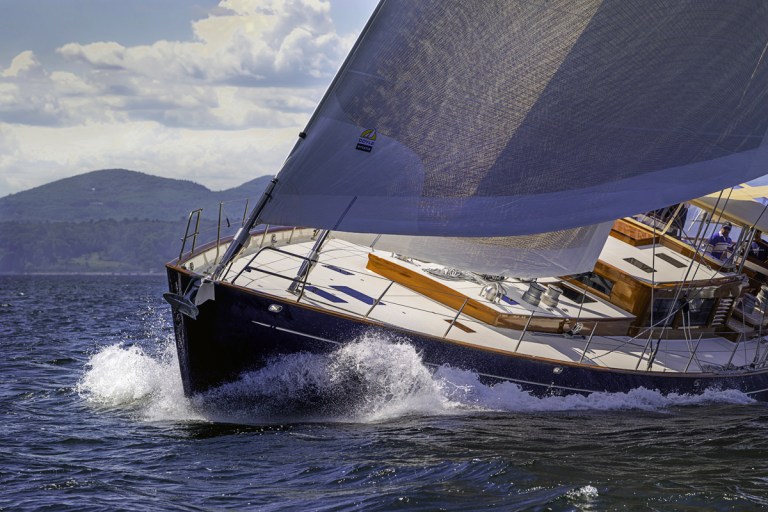
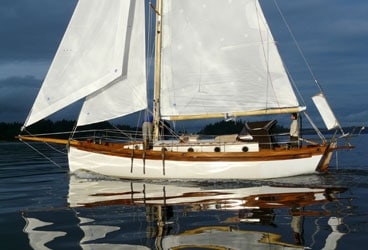
After introductions and the usual Argentine abrazos and kisses, Bryan rushed us down the dock to see Half Lucky, a brand-new Falmouth Cutter 34 that he’d just completed for Les Owen of Alberta. At the risk of betraying my bias in nautical aesthetics, Half Lucky looked exactly as a proper yacht should.
I warned Bryan that I wanted the whole story-his life, the history of Lyle Hess’ design, and how this wonderful vessel came into being.
Back inside their country home and boatbuilding shop, Victoria prepared for us a traditional Argentine asado complete with chimichurri sauce. Over dry Mendoza Malbec, we reminisced about the rugged, haunting beauty of the Uttermost South.
Waypoints for a Boatbuilder
Bryan was born in Uruguay but raised in Argentina. His life in the small mountain towns of the Andes seemed idyllic until Juan Peron came to power. Because of his English heritage and his father’s outspoken politics, by his 18th birthday it was decided that Bryan had no future in Argentina. But he didn’t have the money to buy a bus ticket to Brazil much less passage to a land of real opportunity. Sneaking past trigger-happy military police, Bryan slipped under a fence in a seaside port and convinced a ship’s radio operator to sign him on without pay and get him out.
From there he traveled widely, a young man with burning ambition but without a country in which to fulfill it. He failed to obtain visas to New Zealand, Australia, or South Africa. He found himself destitute on the streets of London and running out of options, but he never ran out of optimism.
Back in Argentina, the pressure on his family became too much. Reluctantly, his father scraped together the means to emigrate to Canada, where he’d served for five years during World War II. By arriving there just before his 21st birthday, Bryan was eligible for Canadian citizenship. It proved to be a perfect match.
Ever since attending a vocational school as a boy, Bryan knew that woodworking would be the central theme of his life. Enterprising by nature, with a strong and steady work habit, he first found opportunity in the logging camps of the far north. With money saved there, he bought a truck and struck a deal with a First Nations man to cut firewood on a reservation and remove it. He sold this to wealthy homeowners at the Whistler ski resort for handsome profits.
Living on those savings, he went to work for free for a Peruvian furniture maker who taught Bryan not only the skills of fine woodworking but also how to work with people, order supplies, and generally run a business.
But you can’t sail a hutch cabinet to distant shores. Fueled by stories of his childhood hero, the Argentine circumnavigator Vito Dumas, Bryan had visions of nautical adventures that would make Sinbad pale.
And then one day he wandered into a boatyard where 28-foot Bristol Channel Cutters were being built. Bryan told David Aitken, the owner, “I want a job.” And motioning toward the boats, he added: “And I want one of those.” Everybody laughed. He started work Monday morning as the lowest man on the staff, but it wasn’t long before his energy and skills moved him up the ranks.
Aitken decided to discontinue the woodworking side of the business and began to offer only the fiberglass hulls and decks for sale.
That was all the opportunity Bryan needed. With his friend, Al Brunt, who’s now the head teacher at the Silva Bay Shipyard School, Canada’s only school for building wooden boats, they formed G & B Boat Works, which finished out these hulls for their customers.
Bryan and Al’s reputation grew until no less than Ferenc Máté wrote in his book Best Boats to Build or Buy, “Their work is precise, and their attitude is that of a traditional craftsman whose work oozes pride. They’ll never get rich, but they sure sleep well at night.”
Máté was right; they didn’t get rich. After three years and a prolonged recession, Al Brunt was forced to find steadier work. Bryan, though, carried on alone-his dream to own his own boat intact-by finessing a deal whereupon a customer would buy two BCC 28 hulls. Bryan would finish out the customer’s boat for the price of the second hull, then begin finishing that out for himself. With no cash flow, it was a long struggle. Bryan says that he lived at first like a rat inside his hollow hull, but seven determined years later, he launched a completed Danzarin.
With Elisa, a pretty Canadian girl, Bryan set sail with no particular destination in mind, just seeking the free life afloat. It took 45 difficult days to fetch the stunning Marquesas Islands. Even with the lure of the South Pacific islands before them, the pull toward his native land proved irresistible. Bryan turned Danzarin eastward toward South America.
After 47 days of open sea, he and Elisa made landfall near Valdivia, Chile, where Diana and I first met them. Elisa returned to Canada while Bryan explored the southern channels of Chile, rounded Cape Horn, then bore off toward Cape Town, South Africa, via Tristan da Cunha.
In South Africa, he looked up Ed McNeil, who once owned the Canadian rights to build the BCC 28. McNeil had traveled to California to visit with Sam Morse, the American BCC 28 builder, and its designer, Lyle Hess.
They all agreed that, although a wonderful design, the BCC 28 was perhaps “too concentrated” and it was time to stretch the basic concept out into a larger, more powerful version. Hess returned to his drawing board.
Of the results he wrote, “This is the best boat that I’ve ever designed.” That wasn’t boastful, for Hess was known to be a humble man with no penchant for self-promotion. He just felt that a lifetime of design experimentation and experience had come together harmoniously in this, his last creation.
McNeil purchased the exclusive rights to build the Falmouth Cutter 34 and set up shop in South Africa. Bryan’s arrival there was timely, for McNeil needed interiors finished and wooden tillers, hatches, and rudders constructed-the type of fine woodwork at which Bryan excels.
With enough money in his pocket to carry on, Bryan set sail for the U.S. East Coast. It was a long and lonely sail, and after much soul searching, he decided to sell his beloved Danzarin upon his arrival in Beaufort, North Carolina. With the proceeds, he returned to British Columbia and purchased five acres in the woods near the city of Nanaimo.
McNeil contacted Bryan to ask if he’d come back to South Africa to finish out a hull and deck. Bryan spent six months there and another 10 months finishing the boat in Houston. The result was his usual showpiece, and the potential for more orders developed.
But even as the business grew, McNeil was tiring of the difficulties of manufacturing on one continent for a market on another, not to mention the complexity of finishing the interiors to the exacting standard that this genre demands.
The logical conclusion was for Bryan to buy the exclusive rights from McNeil and set up shop on his acreage in British Columbia. The problem was how to ship the massive and delicate molds. Again Bryan’s ingenuity came to play. He had McNeil build one last hull, ship it to the states, and then destroy the old molds. From this hull, Bryan manufactured new molds, then hung out his Channel Cutter Yachts shingle.
Half Lucky Is All Good
After a lovely evening, Diana and I retired to sleep in Julia G, a William Atkins-designed Ingrid nestled beneath an open shed next to Bryan’s house. As we slipped below, our hands involuntarily petted the smoothly laminated deck beams, gracefully scalloped fiddles, and finely fit mahogany cabinetry. Although out in the woods with no one near to disturb, Diana and I found ourselves whispering as if we were in a church. And perhaps we were, in a way: a holy shrine of nautical tradition, with such designers as Lyle Hess and William Atkins as the sect’s iconic saints, such craftsmen as Sam Morse, Bryan Gittins, and Larry Pardey as its high priests, and such sailors as Vito Dumas, the Smeetons, and the Hiscocks as its early crusaders.
In the morning, we took Half Lucky out on the waters adjacent to Ladysmith.
Normally I prefer to test a new boat in heavy wind conditions, but I’d repeatedly read stories that claimed that the designs of Lyle Hess showed a surprising turn of speed in light air. I confess to feeling somewhat skeptical that a relatively heavy-displacement vessel with the large wetted surface of a full-length keel with a draft of five feet one inch would move sprightly in the five to 10 knots of wind we encountered.
But Hess had a knack for solving such problems. He incorporated more powerful sections than he had in the 28 and employed a firm turn to a high bilge. This additional form stability and a .35 ballast-to-displacement ratio allowed him to virtually drape the cutter rig with 832 square feet of working canvas. The resulting SA/D of 18.7 surprisingly places the FC 34 in the cruiser/racer category.
We tacked effortlessly through mere zephyrs and, with the help of an extended waterline due to the near-plumb stem, held impressive speeds of five knots in very light airs. The FC 34 should dash off very respectable noon-to-noon runs under normal passage conditions. Fear not the doldrums, for the 40-horsepower Yanmar pushed the boat smartly at seven and a half knots.
The helm feels heavy when compared to modern designs, but that’s because the large, transom-hung rudder helps this boat track like a train. While not as nimble around the buoys as a fin-keeler, the full-length keel and symmetric waterline fore and aft translate at sea into ease of handling, quieter motion, and less strain on the crew and equipment.
I especially loved the deck ergonomics. Wide, unobstructed walkways lead forward to sensible workstations at the mast and foredeck. A small, well-drained cockpit sits low enough to the waterline to protect rather than expose the person at the helm to high wind and excessive heel. Continuous bulwarks, numerous handholds, and 30-inch lifelines add to the overall sense of security.
All deck hardware is cast in silicon bronze, including the massive Maxwell windlass, the winches, stanchions, stern pulpit, chain-plates, turnbuckles, and tangs. Although initially expensive, future archeologists will find this marvelous material in much the same condition that it’s in today.
The hull starts with ISO Ortho NPG Valspar gelcoat. The first layer of glass is impregnated with vinylester resin, and the following layers of hand-laid mat and roving with polyester resin. The molded glass decks are plywood cored and covered with half-inch teak planking.
Hess had a keen eye for aesthetic detail. From the stout boomkin aft to the arching bowsprit forward, he maintained a consistency of traditional style. Somehow, this style isn’t interrupted with the concessions to modern equipment and materials, such as furling Dacron headsails and navigational electronics.
The interior fit and finish of Half Lucky is nothing short of perfection. Yet because of its snugness and simplicity, it feels more like a home than a hotel room. Traditional laddered steps lead below. A small but functional galley lies to port, complete with ample counter space, a large fridge/freezer, a three-burner propane stove and oven, and twin stainless-steel sinks.
To starboard lies a comfortable navigation station with room enough to actually use and store paper charts. A large pilot berth lies aft of the navigation station. The main saloon offers a traditional layout of a slightly offset drop-leaf table with thickly cushioned settees to port and starboard.
A stainless-steel diesel drip heater sits against the forward bulkhead; a curtained portal forward gives easy access to the head to port and stowage cabinetry to starboard. The head has a sink, shower, and an innovative composting toilet. The offset double berth in the forepeak is roomy and comfortable.
Although out of sight, the mechanical, electrical, and plumbing systems aren’t out of mind, for they reflect the same level of meticulous attention to detail.
Overall, I found the Falmouth Cutter 34 to be a masterstroke of design exquisitely executed by a dedicated artisan.
While Victoria heated up her homemade empanadas below, Bryan sat at the tiller sipping his maté out of a traditional leather-bound gourd. Dressed in his old woolen hat and sweater, he looked the spitting image of his compañero, Vito Dumas.
And indeed, they share much in common. Both are doggedly determined men with personalities shaped by the craggy mountains and open pampas of Argentina. Both knew hard work and hard times, yet both managed to take their dreams around the world in their classic little boats. And in the end, both fulfilled what Bryan termed a “sacred obligation” by turning their time and talent into something larger than themselves.
You can visit Bryan Gittins’ website here.
Alvah and Diane Simon have departed from the shores of the Pacific Northwest and are bound for their home in New Zealand.