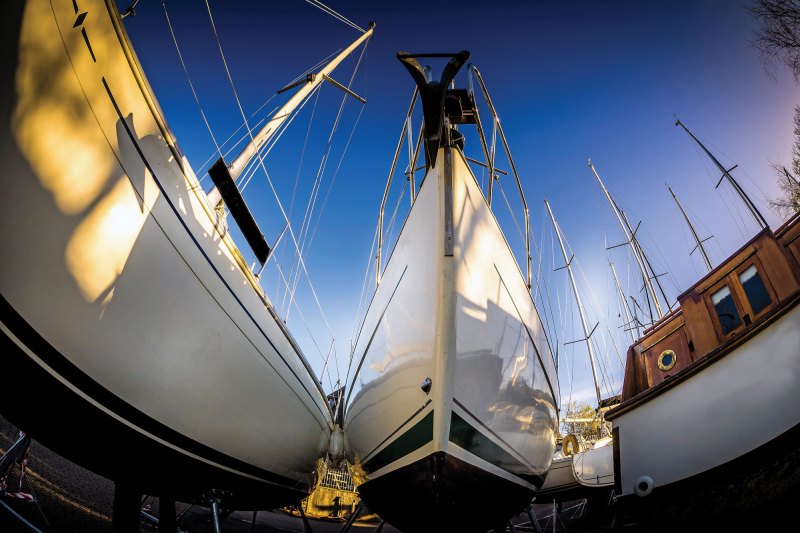
There’s a distinct kind of quiet that settles over a boatyard in late fall. The Travelift has stopped running for the day. Stands are going up under hulls that were slicing through chop a month ago. Somewhere down the row, a diesel heater in a workshop ticks as it cools. Your own boat is up on the hard now too, a little embarrassed-looking out of her element. And the work in front of you determines whether spring commissioning is a half-day job or a week of expensive surprises.
Haul out is a decision as much as an event, and it’s a decision worth making deliberately rather than defaulting to whatever the marina does.
Hauling out and storing indoors eliminates bottom growth and clears the deck for real projects (bottom paint, zincs, seacocks). In snow country, it keeps a winter’s worth of accumulated weight off your decks and rigging. Outdoor hard storage costs less and is easier to find. Wet storage, kept in a slip through the off-season, can be the only practical option in some places, and with the right precautions it works fine even in genuinely harsh locales—it just shifts more of the workload onto ground tackle, fenders and faith in your dock lines.
None of the three is universally correct. The right call depends on your climate, your marina options and how much of the work you want to do yourself.
Hull, Topsides and the Bottom
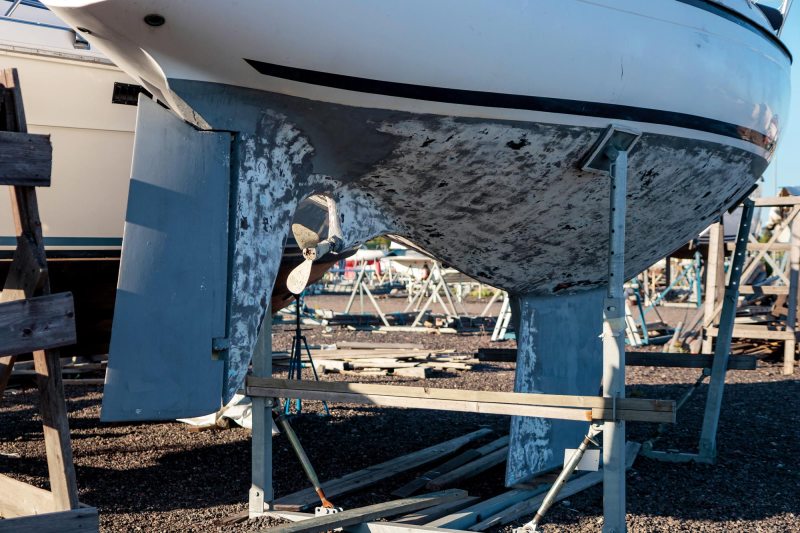
Once she’s up, the clock starts on the highest-value work of the whole season. Pressure-wash the hull before growth and salt have a chance to set. Use a wide-fan tip, never a pinpoint or rotary nozzle that can gouge gelcoat, worked from the top down and kept well clear of through-hulls and any rubber fittings.
This is also your best look all year at what’s actually going on beneath the waterline: flaking antifouling, worn anodes, corrosion around fittings, blistering and delamination show up clearly on a freshly cleaned hull. Bottom paint older than about eight years, or showing real signs of failure, is worth stripping back to a barrier coat rather than patching over for one more season.
Topsides deserve the same attention, even though the damage there is slower and less dramatic. Chalky, faded gelcoat that has stopped beading water is losing its UV protection. A thorough clean-and-polish now, rather than waiting for a full spring refinish, buys real protection through a winter of sun and salt air with a fraction of the effort.
Whatever you paint or don’t, get a breathable, well-ventilated cover on before you walk away, tensioned to survive wind rather than sailing off, and never shrink-wrapped tight against bare paint or gelcoat. That can trap condensation, and it invites blistering underneath.
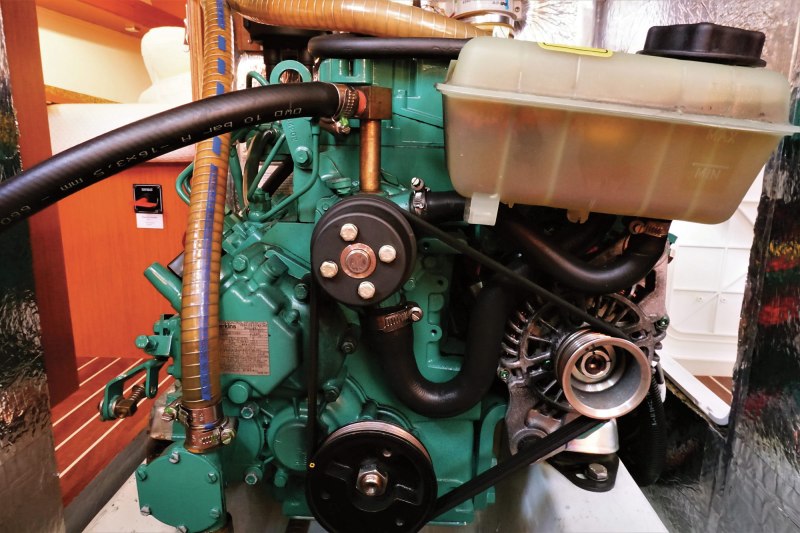
Systems: Where Layup Actually Gets Won or Lost
The engine is the single most expensive thing to get wrong. Change the oil and filters before layup, not after. Contaminants in old oil do their worst damage sitting still. Check transmission fluid, verify your coolant concentration with a refractometer (a weak mix freezes and can crack a block), and top off fuel tanks to keep condensation from forming in the empty space above the fuel. Just pair it with a stabilizer, and a biocide if you’re running diesel, since a full tank stops new condensation but does nothing for water or microbial growth already sitting in there. Run antifreeze through the raw-water intake as insurance against any cold snap you didn’t plan for, and if there’s an outboard, treat its fuel with a stabilizer and run the cooling system through a flush before it goes quiet for the winter.
Water and sanitation systems reward patience more than force. Drain the potable system by gravity where you can; it’s easier on the pump and flushes the bilge as a bonus. Then, bypass the water heater with a jumper hose so antifreeze never has to sit in it fouling the taste for months. Draw nontoxic antifreeze through the system using the boat’s own pump rather than pouring gallons straight into the tank, and remember the shower sump and any deck-wash pump on the same freshwater circuit. The holding tank gets pumped, flushed with fresh water, and pumped again before its own dose of antifreeze; if your heads take raw water, disconnect the seacock side and draw antifreeze through those hoses too, keeping in mind that alcohol-based antifreeze and PVC sanitation hose don’t always get along, so purge more than you think you need to.
Batteries left unattended over a long layup are quietly making the decision between a smooth spring start and a dead bank. Shore-power float chargers built for your battery chemistry are close to maintenance-free once installed; without shore power, a full charge followed by isolating the banks entirely is the fallback, though it demands more vigilance in genuinely cold climates.
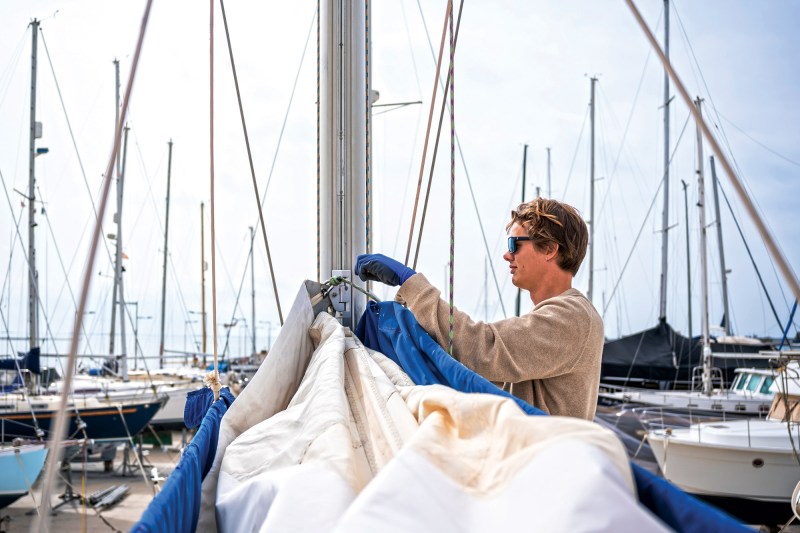
Everything Else that Keeps a Boat from Coming Back Sour
Reducing windage matters wherever your boat spends winter, wet or dry. Furled sails come off and go home or into the saloon rather than staying rolled on the headstay through a season of storms. Anything perched at the masthead—antennas, wind instruments—comes down too, more against roosting birds than wind load, but it’s cheap insurance either way. Loose deck gear, halyards swapped for thin messenger lines, and a healthy surplus of fenders and chafe gear on the dock lines round out the exterior work, and are worth doing even for boats going into a shed.
Belowdecks, the enemy is trapped moisture. Empty and dry the bilge until you’re wiping up dust, not water, and prop floorboards to let air move through the space all winter. Pump the holding tank, run a vinegar rinse through the head to break down mineral buildup, and empty and prop open the refrigerator so nothing grows in it while you’re gone. Launder or bag anything with a hint of must—cushions, foul-weather gear, towels—and strip out perishables entirely.
A boat that goes to sleep clean wakes up the same way.
What You’re Actually Buying
None of this is glamorous work, and none of it happens on the water. But every hour spent under a tarp in October is an hour you don’t spend in April chasing a corroded through-hull, a frozen head or a dead battery bank on the first warm weekend of the season. Layup done right doesn’t just protect a boat; it protects a season.

5 Layup Mistakes that Cost a Spring Weekend
1. Shrink-wrapping straight over bare gelcoat
It feels like the most protective option, and it’s often the one that does the damage. Plastic pulled tight against paint or gelcoat traps condensation underneath all winter. By spring, that trapped moisture has blistered or dulled a finish that would have been fine under a ventilated cover. The fix costs a haul-out day. The mistake costs a spring refinish.
2. Skipping the coolant check
Nobody wants to pull out a refractometer for five minutes on a Saturday when the boat’s already up on stands. But a coolant mix that’s weaker than it looks can freeze solid on the first hard cold snap, and a cracked block doesn’t announce itself until you turn the key in April. This is the cheapest five minutes of the entire layup and the most expensive to skip.
3. Antifreezing the water heater directly
Pour antifreeze straight into the potable system without bypassing the water heater first, and it sits in there all winter turning the taste and smell of your water into something you’ll be flushing out for weeks come spring. A simple jumper hose between the heater’s in and out ports avoids the whole problem. It’s a five-minute fix most people only learn about after the first bad glass of water.
4. Leaving fuel tanks anything less than full
An empty tank isn’t an empty tank. It’s a tank full of humid air, and condensation forming in that space all winter is exactly how water ends up in your fuel line on launch day. Topping off before layup, on the main tank and the cabin heater’s tank alike, is one of the few jobs on this list that costs nothing but a stop at the fuel dock. It’s not a substitute for a stabilizer, though; pair the full tank with a stabilizer (and a biocide on diesel) to deal with the water and microbial growth that’s already in there, not just what’s trying to get in.
5. Trusting the batteries to just be fine
A battery bank left alone all winter without a smart charger, or without being fully charged and isolated, doesn’t fail gracefully. It fails quietly, and you find out on launch day when nothing turns over. Whether it’s a float charger on shore power or a deliberate full-charge-and-isolate before you walk away, this is the difference between an easy spring start and a tow back to the dock.