My official role at any boat show is observer. I am there to experience the boats, talk to the builders, take the pulse of the market, and report back to you with something useful. I have a press badge. I have a notebook. I have, in years past, actually used the notebook.
What I have never mastered, despite what can now be described as extensive field research, is any meaningful immunity to the experience itself. I step onto a dock in Cannes, France, in early September with the Mediterranean glittering behind me and a 60-foot sloop directly in front of me, and something happens that has very little to do with journalism. I have stopped pretending otherwise.
A couple years ago, I found myself deep in the aft stateroom of a sailing yacht considerably beyond our annual editorial budget, or any budget I’ve encountered in my marine media career, trying to look professionally evaluative while a sales rep walked me through the full spec sheet. I was taking notes. The notes said the asking price, and then beneath it, a single word I can’t print in a family publication.
The boats will do that to you. This is not a character flaw. It is, I’ve come to believe, simply what happens when you put extraordinary objects in front of people who love the sea.
We cover three shows this fall, and if you’ve been to all three, then you know they are as different from one another as the waterfronts they lean on.
Cannes comes first, and the South of France is its own category entirely. The Cannes Yachting Festival does not traffic in the modest or the practical. It is held along La Croisette in early September, when the Mediterranean is still warm and the rosé arrives with a conviction suggesting the French have collectively decided no serious decisions will be made before aperitifs are served. The boats are extraordinary, the crowd is a genuinely interesting mix of serious offshore sailors and people who are just there to observe, and the whole thing operates at a frequency that is difficult to describe until you’ve stood on that pink carpet and felt it yourself.
Newport, Rhode Island, is different in the way New England is different: on purpose, a little weathered, and damn proud of it. The Newport International Boat Show has the America’s Cup in its bones and a working waterfront that makes you feel like sailing here has always meant something beyond recreation. Someone will corner you on the dock with a 40-minute discourse on keel geometry, and you will not entirely mind, because they will probably be right.
And then there is Annapolis, Maryland. The Annapolis Sailboat Show is the one that feels, more than any other, like a homecoming. The Chesapeake Bay in October has a bite to it that makes you feel like the sailing season isn’t ending so much as getting serious, and you will, without question, run into everyone you have ever met in sailing within the first four hours. Budget accordingly—not just for the boats, but for the time. You are not getting out of there quickly, and you shouldn’t try.
Here is what I keep coming back to, after all these years: The boats are only half the story.
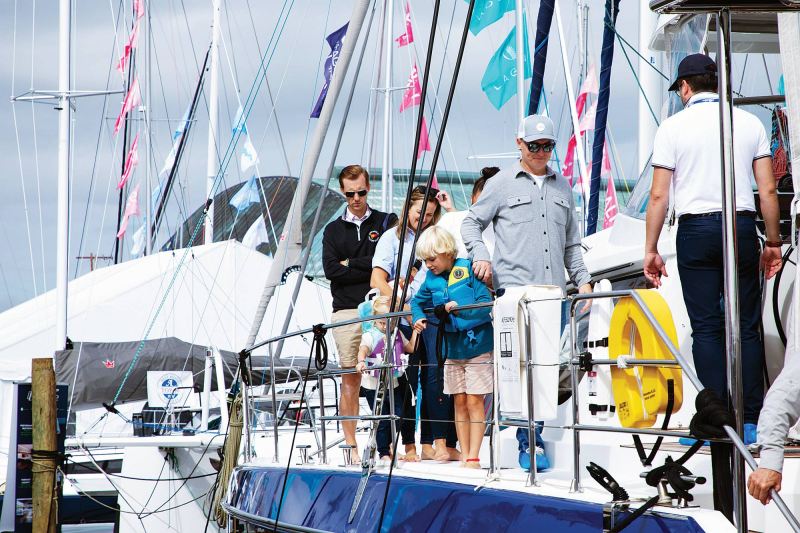
The boats are the occasion. What is actually happening—at every dock, in every cockpit, over every plastic cup of mediocre white wine—is the sailing community reminding itself what boat shows are for. First-timers are catching the bug. Veterans are recalibrating their cruising plans. Couples are standing in the saloon of something slightly beyond their budget and saying to each other, with some combination of alarm and genuine excitement, what if.
Those moments are what the boat show is really selling. I’ve covered this sport for a long time, and I have yet to find a better argument for why any of us do it.
See you on the docks.