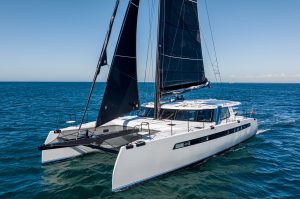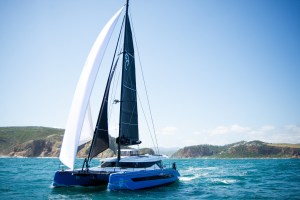
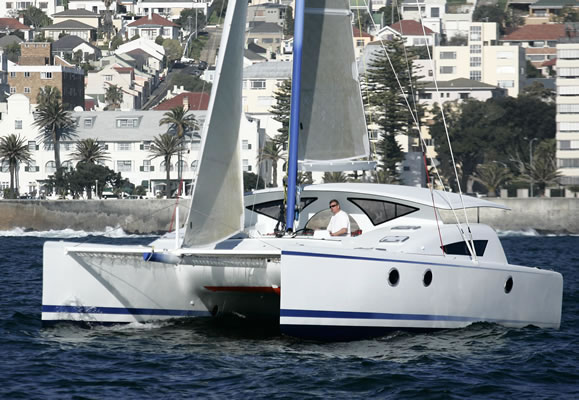
Though the catamaran docks were host to the usual cast of two-hulled characters during last fall’s U.S. Sailboat Show in Annapolis, Maryland, the Moxie M37 Island Hopper was the sole newcomer and the only multihull entered in Cruising World’s 2009 Boat of the Year contest.
Even in a normal year, when upward of half a dozen new cats would make their debuts at Annapolis, the Island Hopper would’ve stood out, if only because it delivers what most catamarans can only promise: exhilarating sailing in even the lightest winds.
Uwe Jaspersen conceived and designed the Moxie Yachts’ M37 and built it at his company, Jaz Marine, in Cape Town, South Africa. In his career, Jaspersen has worked on the production line at Voyage Yachts, on high-tech custom Gunboat cats, and as a specialist in composite structures. This blend of experiences shows both in the form and in the execution of the M37.
In concept, the boat owes more to the Gunboat than to the Voyage school. Its intent is captured in its name: Pick a group of islands well endowed with anchorages, beaches, sunny days and balmy nights, and a watering hole here and there, then bounce from one to another in the Island Hopper.
Unencumbered with the trappings of the customary cruising catamaran (if you want air-conditioning, you’ll have to go ashore to the hotel), it’s light. Its fine hulls don’t pack much volume but are easily driven, so it doesn’t take a whole lot of wind or sail to get the M37 sailing at or even above the true-wind speed. In the light conditions that prevailed in Annapolis after the 2008 U.S. Sailboat Show, it waltzed where most of the other sailboats around it were only able to wallow.
Because sailing is the first order of business aboard the Island Hopper, its design aims to make that as effortless as possible. The cockpit is forward, at the base of the mast, and all controls lead to it, even if, as in the case of the sheets for the asymmetric spinnaker, they do so somewhat tortuously. All these lines and their attendant winches and clutches converging in a small space can create a little confusion for the casual visitor, such as a boat reviewer. With practice though, one person, especially if endowed with the moxie and aptitude of the boat’s builder, can raise and trim sails, raise and lower the daggerboards, rotate the mast, and operate the engine controls with ease and efficiency. The one thing that the cockpit lacks, however, is a view around or through the headsail when the screecher’s set, though a window cut in the sail would improve visibility. As an alternative, a lookout posted on the weather bow or, preferably, the lee stern would be helpful.
Below the water, the M37 has daggerboards that are asymmetric to generate maximum lift and canted in at the toe so their housings don’t cramp the staterooms. The rudders are in cassettes, and when one caught a Chesapeake crab trap, Jaspersen easily cast it loose by withdrawing the rudder, even as the boat sailed at 6 knots.
In simple-sailing mode and when sailing upwind, the M37 flies a self-tacking jib, which leaves the driver one hand free to play the mainsail and adjust the rotating wing mast when tacking. The jib is hanked on so that, when dropped for off-the-wind work, it remains attached to its stay while the crew sets the screecher, which is on a continuous-line furler. When even more power is wanted, the screecher gives way to the sock-set asymmetric. The high-aspect-ratio mainsail has a square top, a common feature on high-performance rigs but one that doesn’t adapt well to conventional cruising norms because the top batten has to be disconnected in order for the top several feet of the sail to stow. Still, this boat isn’t targeted at the conventional cruiser.
Living aboard the M37 will be a little more akin to camping than it would be in a “cruising” catamaran. While it does have a queen-berth cabin in each hull, its appointments verge on the spartan, simply to support the performance goals. Each cabin has a head compartment forward of it. The galley, located in the aft end of the starboard hull, has an Isotherm fridge/freezer, a two-burner range (but no oven), and double sinks in a space comparable to that of a monohull in the low 30-foot range. In the port hull, the aft end serves as a nav center or office. The foot well for the “desk” has a filler to convert it into the head of a double berth if desired.
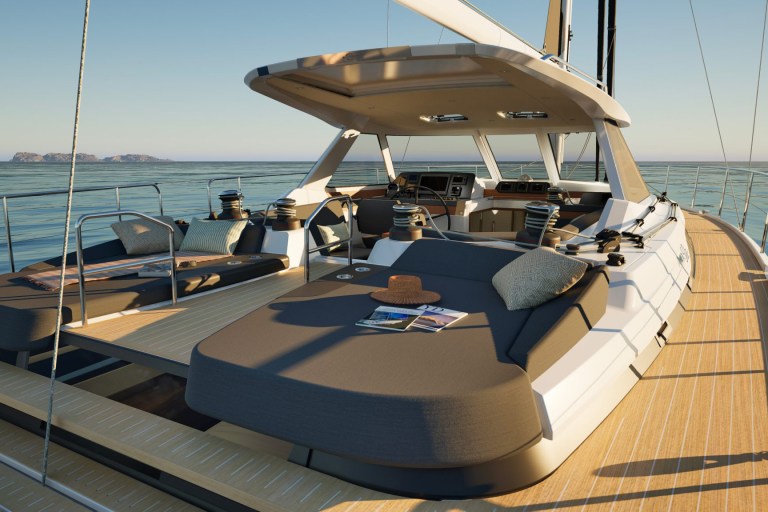
In benign weather, the place to be when not sailing is in the lounging cockpit between the hulls. Two parallel benches seat eight around the table, and their backs fold down to become double berths. A vast icebox in the table ensures that there need be no shortage of cool beverages aboard. A rigid, carbon-fiber arched roof covers this area. Its low profile complements the lines of the boat’s superstructure, but negotiating it when entering the cockpit from aft takes practice. Getting around the side decks would be easier if the roof had a more grabbable perimeter or handrails.
Access between the lounging cockpit and the working cockpit is through a circular opening in the main bulkhead, which can be fully or partially closed with clear plastic panels. The entire lounge area can be enclosed with plastic or insect screens.
For auxiliary power, the M37 has a pair of Lombardini diesels with saildrives. Effective insulation holds their noise down to a comfortable level. Jaspersen chose these engines for their aluminum blocks, which, as well as helping trim the boat’s overall weight, are light enough that they can be easily lifted out of the boat and taken to a shop for service. He will substitute a more conventional brand if a customer requests it.
Jaspersen’s aim with the M37 was to “create a coastal cruising boat with raceboat performance . . . yet be uncomplicated to sail.” He’s certainly achieved the sailing goal, and the execution of the structural work appears first-class. If some of the finish details on the cruising end are a little behind in finesse, perhaps that’s to be expected in a prototype boat of this nature, and it shouldn’t detract too seriously from anyone experiencing the lighthearted fun that the M37 both promises and capably delivers.
Specs
LOA 39′ 6″ (12.04 m.)
LWL 36′ 0″ (10.97 m.)
Beam 22′ 0″ (6.71 m.)
Draft (brds. up/dn.) 2′ 3″/6′ 11″ (.69/2.11 m.)
Sail Area 555 sq. ft. (51.56 sq. m.)
Displacement 6,065 lb. (2,751 kg.)
D/L 58
SA/D 26.7
Water 57 gal. (216 l.)
Fuel 32 gal. (121 l.)
Mast Height 54′ 6″ (16.61 m.)
Engine Two Lombardini 20-hp.
saildrives
Designer Uwe Jaspersen
Price $355,000
Moxie Yachts Ltd.
(908) 837-9562
www.moxieyachts.com
Jeremy McGeary is a CW contributing editor.