japanese sailing 368
Japan has been an alluring yet elusive goal of European sailors since the 7th century, when St. Isidore of Seville described it as “the Garden of Eden, impossible to reach because God has sealed it off with flaming swords.”
My wife, Diana, and I encountered no actual flaming swords, but we did face effective deterrents in sailing to and entering Japan.
In Japan, typhoons are known as kamikaze, the Divine Wind, because twice Kublai Khan tried to invade the nation and twice his fleet was destroyed by typhoons at the critical moment. This wasn’t just poor timing, for Japan has recorded a typhoon in every month of the year. However, from May to September, their likelihood increases dramatically.
Even so, we couldn’t depart from Guam too early, for the North Pacific would still be serving up its gusty gales. By shaping a course toward southern Japan in late March, we hoped to duck under the last of winter’s tantrums and yet still avoid the curse of the Khan. Of course, this strategy relied on our ability to make a fast passage.
The word “frustrated” appears in our logbook several times between our departure from Guam and our arrival in Okinawa 12 days hence, for we experienced two kinds of wind-calm and contrary.
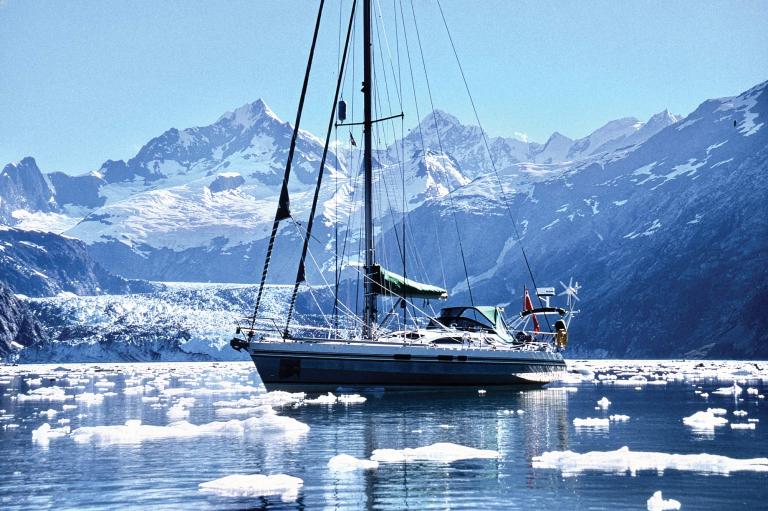
In hindsight, it was perfect training for the Kafkaesque scenario we faced upon our arrival in Naha, the capital of Okinawa. A press of uniformed men swarmed on board our 36-foot steel cutter, Roger Henry. I think they represented immigration, customs, the coast guard, the department of transportation, animal quarantine, the port captain, and perhaps even the public library. I had writer’s cramp before I finished signing the pile of indecipherable forms.
A man in civilian dress declared himself our “agent.” More through pantomime than English, he indicated we were to meet him the next morning at the entrance to Ginowan Marina, just south of Naha. We dutifully did as we were told.
The same horde of officials awaited us there, for apparently, in those scant five miles, we’d crossed a line of jurisdiction and had to officially enter this new port. We were handed a form in English that stated that we were to be either fined the equivalent of US$15,000 for entering a closed port without prior permission or face a possible imprisonment of two years and the confiscation of our boat.
This was a critical moment. I could have reacted with the overt indignation of a Westerner or the quiet acquiescence of an Easterner.
I smiled and I waited.
Something occurred in that silent space. The officials reached for their cellphones as if going for their guns. The cacophony that followed sounded like the floor of a stock exchange. We were bundled into a car and taken to an obscure office to retroactively obtain permission to enter Ginowan. We also applied in advance for permission to enter every port we hoped to visit, detailing specific dates and exact times of arrival and departure. To varying degrees, we faced this in every port for the next three months.
Archaeologists today think that Japanese civilization has existed since at least 11,000 BC. The first Europeans didn’t land in Japan until 1542, when three shipwrecked Portuguese sailors found themselves washed ashore. But it would be more than 300 years before any significant interaction occurred.
Despite its proximity to the turbulent Asian mainland, Japan wasn’t occupied by a foreign army until the end of World War II. Thus, the culture grew insular in layers of complexity that an outsider can hardly hope to understand. The restrictions imposed on cruisers can be seen as the xenophobic remnants of this deep isolation.
But inevitably, behind the barrier of officialdom, quiet civilians would be waiting for a chance to invite us to their home or guide us on a tour of their city.
Diana had done her homework on Japan and had a hit list of areas famous for fiber dyeing, unique pottery, and intricate weavings made from such natural material as banana fibers.
In the ancient alleys of Naha, she explored the 800-year-old kilns that somehow escaped the devastation of Allied bombings. She was a big hit in the Naha open market. Tiny saleswomen snatched her into their shops and dressed her in exotic kimonos. Constantly giggling, they fussed over her like a princess, puffing her hair and adjusting the ceremonial silken belt called the obi. I’ve never seen her look more beautiful. Nevertheless, I didn’t spring for a US$5,000 kimono.
I, too, had studied my areas of cultural interest. The next day, we toured the historic Zuisen Distillery, where from ancient clay casks I sampled awamori, the traditional rice lightning of Okinawa.
As we sailed north from Okinawa through the rest of the Ryukyu Islands, my ignorant notion that all of Japan was an overpopulated industrial wasteland was shattered. We passed tall mountains, deep, verdant valleys, unspoiled jungles, and coral-studded waters.
Hiking through snowcapped mountains on the island of Yaku Shima, a United Nations World Heritage Site, we marveled at towering, 2,000-year-old cedars. We watched shy deer sneak through the forest and wild monkeys groom each other in the bush. Without success, on Kakeroma Jima I searched for the famed and feared habu, a poisonous snake.
In the town of Naze, on the island of Amami O Shima, a man on a bicycle waited patiently on the seawall above us. When the officials departed, I invited him down for tea. He was clearly pleased. The next day, he drove up in a car, opened the passenger door, and motioned for us to get in. We had hardly a word in common, but Mr. Shabata wasn’t uncomfortable with long silences. As we drove to the north end of the island, he let the sweeping beaches and craggy cliffs do the talking. He was proud not only of his island’s beauty but also of its place in Japanese culture and history. He led us into an art museum to see the work of the native artist Tanaka Isson. When Diana showed sincere enthusiasm for Isson’s work, Mr. Shabata positively beamed.
In our encounters with the unanimously gracious Japanese, I’m sure we did nothing to dispel the historic notion that Europeans are basically barbarians. We stumbled often in matters of etiquette. Because we neither speak nor read Japanese, we had to deduce much and improvise often.
In ports on Kyushu and Shikoku islands, we took to following the local tuna fishermen at lunchtime down narrow lanes and through split-curtain entrances into what turned out to be affordable specialty restaurants. I thought I began to recognize the telltale symbols for soba or udon noodle shops until one day I walked smack into someone’s living room and made a chopstick-like motion indicating that I would like to eat. I’m sure if I hadn’t recognized my embarrassing mistake, the surprised woman would have fed me.
We were quickly forgiven, patiently instructed, but then tested again, for, above all, manners matter.
We toured the 15th-century castles of Shurijo and Obi, and they were grand. But it was the Shinto shrines that we sought out most. Their history is fascinating and the architecture stunning, but it was the pious and peaceful environment created within those ancient walls that touched us deeply.
From the port of Tosashimizu, on the beautiful island of Shikoku, we took a bus to the Kongofukuji temple. At the torii, or entrance gates, we joined a long line of pilgrims dressed in traditional white smocks and conical hats and carrying ceremonial staffs. For a thousand years, pilgrims have walked the 1,000-mile route connecting all 88 sacred temples.
We passed silently under two giant statues of fierce deities into the inner courtyards. There we stopped at a fountain to perform a traditional ceremony. We washed our hands, took a sip of water, and offered a symbolic sip to the patron spirit, which may be a turtle, a frog, or a bird. Diana lit aromatic incense in an enormous bronze urn while I threw a donation of coins into a gilded tray.
Though most of the shrines were Shinto, we learned much about Buddhism, for the two religions don’t exist so much side by side as one superimposed upon the other.
On that theme of one system imposing itself upon another, in 1853 Commodore Matthew Perry of the U.S. Navy sailed a fleet of black gunboats into the port of Shimoda on southern Honshu and “negotiated” the opening of Japan to American trade, thus abruptly ending 300 years of isolation.
One would think that the mood regarding this day of infamy would be as black as Perry’s ships, but the occasion is widely celebrated. We sailed into Shimoda under banners depicting Perry’s arrival and docked in front of the memorial of the treaty signing. Even the manhole covers in the streets were cast with images of Perry.
Shimoda was perhaps the prettiest town we visited, with its bridged canals and beautiful temples draped in blooming hydrangeas. But unfortunately, the crowded port offered no safe mooring. When a typhoon approached from the south, we decided to race it north and seek better protection. As the Japanese coast is littered with unlit fishing nets, night passages aren’t recommended. However, we chose this as the lesser of two evils and set out at dusk in brisk airs for Aburatsubo, in the Sagami Gulf.
The iconic Mount Fuji appeared above the clouds in the crimson light of dawn. A Japanese proverb urges that one should “aspire to be like Mount Fuji, with such a broad and solid foundation that the strongest earthquake cannot move you.” I wondered if that included typhoons.
Just as our barometer began to drop, we inched our way down a narrow entrance that doglegged into a keyhole-shaped bay. Aburatsubo has the reputation as the best typhoon hole in Japan, and we couldn’t have been more relieved when we dropped our lines on the inner dock of Misaki Marina.
As tired as we were, sleep wasn’t an option. Takumi Futamatsu, the vice commodore of Aburatsubo Yacht Club, greeted us with a bouquet of flowers, club shirts, a tour of the town, and a sumptuous sushi lunch. I was grateful, but I was anxious to get back to the boat until Takumisan showed me the latest weather printouts. They predicted that the typhoon would track safely out to sea.
With another typhoon moving slowly up the coast, we were reluctant to push on to possibly inferior harbors. This seemed an ideal time and location to haul Roger Henry out of the water for some much-needed maintenance.
Mr. Futamatsu is a dignified and formal man who can trace his family name back through an astonishing 74 generations. Nevertheless, he appeared at the boatyard the next morning dressed in a pair of overalls and insisted on helping me haul, scrape, and paint the bottom of my boat.
Too often I have subjected Diana to living onboard while on the hard with grinders screaming and dirt flying. I agreed it was a convenient time for her to take a train to the historic city of Kyoto, recognized as the cultural and artistic center of Japan. Alone and speaking no Japanese, she intrepidly set out to research the ancient art of indigo dyeing.
Apparently the city was a cultural cornucopia, for Diana returned in a state of near euphoria and loaded down with treasures. Soon after, we jumped the bullet train to Tokyo to rendezvous with Yoshio and Akemi Amanuma, two accomplished sailors we’d met near Cape Horn many years ago.
Although still young and robust, Yoshio had suffered a stroke. He was rendered partially crippled and nearly speechless. Akemi had been forced to sell their beautiful yacht, move into her elderly parents’ house, and tend to Yoshio constantly.
Over an extravagant traditional dinner, Akemi explained that her father, Kensan, had just retired at the age of 94 from his trade of handcrafting specialty light bulbs. His age didn’t seem to temper his enjoyment of superb sake, for he wouldn’t allow either his or my glass to lay empty for even a moment.
Akemi’s 87-year-old mother, Masua, decided to retire from teaching because she was simply too busy with other things. Among those things was her practice time on the shamisan, a traditional three-string instrument strummed with a turtleshell implement. Masua sat gracefully on the floor and in a slight trill sang several traditional songs for us.
Then she jumped up nimbly, dashed out of the room, and returned with a gift for Diana: an antique kimono of enormous value. To refuse her gift would be the height of rudeness, yet we were reluctant to accept. The Japanese penchant for overwhelming generosity is similar to the Polynesian custom called fakamolemole; a guest there dare not even compliment an object lest the host immediately offer it as a gift.
On the train heading back to Roger Henry, I thought of Yoshio and was reminded to make our miles, both figuratively and literally, while we could. We had many of those miles yet to make, so we decided to sail directly from Aburatsubo across Tokyo Bay and up the coast of Honshu, the largest and most populous of Japan’s 4,000 islands.
Diana and I have dodged the graybeards off Cape Horn and the icebergs of the high Arctic, but we’ve never faced navigational hazards to match the shipping in Tokyo Bay. An unbroken flow of fast-moving traffic parades in and out, day and night. To cross it was like running across an eight-lane freeway.
I detected a gap and thought we might be able to squeeze through off the stern of one ship while hoping to avoid the bow of the next. As we entered the valley of death, a fishing boat dashed at us head-on in a game of chicken, swerving away at the last moment. It was a long night.
Our effort was well rewarded when we beam-reached into the port of Ishinomaki. The news of our welfare and whereabouts seemed to precede us up the coast, passed from sailor to sailor. We rafted up to the Bristol Channel Cutter Freelance III, which was decorated with a sign that said “Welcome, Roger Henry.”
Koichi Ohmura, the owner, rowed out to our boat with food, gifts, and an invitation to his home. We thought he meant for a brief visit, so we brought only a bottle of New Zealand wine as a gift. But he and his shy wife, Yoshiko, assumed our stay would be for the night at least.
Never mind our lack of clean clothes; they already had our kimonos laid out next to wooden sandals, for outdoor shoes aren’t worn in a Japanese home.
While Koichi prepared some specialties for dinner, Yoshiko took us on a tour of her garden. No people on Earth revere nature more than the Japanese-that is, once they’ve bent it to their will. The sculpted gardens were a model of symmetry and perfection. If you see a pebble beneath a bush, rest assured that it’s meant to be there.
As to the food, glorious food, the Japanese like to eat with their eyes. Yoshiko presented us with a work of edible art. I can sincerely say that we have never so enjoyed the ceremony of eating or feasted on such flavors.
We sat on the floor around a low table, Koichisan happily sipping sauvignon blanc while Diana and I enjoyed dry sake. We broiled thin strips of pork, beef, chicken, seafood, and vegetables over a hibachi and sampled pickled ginger, marinated beets, shredded daikon radish, salted plums, and fermented soybeans.
We talked into the night about sailing and travel. Koichi brought out his photo album of boats past. When our words in common failed us, the pages of the dictionary fluttered like cherry blossoms. As a last resort, we drew little pictures to explain ourselves.
Koichi is a teacher, or sensei, of the ancient art of hand-making soba noodles. He promised to take Diana out to his studio in the morning and instruct her.
Finally, we retired to our simple yet elegant room. Less is more in Japanese decor. The floor was paneled with tightly woven straw mats called tatami. Sliding rice-paper doors made up two of the four walls. At one end was the family shrine with photos of generations past, a single flower, and an incense burner; at the other was a futon on the floor and a clothes rack, the only furniture in the room.
Koichi explained that the sword placed across my pillow was an ancient courtesy extended to honored houseguests. The rice-paper doors were left slightly open on either end of the room to assure a fast escape in the event of unexpected treachery. In this way, a guest can sleep in peace.
After several hospitable days spent touring northern Honshu, we hoisted the mainsail and sadly left these fine people.
The Kuroshio, or Black Tide, Current ranks as one of the strongest in the world. It flows north for almost the entire length of Japan and can be a boost to those sailing its way, but when opposed by the wind, it has a reputation for kicking up steep and dangerous seas. Perhaps more dangerous, just like the Gulf Stream, the warm current conveys typhoons north to latitudes they might otherwise not reach. As we sailed north, we monitored the weather carefully and plotted out hiding holes and fallback plans. Our options were many: Faced with these ubiquitous typhoons, the Japanese government has fortified every coastal village, however small, with a stout breakwater.
The Kuroshio gave way to the contrary Oyashio Current, and it took several days of difficult navigation though fog to reach the port of Kushiro, on the northernmost of the Japanese big islands, Hokkaido.
Although very much a part of Japan politically, Hokkaido is different. It’s home to the Ainu, an ancient indigenous group pushed north by an influx of people from China, Korea, and possibly Polynesia, to Hokkaido, a land considered too remote and cold to be of much value.
There was little contact between the Ainu and the Japanese until the late 1800s, when trade relations led to mass migration from the south. It wasn’t long before the majority Japanese government began the systematic suppression of Ainu culture. Economic disenfranchisement and the social decline of the Ainu soon followed. Although the world spotlight was focused on these inequities during the 1972 Winter Olympics in Sapporo, it’s taken the ensuing decades to restore a prideful identity for the Ainu and to achieve some social parity.
In Okinawa, I’d spent two days helping a spirited but inexperienced Japanese sailor named Yasuo. He explained that he’d left his wife, Hideka, and young son behind in Hokkaido to pursue his dream of sailing around the world on his Island Packet 29, Eternity.
We telephoned Hideka from the docks of Kushiro. She raced down with their handsome 6-year-old son, Yujin. She wined and dined us relentlessly and took us inland to see an Ainu village and into the central marshes to view the rare and revered dancing crane, the tancho.
Hideka asked if I’d stand in for Yasuo at the father/son day at Yujin’s school. I can proudly announce a first-place ribbon in the giant-ball race.
On our last day in Japan we watched-or, more accurately, felt-a team-drumming competition on the dock right next to our boat. Enormous ancient drums thundered out a bass beat while smaller drums drove toward a crescendo of complicated rhythms. The lesser teams were outstanding, and the best were sublime. The focus on perfection and the discipline, dedication, and teamwork somehow embodied all the finest qualities that we’d seen in the Japanese throughout our cruise.
We could hardly tear ourselves away from this exotic land. But we faced 1,300 miles of rough ocean just to reach the outer Aleutian Islands and another 1,300 to find a safe winter haven on the Alaskan mainland. We decided to set sail from Hokkaido on July 10 even though the port was shrouded in thick fog. Ships bore down on us bellowing out warnings, and hidden rocks slid too closely by. The contrary Oyashio Current thwarted our progress. Getting away proved as difficult as it had been to enter.
The next day, one of the remote Kuril Islands momentarily appeared out of the fog. At that point, from its southern to northern tip, we’d spanned the Land of the Rising Sun. Japan isn’t a postcard cruising destination in the normal sense. The winds are confused; the typhoons are as numerous as they are dangerous. Due to many official restrictions, the spontaneity of cruising is all but lost.
And yet we’d sail through those legendary flaming swords and hurdle twice the bureaucratic barricades to see that “Garden of Eden” again. Even with three months of energetic effort, we missed many of our areas of interest. Next time, we’ll sail the emerald islands of the Inland Sea, revel in Tokyo’s frenetic nightlife, attend a traditional Kabuki play, participate in the stylized tea ceremony, and ski the legendary powder of Sapporo.
We approached Japan with open hearts and minds. Daily, we were confronted with and challenged by a culture as old as ours is young, as communal and controlled as ours is individual and free. The beautiful lands, the exquisite cuisine, the ancient culture, the stunning architecture, and the traditional arts of Japan transported us. But more important, we were deeply touched by the overwhelming honesty, hospitality, and generosity of the Japanese people.
We humbly bow and say, “Domo arigato gozaimasu.” Thank you very much.
Alvah and Diana Simon are sailing Roger Henry from the Pacific Northwest to New Zealand.