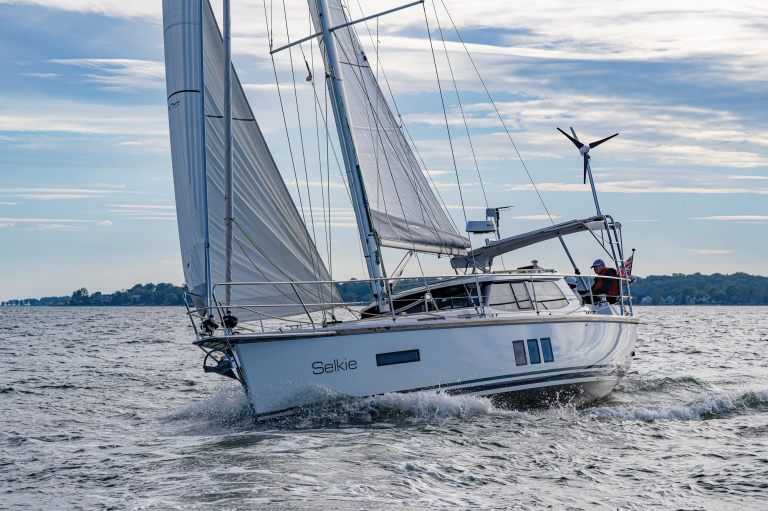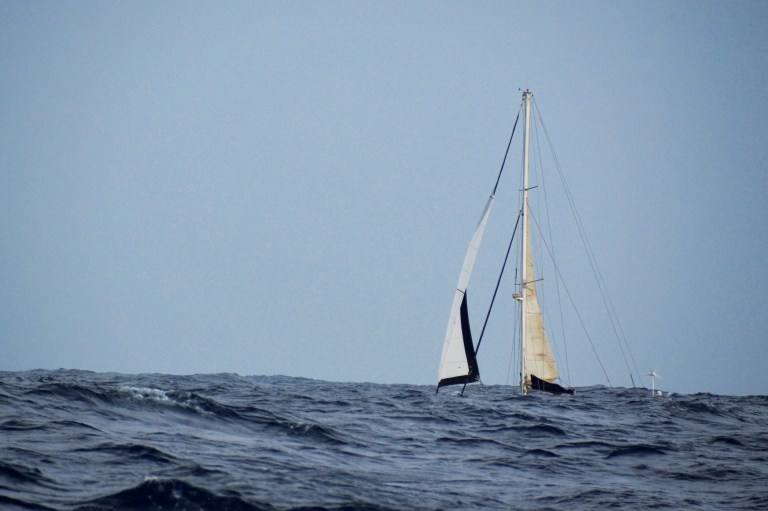
I found my sea legs on Friday, November 6, 2020. It was day four of our passage from Put-In Creek, Virginia, to Antigua. Some 750 miles from land, we had left behind the stress of U.S. politics, COVID-19, and the world as we knew it. I felt good.
During the next five hours of my night watch, from 20:00 to 01:00, I checked the sails, instrument readings, weather and sea state every 15 minutes. After completing my 360-degree visual sweep, I hovered over the radar screen, scanning AIS for nearby vessels. Then, I peered into the bilge, all while my captain, Michael, slept.
In between my watch duties, I opened my computer for the first time while sailing. I’d forgotten to take my seasickness medication, and to my surprise, I wasn’t nauseated by the screen. That’s when I realized something inside me had shifted.
The point was to change. Wasn’t it? In a novel, the main character is transformed by the journey. And after all, I was on the journey of a lifetime.
In the beginning, I felt like a fish out of water. Even though I had earned my U.S. Coast Guard captain’s license and had been cruising the East Coast with my husband for five months, a profound sense of impostor syndrome came over me in the weeks leading up to the start of our Salty Dawg Rally. Michael felt at home in the group. He grasped the complicated weather GRIBs and routing plans discussed ad nauseum on video calls. I, on the other hand, felt overwhelmed. I was convinced the other participants were elite sailors, and I was just a nurse with a sense of adventure who loved and trusted her husband. Regardless, we were going to Antigua, with or without my confidence.
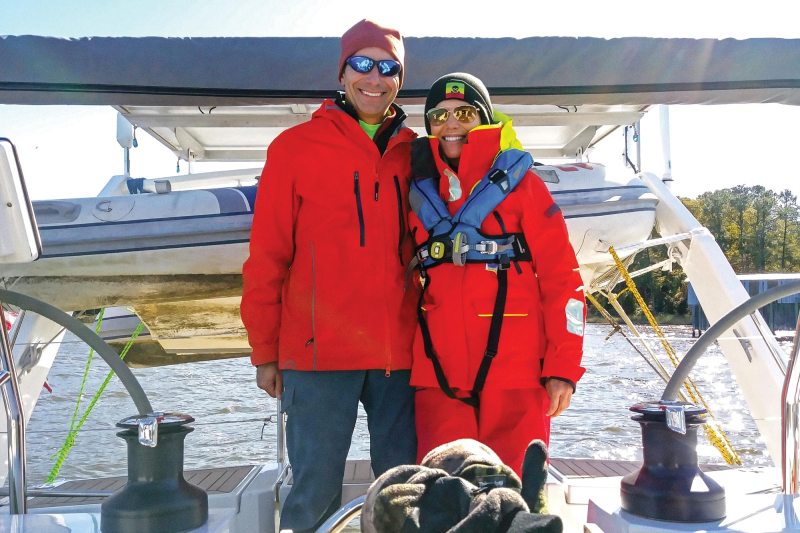
Departure day was frigid, but sunny. We suited up in bulky gear and snapped a photo. We laughed at our bundled selves and gave in to the thrill of raising our anchor.
Gerty, our Allures 45.9, liked to sail downwind in 20 knots or more, so we set sail on the back of a west-northwest blow and tore out of the Chesapeake. A full moon lit my first night watch, calming me enough to nibble on granola bars after I’d had trouble keeping my dinner down. With some nourishment, my synapses started firing, and I remembered everything I had never really forgotten about how to sail our boat.
When the sun rose, all was well until Michael tried to pole out the jib. The pole swung across the foredeck and smacked him in the forehead. I watched the accident unfold from the helm, and saw a bump over his eye rise and split open from 15 feet away.
Please don’t pass out and fall off the boat, I prayed.
Seeing that he was conscious—and remembering that he was tethered—I held my breath. He steadied himself, made eye contact with me through the dodger window, mouthed “ouch” and continued setting up the rig.
We owe a debt of gratitude to the dolphins that welcomed us into the Gulf Stream after the mishap. Their joyful energy lifted our spirits. With 13,000 feet of water beneath us and the ocean stretching infinitely in every direction, we couldn’t help but wonder: How did they find us?
We marveled at the color of the water. I described it as what a crayon company would call Ocean Blue. I imagined my 5-year-old self plucking it from a classic two-tiered box.
We also praised Michael’s decision to lash the dinghy to Gerty’s arch instead of the foredeck.
“It’s totally secure,” he boasted, and I agreed.
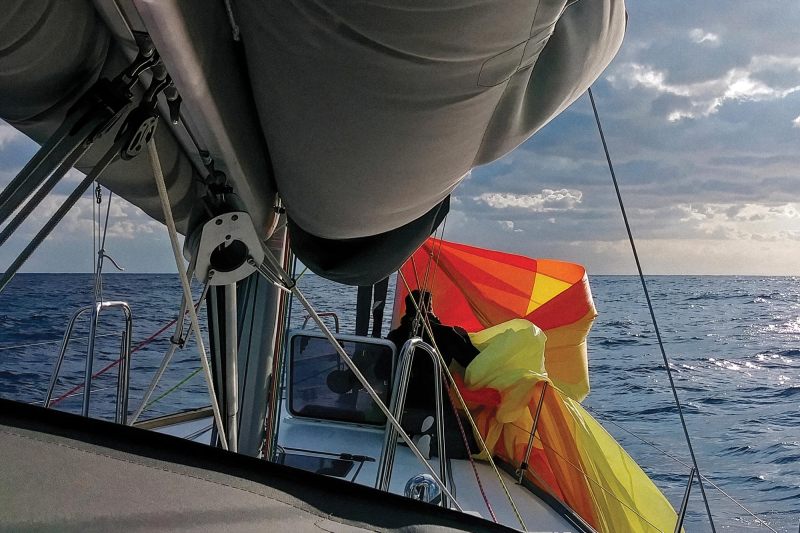
As we turned south, the wind eased to 12 knots from the northeast. We raised our sunset-colored spinnaker—Gerty’s Happy Sail—and settled into a beam reach.
But not two hours later, we heard a bang.
The sail had torn from head to tack along the luff. Again, Michael tethered to the jackline and made his way forward, gathering the shredded sail and stowing it in the locker. We mourned its loss.
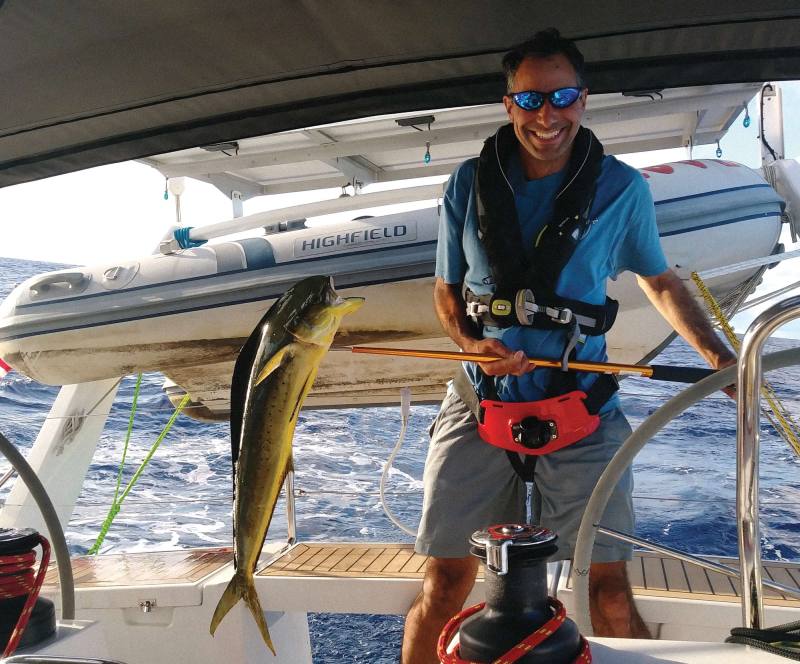
A chance to see a rainbow unobscured by land is reason enough to make the bluewater passage to Antigua. That, and the possibility of catching a mahi. Imagine a neon-green, iridescent fish so beautiful that it’s painful to watch it die. Michael caught a big one, and for the first time in my life, my food meant something to me.
After dinner, stars scattered across the midnight sky, and I knew the trip was worth the leap of faith we’d made.
That night, Friday, November 6, was the calm before the storm. Because as the wind clocked to the beam, a squally, windy, wavy and drastically heeling world would become our home for the rest of the passage.
I remember a cacophonous symphony droning on and on in the salon. The rhythm section—cabinet creaks, dish squeaks and rattling silverware—played endlessly, interrupted only by our slamming V-berth stowage cover. But what I dreaded most was the absence of sound. Silence meant Gerty had been launched off a wave and was about to crash violently into the sea. During those airborne moments, I levitated above the settee, my hysteria peaking. Sometimes I jumped up and rushed to the companionway, only to be blown back inside by the roar of the wind and sea.
By day five, we were exhausted, and Michael, a captain who knows his audience, suggested we heave to. The maneuver would keep Gerty in a holding pattern and allow us to rest at a cost: We would lose some precious easting we had worked so hard to make. Still, it was a sacrifice we were willing to make because we needed a break and a shower.
Unfortunately, as soon as Gerty leveled, her bilge alarm sounded. I checked the forward bilge. Six inches of water. I didn’t panic. I tasted it, as I had learned to do. It was salty. We were sinking. So, I cried.
The 30 seconds it took Michael to assess the situation and explain that we were not in danger were too long. I was giving up. But giving up on a bluewater passage is akin to giving up halfway through childbirth. It’s not an option.
Our ship’s log tells a tale of putting in and shaking out reefs all night. We sailed through steep seas, opposing currents and relentless squalls. What I remember now is waking up clean for my morning watch on day six, and hearing Michael shout something over the din, words I’ll never forget: “I couldn’t have done this without you! We’re almost there! We’re gonna make it! I love you, Jill!”
He was right. We were going to make it. And I loved him too.
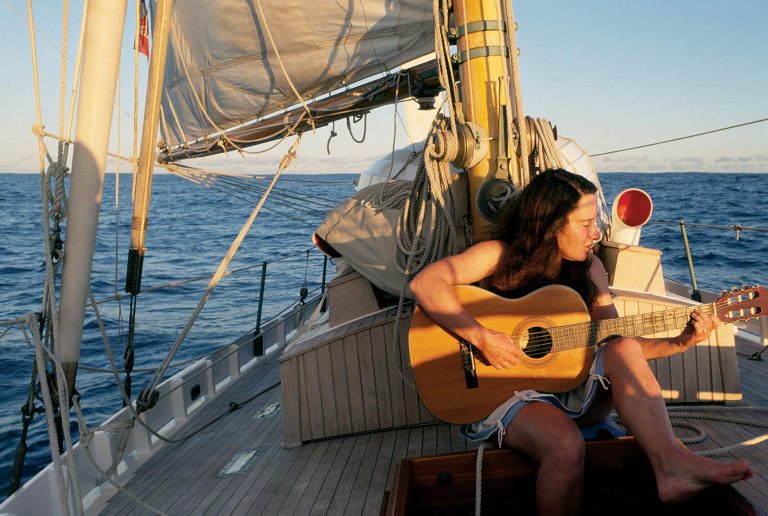
When he went to sleep, I scrambled to find my noise-canceling headphones. I stood alone in our drenched cockpit, shrank the routing app and enlarged the music app on our waterproof tablet. Then I pressed shuffle—and of the hundreds of songs in our library, the powers that be chose Billy Joel’s Getting Closer.
Jill Gallin and her husband, Michael, have sailed more than 25,000 nautical miles since their maiden bluewater voyage to Antigua. Follow their journey at svgerty.com.