Peter Kampmann
Menudo marineros—which roughly translates to “crap sailors”—is what a local Spaniard called us during one of our first docking attempts aboard our new catamaran. This was less of an insult than a statement of fact, given that my wife, Veronique Bardach, and I had managed to drop two fenders and nearly impale our pristine hull on the corner of the pier while docking in heavy winds at Ibiza. To say that we knew little about sailing at the time would be to overstate our abilities by half.
Fast-forward nine months. Veronique and I have just set off on an Atlantic crossing with only our female dog, Ria, as crew. We’re reasonably confident that we’ll make it to the other side without significant damage to boat or body. The intervening nine months spent cruising around the Mediterranean were a nonstop learning experience that taught us more than we could’ve imagined—often the hard way—about cruising, about ourselves, and about human nature.
My part of the story began about five years before, when I was 35 years old: I suddenly became fascinated by the appeal of long-distance cruising. I knew next to nothing about sailing, but the intuitive draw of life at sea seemed irresistible. So I signed up for a weeklong liveaboard-sailing course in the Virgin Islands, which taught me just enough to be dangerous and somehow sufficed to establish my credentials with charter companies. Over the coming years, I chartered in the Caribbean on three occasions and borrowed a friend’s monohull to sail on the Chesapeake for a few weekends. But I was still very far from my goal of circumnavigating. Indeed, I hadn’t even found my partner in crime.
Veronique entered my life like a bolt of lightning. Born to French parents, raised on the island of Mallorca, and having pursued her career in the United States, she embodied the best of all three cultures in a way that continues to melt me. Yet I had my work cut out. Early on, Veronique announced unequivocally that she had no interest in marriage and that she’d never go sail around the world. Getting her to the altar took all the charm I could muster, but getting her interested in sailing, I found, required altogether more craftiness.
We began by chartering a monohull for a week in the Virgin Islands. Her objections to the constant heeling and cramped quarters led me quickly to suggest we try a catamaran next, a concession sufficient to win her approval of another warm-water charter the following year. In the meantime, I gently chipped away at Veronique’s resistance by appealing to her own deep-seated thirst for adventure—she’d worked as a venture capitalist, after all—and by reminding her that there’s no time like the present.
Our two weeks of Caribbean chartering fooled us into believing that life at sea is all fun and games. The typical charter experience can be wonderfully deceptive in this way, by concealing many of the challenges of full-time cruising. Blinded by our ignorance, we made the big decision early in 2007 to set off cruising as soon as possible. Still on the somewhat lengthy to-do list were to buy and equip the right boat, gracefully exit from the respective companies that we’d founded, sell our house, and, last but not least, find a worthy four-legged travel companion.
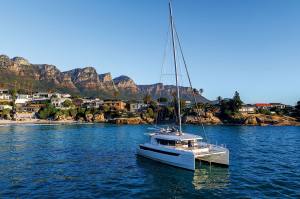
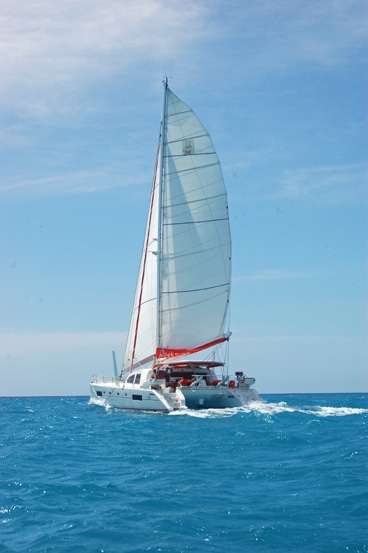
Roughly a year later, in March 2008, we arrived in Canet-en-Roussillon, France, to pick up our new Catana 50 catamaran. We had in tow 71 boxes and a fabulous bulldog we’d named Ria. We christened our new home Vérité, not because we have any particular claim on the truth but because of the play on the first two letters from our three names.
In our haste to prepare for our trip, we found little time to improve our distinctly subpar sailing skills. In our first weeks on board, Veronique provided near constant entertainment with such repeated inquiries as “What’s the boom?” and “What do you call the left and right sides again?” My knowledge wasn’t much more advanced. I had no experience sailing or anchoring in heavy weather, didn’t know what an impeller was, and had no idea how to fly a spinnaker. We took in as much as we could during one week of commissioning at the yard and a subsequent week of onboard training by an excellent skipper, who thankfully agreed to serve as our “boat coach by phone” thereafter. And then, suddenly, there we were, by ourselves aboard our new floating home—and clueless as could be.
Our trial by fire began immediately in the Balearics, with days on end of sustained winds over 45 knots and seas to match; these led in no time to a bent anchor shaft and a torn solent jib. I was pleased to see how well Vérité sailed upwind in 45 knots, thanks to her long daggerboards, but I was a little concerned when a very seasick Veronique threatened mutiny on the part of the female crew—which, as she pointed out, represented a two-thirds majority—unless we switched to different angles of sail. When we reached our destinations in those big winds, we couldn’t decide which frightened us more, the possibility that our anchor might drag in the middle of the night or the maneuvers required to back our 50-footer in a gale to tie stern to in a tight slip.
Over the coming months, we faced several close calls, including nearly hitting a car ferry in Montenegro, dragging anchor during 55-knot gusts in a very crowded anchorage in Mikonos, Greece, and hearing three of our four davit lines snap loudly at the same time, leaving our dinghy inverted and barely attached while we were under sail at night in heavy seas.
The more the miles slid by, the more we learned—and the more naïve many of our early assumptions proved to be. For instance, it took only our first long passage—from Mallorca to Tunisia—to disabuse us of the idea that Egypt would be our next stop and to hammer home the reality of how long and exhausting passages can be. We also learned the hard way that Mother Nature has a strong opinion about course selection and that trying to sail long distances upwind is a fool’s errand. Of all our misguided assumptions, however, the one most mercilessly debunked by reality was that buying a new boat would be much like buying a new car: Sure, we’d need to do some routine maintenance, but beyond that, we could count on relatively trouble-free operation for the first few years. How wrong we were.
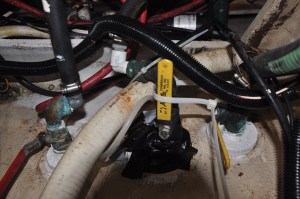
Here’s a brief list of what needed fixing or replacing in our first months of sailing: the saildrives on both engines; the starboard spreader shroud supporting our mast; the primary motor on our desalinator; our dive compressor; our anchor, which bent; our catwalk; virtually every element of our marine electronics: chart plotter, radar, speedo, VHF; our BGAN sat-com system; one engine tachometer; our main halyard and topping lift; the drum plates on both roller-furlers; one of our gel batteries; our washer-dryer; and three leaks, one of which took months to diagnose. While all were covered under warranty, the challenge of finding the right parts and technicians in each new location was exhausting. Just try, for example, importing a gel battery into Tunisia.
Confronted with so many repairs from the get-go, the image that kept coming into my head was that of Sisyphus, the Greek mythological figure condemned to push a big bolder up a hill every day only to watch it roll back down each night. It was of no use to complain to our family and friends back home, as they had zero sympathy and were certain that our days consisted of little more than sipping martinis on sun-drenched beaches. Surely, we thought, our incessant boat problems must be an anomaly; we must be the victims of terrible luck. However, as we began meeting other long-distance cruisers, we discovered that our experiences were actually par for the course with a new boat and that several had it even worse. Still, these were dispiriting times aboard Vérité.
Our turning point came roughly four months into our cruising life. It certainly helped that we’d reached warmer waters, allowing us to swim and kiteboard regularly, and that we’d settled into a comfortable rhythm, no longer pushing ourselves so hard in terms of distance. The most important ingredient, however, was a certain mental reprogramming. For me, much of it came down to making peace with the never-ending list of repairs and maintenance by starting to see these less as nuisances and chores and more as challenges and a hobby. Necessity being a powerful motivator, I soon discovered that I could actually fix many of the problems myself—and that figuring out how could even be fun.
Our time at sea has also proved wonderful for our life as a couple, contrary to dire warnings from friends back home who feared that cohabitating 24/7 in a tight space could be too much, even for newlyweds. Back in Washington, D.C., we were consummate workaholics, too often dedicating our weekends and evenings to our careers rather than to each other. Our new life, in many ways, is the mirror opposite. Although we each still work part-time from the boat, the opportunities for play, intimacy, and mutual discovery abound. In addition to teaching us to function effectively as a team, life aboard provides something all too rare: the time and space to really enjoy each other. None of this is to say that arguments or disagreement don’t arise; they do. But the close quarters teach us to resolve differences far more rapidly. There is, however, one realm on which we’ve agreed that the normal rules of romance and civility shall remain suspended due to extenuating circumstances: anything said in anger during a docking maneuver.
Ria contributes immeasurably to our adventure and doubles as our social secretary and alarm system. Without meaning to, she provides constant amusement, such as when she takes it upon herself to protect us from a swarm of menacing dolphins who otherwise would surely sink the boat. She also helps set our daily pace by requesting frequent walks, in exchange for which she volunteers to pre-wash all dishes. We have her to thank for countless introductions, as many locals we meet are initially far more interested in her than us.
An unexpected benefit of our trip is how it has renewed our faith in human nature and, especially, in cruisers. Coming from U.S. big-city life, where you hardly know your neighbor, we’ve been overwhelmed by the spirit of generosity that pervades the cruising community. On countless occasions, fellow cruisers have come to our help when we’ve most needed it, teaching us how to solve our latest problem or lending us just the small piece we lacked. The epitome came when we hauled out in France to redo our anti-fouling. Due to the weather conditions, we had to paint on a weekend, when no yard workers were around. Yet somehow we were joined by six volunteers, people whom we’d literally just met, and they toiled with us for nine hours. I felt a bit like Tom Sawyer, with the exception that he probably didn’t treat his fellow painters to lots of wine, cheese, and pâté.
Our favorite cruising grounds in the Mediterranean were the pristine fjords of Croatia and the plentiful islands of Greece. Indeed, the medieval town of Dubrovnik may well be the single most beautiful anchorage in all of Europe. Meanwhile, the Greeks have sociability built into their genes, and several local fishermen adopted us during our stays in remote anchorages, making our time in the Aegean all the more memorable. Far sooner than we would’ve liked did winter begin its steady march, and it was time to turn back east for Gibraltar.
Our toughest decision preparing to cross the Atlantic was whether to undertake it alone or with crew. Caution argued for the latter. Yet we knew that we’d be much happier on our own, and by this time, we’d built up just enough confidence in our sailing skills to try it solo. While several books describe the standard Atlantic passage as a milk run, our crossing was anything but. Our wind meter clocked gusts up to 51 knots, and the waves regularly exceeded 25 feet. Vérité held up wonderfully. But the passage was a little tough for Veronique, who was too often in the grips of mild but persistent seasickness. Yet she soldiered on in style, and she somehow found it in herself to produce one gourmet meal after another that would make her French ancestors proud.
My own spirits were high throughout the crossing; my dominant emotion was awe. I was in awe of the power of the elements pounding around us; I was in awe of the perpetual-motion machine on which we sailed that could travel from one continent to another on wind alone; and I was in awe of the generations of mariners who’d made this trip before, without the modern conveniences of GPS or autopilot. There were also the occasional moments of fear in the dark of night when the waves and winds were at their height and Vérité felt like a cross between a freight train and a bucking bronco. Those were the times that I felt most alive.
We made landfall in St. Barts on December 28, after 16 days at sea. Our arrival in the Caribbean was a microcosm of our first nine months of cruising: a little painful at the outset, but increasingly blissful over time. In the middle of our first night anchored in St. Barts, a large powerboat dragged onto us, causing damage to our bow. We’d made it across the Atlantic without incident, only to get hit upon our arrival in a safe harbor. Go figure. But then everything started looking up as we indulged in several nights of parties, including an all-night dance fest aboard Octopus, the megayacht owned by Mircrosoft co-founder Paul Allen. Note: The onboard submarine is about the size of Vérité. Everyone was celebrating the New Year. Veronique and I were also celebrating the end of the first of many chapters in our cruising life.
Ted Halstead, an author and public speaker, set sail on Vérité in March 2008 with his wife, Veronique Bardach, and their dog, Ria; the goal was a circumnavigation. They’ve spent time in the Med, the Caribbean, and the South Pacific. Currently in Fiji, Vérité is headed next for Indonesia.