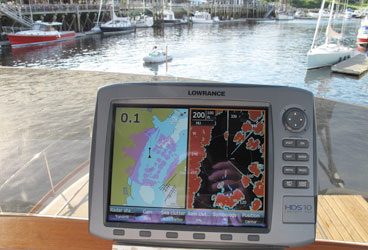
Ben Ellison| |Broadband Radar comes into its own in close, targeting an inflatable and moored boats when set at a range of 200 feet.| If your knowledge of radar performance is based on experience with older, fully analog scanners, fuggetaboutit! The modern incarnations of the 18-inch radomes, so favored by sailors because of their compact size, are somehow defying the limitations that used to dog this class. I say “somehow” because the magic going on under the domes is a complex stew of software, digital signal processing, and tweaked subsystems that isn’t accurately reflected in once fairly definitive specifications such as horizontal beam width and transmit power. In fact, there are no comparative specs whatsoever for new radar-branding terms like Digital, High Definition, Ultra HD, Super HD, and the like. And the magnetron-free Broadband Radar introduced by Navico last winter, the BR24, which is available under the Simrad, Lowrance, and Northstar brand names, is off-the-charts different.
Across the board, all the modern 18-inch radomes work better than their predecessors-and Broadband is truly different-but you can’t really grasp how much better, and how they diverge from each other, until you see a lot of them in real-world action. Which is pretty much what I did all last summer.
The original project was to test the novel Navico Broadband Radar BR24 solid-state radome. Two months later, I’d mounted it at 22- and 14-foot heights on my 37-foot Downeast cruiser, Gizmo, as well as just 5 feet off the water on an outboard-powered catamaran, and I’d monitored its target output on both Lowrance HDS-10 and Simrad’s NX45 multifunction displays. I’d also equipped Gizmo with Raymarine’s new “Digital” RD418D radome connected to a C140W display, figuring that it would provide an ample performance comparison between its traditional magnetron vacuum tubes and Navico’s new-fangled solid-state circuitry. But when I saw how well it compared and how much help both radomes provided in this season’s abundant Maine fog, I had to also try the latest radome/multifunction display combinations from rival manufacturers Garmin and Furuno.
As Labor Day fades away, Gizmo is earning its name rather splendidly, sporting four radomes, including Raymarine’s spanking new 18-inch HD, and four multifunction displays, including Simrad’s brand new MFD, the NSE 12. I’m not done testing yet, and I’ve already learned way more than can fit into one article. So let me focus now on the BR24, which has some especially noteworthy qualities for power-conscious sailors. In January we’ll look at the overall radome feature/performance competition. But in the meantime, here’s a teaser: Some 18-inch domes now offer display and tracking aids normally seen only on ship radars and/or useful 3D radar overlays never seen until recently. For ongoing testing notes, log on and visit my electronics blog (www.cruising
world.com/panbo).
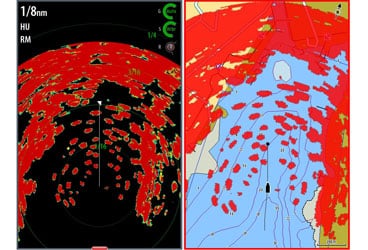
Ben Ellison| |When it’s set at 1/8th of a nautical mile, it’s easy to spot boats moored in the harbor at Rockport, Maine, with Simrad’s BR24 radome and the new NSE 12 display.|
The BR24 demonstrates its very unusual nature in the few first few seconds it takes to switch from dead off to Standby, and the second more it takes to Transmit and paint targets. Navico reasonably calls the feature InstantOn, and any sailor who’s struggled with the shut-it-down-to-save-juice/keep-it-on-for-safety conundrum will appreciate it. Modern magnetron radomes do go from Standby to Transmit nearly instantly, but they typically take over a minute to warm their tubes into Standby mode and consume about 15 watts just sitting there and about 25 when transmitting. The BR24 draws about 18 watts transmitting and 7 watts in Standby, by my measure, and it’s reasonably prudent to shut it down most anytime, thanks to InstantOn.
A side note for power misers: Unfortunately, the mighty MFDs that display modern radar can take over a minute, even 2 minutes, to boot up, depending on chart types, attached gear, and software. Two trends, though, are making it less battery draining to leave MFDs running. The pleasingly bright screens on both the Lowrance HDS and the Simrad NSE series use more power-efficient and cooler-running LED backlighting instead of cathode tubes. And both the NSE and Furuno’s NavNet 3D MFDs have sleep modes that reduce power use sharply but can switch back to life instantly.
Broadband Radar is easy on power, not just because it lacks a magnetron to heat but also because its transmissions peak out at a measly 0.01 watt. That’s why the BR24 radome qualifies for a Federal Communications Commission Safe Distance rating for humans of zero feet; in publicity material, Navico calls it a “huggable radar” and says that it “can be mounted safely in locations impossible with other pulse radars.”
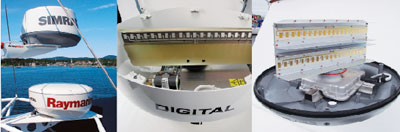
Ben Ellison| |Navico’s Broadband Radar BR24 radome (the Simrad, left) is taller than a digital one because of its two antennas (right) rather than the one in a conventional set, such as Raymarine’s (center). |
While the real-world hazard of 2- and 4-kilowatt magnetron pulse radiation is debatable (visit my blog to read the knowledgeable commentary on this topic), other 18-inch radomes do typically come with 2- to 6-foot safe-distance ratings and/or recommendations to mount them overhead. However, while you can safely mount a BR24 most anywhere, you need to consider the unit’s several other unusual characteristics before you choose a location.
A magnetron radar simply can’t switch from pulse to receive modes fast enough to catch really close-in echo returns. The result is a circle of noise, or filtered blankness, called the “main bang,” which typically extends 50 to 100 feet from your radome when it’s set at what’s usually its tightest range, an eighth of a nautical mile. This dead space gets larger as you range out. By contrast, Broadband Radar’s Continuous Wave Frequency Modulated targeting technique transmits and receives simultaneously and has no main bang. And although modern maggies are much improved, C.W.F.M. is also able to resolve range better than magnetron pulses can.
I saw vividly valuable examples of Broadband C.W.F.M. close-range resolution in many situations this summer, including a benchmark experience in Camden’s outer harbor, with its hundreds of moored vessels and a busy channel marked only with low, round buoys. I didn’t find much use for the BR24’s previously unheard of 200- and 300-foot ranges, but I found its 400-foot setting quite handy in thick fog. This range, also expressed as 0.0625 or a sixteenth of a nautical mile, is only seen otherwise on the premium Furuno DRS2D, where it isn’t quite as detailed.
However, I got the very best near-range results with the BR24 mounted low on the skiff, regularly nailing small, difficult targets, such as those Camden channel buoys, and holding them until nearly alongside. When installed high on Gizmo’s antenna mast, the BR24 lost some of its main-bang-less close-in acuity (due to the 25-degree vertical-beam-width limitation it shares with all radars), and when lowered to the front of the flying bridge, about 14 feet off the water, it couldn’t “see” backward through the bridge at all. Other radomes showed some interference when trying to see though the same bridge, or even through my 4-inch-diameter aluminum mast, but none as much as the BR24.
Jesse Deupree reports that a BR24 mounted 12 feet off the water on the stern of his trimaran occasionally picks up his mast or wet sail, though he doesn’t find it a bother. I wonder, though, if Deupree would be even happier with his Broadband system if he’d mounted the antenna forward of his mast and lower? I recommend experimenting with BR24 mounting locations before bolting one down. You can, after all, safely hold a running one in your hands.
As well as being more sensitive to onboard obstructions, the BR24 also seems more sensitive to interference from other radars. This problem manifests itself as intermittent spokes superimposed on the target display when you’re within a quarter of a mile or so of transmitting magnetron scanners. It’s not a deal breaker, in my opinion, but it’s annoying, especially given how automatically free of noise the target imagery coming from the BR24 and other modern radomes normally is.
What might be a BR24 deal breaker for some sailors, though, is its long-range performance. While my testing suggests that no other 18-inch radome beats its resolution at extreme close range and that it competes with the best up to about 3 nautical miles, its competitive targeting abilities taper off fairly steeply at distances beyond that. You can see what I mean in the screenshots (posted below) comparing the BR24 to the Raymarine RD418D at ranges of 6 nautical miles and an eighth of a mile. It’s a bit ironic that Navico chose to put 24, the radome’s theoretical maximum range, in its title, as the very farthest that I’ve seen it target even a bold granite island is about 12 miles. (Radome naming is often confusing; what Furuno calls a “19-inch” dome, for instance is 2.5 inches smaller in case diameter than Raymarine’s 18-inch domes. The BR24’s case, incidentally, is also 19 inches, though it’s an unusual 11 inches high, due to its dual antennas.)
For many skippers, however, long-range radar performance isn’t as important as it once was. GPS chart plotting has significantly reduced radar’s navigational value; the Automatic Identification System has become the tool of choice for identifying far-off ships; and satellite live-weather systems, even Internet-connected cellphones, can often monitor distant storms and lightning better than the largest marine radars, at least along the U.S. coasts. Today, there are many sailors who rarely use their radar beyond the 3-nautical-mile range, and that includes me.
I should also note that the BR24’s longer-range weakness stands in sharp contrast to the Raymarine unit’s strength. More than one Gizmo guest this summer was amazed by how close the latest 18-inch magnetron radomes came to painting distant targets in ways like their more powerful cousins, the open-array scanners-but, more on this in my January column. The BR24-which lists for $1,850 to $2,100, depending on which Navico brand decal is on its casing-is a very welcome innovation in marine electronics, and I hope we’ll eventually see more solid-state radars. And it’s especially seductive if power efficiency and close-range resolution are high on your priority list and you happen to own or like any of the several Lowrance, Simrad, or Northstar multifunction displays with which it works. Otherwise, you have a lot of radars and related MFDs to consider. One thing for sure: Radomes aren’t like they used to be.
Some sample radar screen shots:
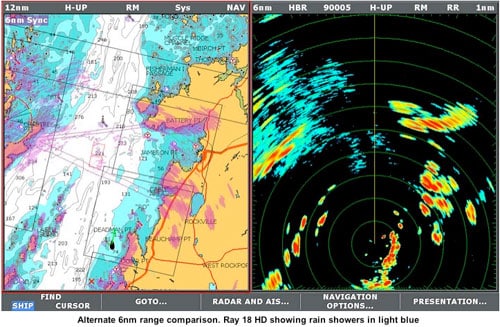
Ben Ellison| | |
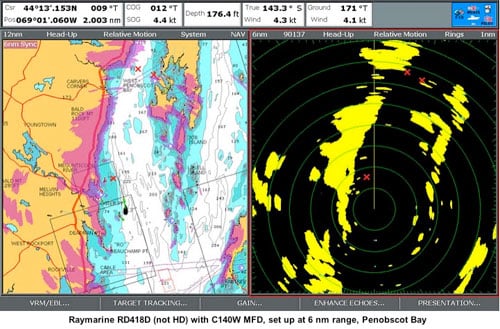
Ben Ellison| ||
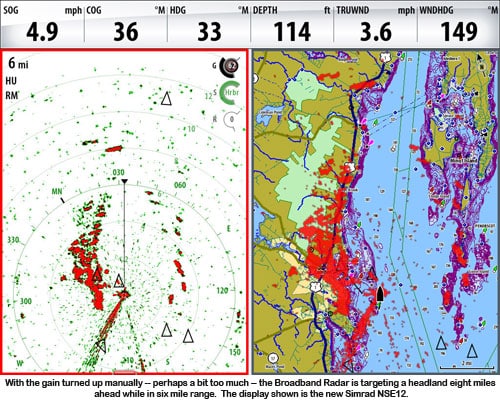
Ben Ellison| ||
Ben Ellison is CW’s electronics editor.