
For four decades, the name Jimmy Cornell has been the gold standard for the organized transatlantic crossing. But as he marks the 40th anniversary of the ARC, the man who taught thousands of sailors how to cross the pond is pointing his bow toward much colder, more demanding horizons.
The High Latitude Challenge 2026–27 is a 24,250-mile clockwise odyssey designed to thread the needle between the two most formidable trophies in world cruising: the Antarctic Peninsula and the Northwest Passage.
Unlike the traditional rallies that Cornell pioneered, the HLC is a rolling event, a more fluid, coordinator-style framework built for a new era of exploration. It arrives at a pivotal moment. In 2024, both the Arctic and Antarctic recorded their highest number of visiting yachts in history. As these remote regions face increasing environmental pressure and tightening regulations, Cornell is stepping in to provide a logistical safety net for a cruising movement that is already well underway.
The following conversation between Cornell and Cruising World Editor-in-Chief Andrew Parkinson digs into the technicalities of “ice-proof” prep, the reality of Arctic self-sufficiency and why Cornell says you don’t need a steel hull or deep pockets to witness the ends of the earth.
Cruising World: You are the father of the modern sailing rally, yet you’ve described the HLC as a rolling event rather than a traditional structured rally. Why is this more flexible, coordinator-style approach the right fit for high-latitude exploration compared to the traditional ARC model?
Jimmy Cornell: There are several reasons why I decided not to run the HLC as a structured rally. The main reason was my concern for the environment and the wish to avoid the need to fly one of our representatives to every stopover along the event route. I also believed that such a flexible framework would appeal to the more experienced sailors I expected to join this kind of challenging event.
CW: It seems that you notice cruising trends and then create events to match what sailors are already attempting to do on their own.
JC: Yes indeed, and this was also the idea behind the initial ARC and later round the world in rallies. Also, I expect that in the Northwest Passage and Antarctica, more stringent regulations and limitations might be imposed, and in such a situation, an organized event would have a better chance of being allowed to happen.
CW: You’ve timed this route to hit the “safe seasons” in both hemispheres. What was the biggest challenge in syncing the calendar to avoid tropical storms while ensuring the ice windows in the Arctic and Antarctic stayed open?
JC: This aspect of the HLC was easily dealt with because I had already sailed that route myself. At the end of my voyage with my son Ivan to Antarctica on Aventura III, we decided to set off on what we would describe as a transpacific marathon. We left Antarctica in February by sailing a similar, but more ambitious route as the HLC, starting with a cruise through the Chilean Archipelago, then on to Easter Island. From there we made a long detour to the Pitcairn, Gambier, Austral, Society, Tuamotu and Marquesas Islands, crossed the equator via the Line Islands to Hawaii, and continued to Sitka in Alaska, where we arrived in July. The route and timing of the HLC will follow the same timeframe, but in a more relaxed and less-ambitious way.
CW: You’ve designated Mar del Plata, Argentina, and Honolulu, Hawaii, as logistical hubs. For a cruiser preparing for the Drake Passage or the Northwest Passage, what are the most critical last-minute services these hubs will provide?
JC: The opportunity to have access to a good range of repair and service facilities before tackling those two demanding destinations.
CW: You’ve seen fiberglass boats succeed in the ice, but you’ve also seen rudders damaged. What is your honest advice to an owner of a modern production GRP boat who is eyeing the Drake Passage?
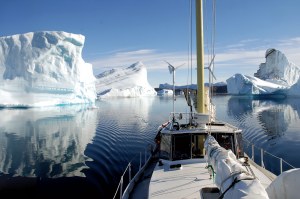
JC: The Drake Passage itself should not be a matter of serious concern for anyone with a well-built GRP boat. Hull material is more of a concern in Antarctica because of the drifting ice. However, being aware of this factor and acting cautiously, GRP boats have cruised successfully in Antarctica. But it is indeed something to be borne in mind, and this is the reason why among the boats signed up for the HLC, three owners have decided not to sail to Antarctica but spend the extra time in southern Chile.
CW: You are encouraging a low carbon footprint with special prizes for renewable generation. Given that wind generators can struggle in the light winds of the Northwest Passage, and solar is limited by the sun’s angle, what does the ideal energy grid look like for an HLC vessel?
JC: This is a valid point, and it does not apply just to boats sailing in high latitudes. However, I do believe that although we are still some ways away from being able to have zero carbon footprint on our boats, we can and should make an effort to cover some of our electricity needs, not just with solar panels or wind generation, but primarily with highly efficient hydro generation.
Aventura IV had been set up in this fashion, and the system worked well, even though we had no diesel genset and never had one on any of my previous boats. Having completed the eastbound transit of the Northwest Passage on Aventura IV, I left Greenland with a friend bound for the UK. Two days into the passage, we were unable to start the engine, and eventually I concluded that we had an air lock but couldn’t trace the source. Rather than turn around and get it repaired, I told my friend that as we were in the windy North Atlantic, I would rather continue.
That’s what we did, and sailed over 2,000 miles all the way to Falmouth, in southwest England. We managed to cover all our energy needs mostly from our efficient hydro generator. It was that trip that inspired my next boat. On Aventura Zero’s last passage, from Tenerife in the Canary Islands to La Grande-Motte in the South of France, we sailed the 1,544 miles in 10 days nonstop and covered all our needs from the two propellers generating electricity, with some help from the solar panels.
CW: You mention a 1,000-mile range under power for the Northwest Passage. For many modern sailboats, that requires a massive amount of jerrican engineering. How should a participant balance weight against the necessity of fuel in the Arctic?
JC: That is indeed true, but again, I can only speak from personal experience. I had to supplement the tank capacity with eight jerricans, but we managed to refuel on two occasions with only once resorting to our jerrican supply.
CW: High-latitude sailing is surging just as these ecosystems are at their most fragile. How does the HLC balance the desire for adventure with the responsibility of leaving no trace in places like the Antarctic Peninsula?
JC: I can assure you that we can indeed leave no trace, and I managed to do that in both Antarctica and the Arctic. It is something we will ensure that participants in the HLC will rise to the occasion.
CW: You’ve noted that a firearm is compulsory (not in Canada, only strongly recommended) for the Northwest Passage. For many international sailors, this is a daunting legal and practical hurdle. How is the HLC helping sailors navigate the transition from mariner to prepared Arctic explorer?
JC: For those starting from the east, acquiring a gun in Nuuk, Greenland, is quite easy, as there are several shops selling them. Those starting from the west should be able to buy or order one in advance to be collected in Dutch Harbor, Alaska. On my latest voyage in the Northwest Passage, I did not have a gun on board. Because of that, we were very careful not to spend any time ashore in places where we didn’t have a clear view for at least a couple of miles, so we could always take avoiding action if we saw a bear. We did see some while we were at anchor, but never while we were ashore.
CW: Without a fixed fleet moving together day-to-day, how do you plan to foster that famous ARC camaraderie among sailors who may join or leave the route at different stages?
JC: We seem to have already achieved that by our monthly webinars. Our participants are already in contact with each other and running their own WhatsApp. Some have even sailed together.
CW: You’ve sailed Antarctica and the Northwest Passage multiple times. If a sailor can only join for one half of the challenge, which one do you believe offers the more profound transformation for a mariner, and why?
JC: Antarctica. It is the only place I have visited where sitting in the middle of a noisy penguin colony, I felt that I was seeing the world how it was 5,000 or even 50,000 years ago. It is a feeling that I will treasure for the rest of my life.
Also worth mentioning is that although the passage to the Antarctic Peninsula is more challenging, I consider the transit of the Northwest Passage to be more unpredictable. The Antarctica passage and the cruise along the Peninsula is less dependent on outside factors, as they are well known. In the Arctic, if the passage is blocked in any critical point, all you can do is wait and hope that the situation will improve, and you can complete the transit before the safe season is coming to an end.
CW: As you look toward the start this year, what would you say to the traditional cruiser who feels these high-latitude routes are only for steel-hulled professionals or the ultra-wealthy?
JC: It wasn’t a steel hull or a deep pocket that took me to Antarctica or the Arctic, but my wish to see this still-beautiful and unique world before it is too late.
To learn more about the High Latitude Challenge 2026-27, visit cornellsailing.com.