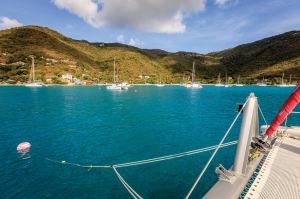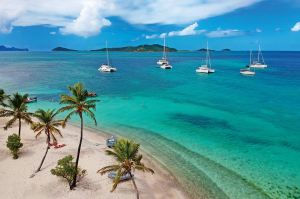
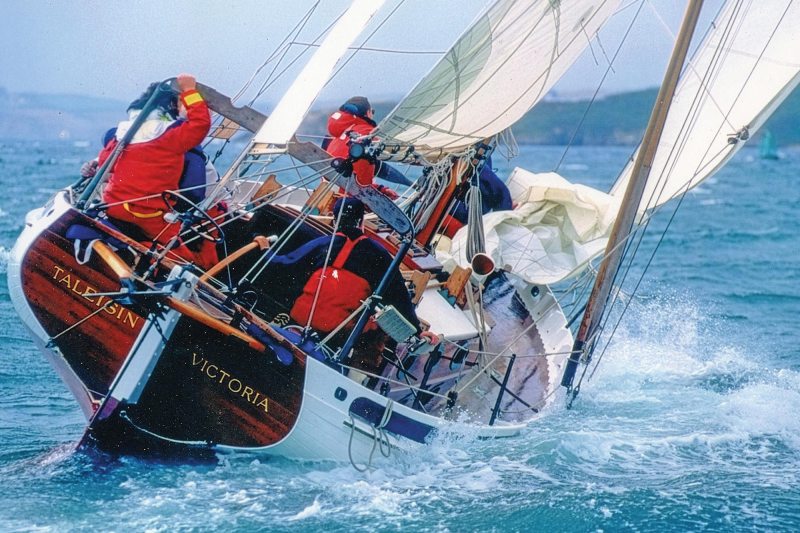
My husband, Larry, had just lowered Taleisin’s anchor. As soon as it was set, I had hoisted our Q flag. With the bright yellow square flapping in the breeze, I turned to help Larry repack Taleisin’s colorful spinnaker, which lay in a messy pile along the side deck. This bright blue, green and white mass of nylon had flown day and night during the last 400 miles of our passage from Tonga to New Zealand, pulling us along at a sedate but steady 4½ knots. In fact, we’d been able to carry that spinnaker all the way up the river leading to the Opua customs anchorage area. Now we were rushing to tidy up, as I had spotted the customs launch wending its way toward us.
Just before the officials arrived alongside, a sleek-looking sailboat came to anchor close by. “That looks like a racing chute,” the helmsman on the 35-foot sloop called over. “What’s it doing on a cruising boat?”
“Worked wonderfully in the light winds we’ve had the past five days,” Larry replied. “Besides, we do enjoy an occasional bit of racing.”
“If you two like racing, come on along on Saturday,” the helmsman said. “I’ve always got room for extra crew.”
As soon as the customs boat pulled away from Taleisin’s side, our neighbor rowed over. His name was Matt. “Love to have a look on board,” he said. We shared cool drinks in the cockpit with our first Kiwi visitor, and Larry asked if overseas yachts could join the race.
“Of course! I’m sure the committee can come up with a handicap for you,” Matt said. “Get out your chart, and I’ll show you where we will be heading.”
I spread out our large-scale chart of the Bay of Islands on the cockpit sole. Matt pointed out some potential dangers, places where steep-sided islands interfered with the wind, narrower spots where the eddying tidal currents could become a problem.
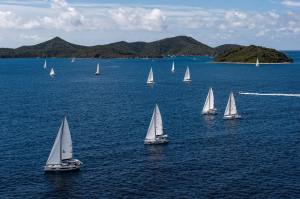
The next morning, Larry was overboard, scraping away at the dangling goose barnacles that had accumulated under Taleisin’s counter and along the bottom of her keel during our passage. And then, three days after dropping anchor, we were underway again, surrounded by two dozen boats headed for the start line.
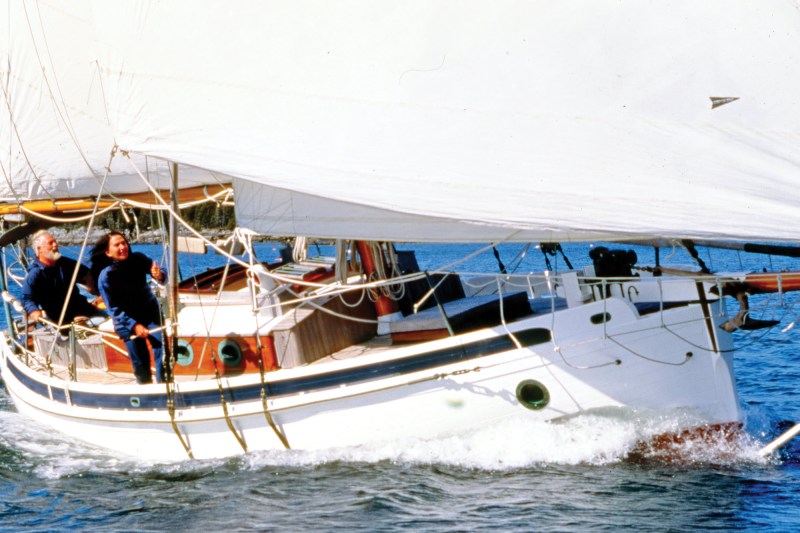
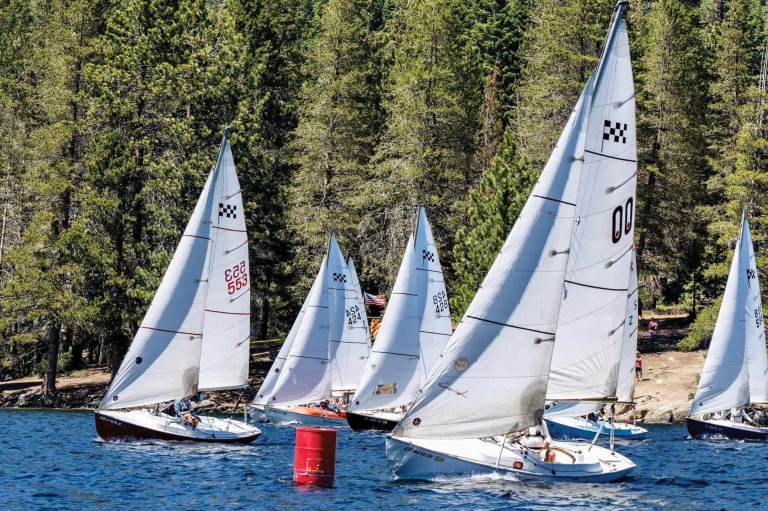
It was a fun race: sparkling seas, some ribald comments about our distinctly non-racey boat, a few challenging moments as we rounded the small islands and turning marks amid a gaggle of other determined racers. We were delighted when we managed to finish ahead of several far-racier boats. We’d spotted several anchorages we wanted to explore during the next weeks and felt far more physically extended than we did when we were “just cruising.”
Right before we reached back into the anchorage off Opua, Matt motored close alongside and called over: “Crew wants to buy you a drink. Come on over to the clubhouse as soon as she’s home and hosed.”
By the time we returned to Taleisin that evening, the prime benefit of adding racing to our cruising life had once again been confirmed. We had a bevy of new friends, a generous list of invitations, and offers of assistance to help introduce us to this new land we’d sailed so far to see.
Though Larry had come to cruising via his time racing sailboats around Vancouver, I had little experience with pushing a sailboat to compete with others. So I have fond memories of the first time Larry suggested we add club handicap racing to our cruising life.
We’d sailed into Gibraltar in late 1974, just as winter gales began to blow in the Mediterranean Sea. The need to stop for a few months to begin writing my first book, the offer of a relatively inexpensive marina berth, and the prospect of interesting boat-repair work for Larry made this a logical place to stop for the winter. The downsides were the blockade imposed by the Spanish that made Gibraltar feel like a small, isolated island; the limited population; and the lack of any nightlife. I remember wondering what we would do for a bit of entertainment.
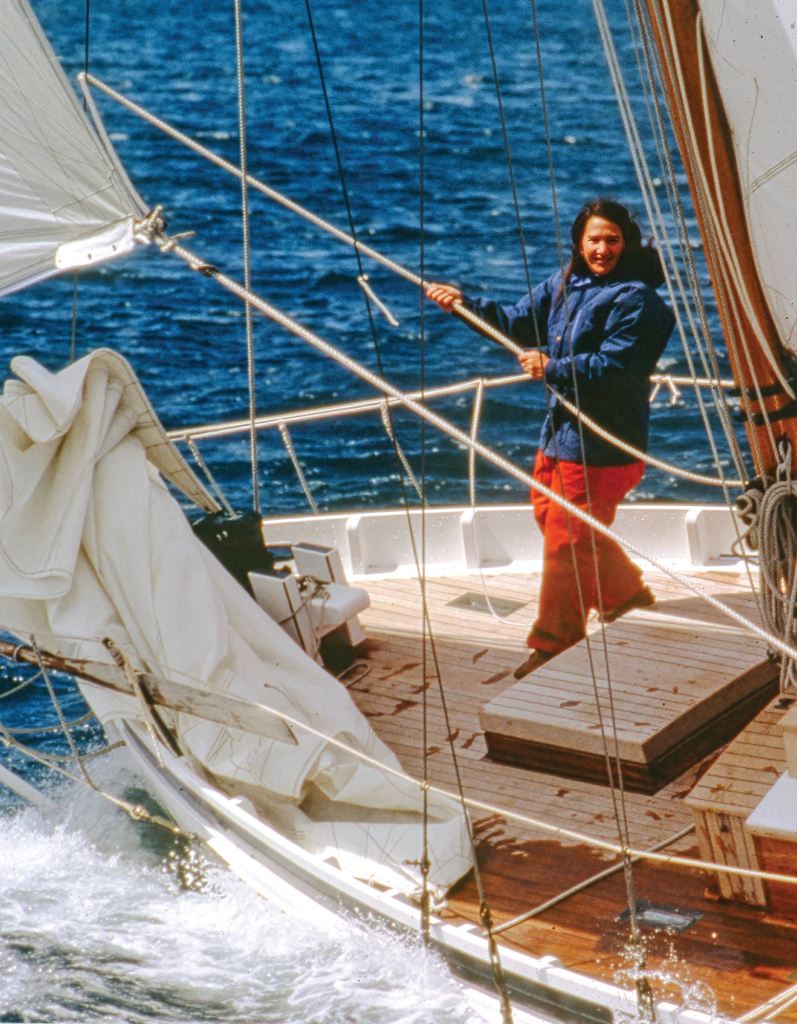
Then, the day after we secured our 24-foot, 4-inch Seraffyn stern to the rickety marina dock, an upright-appearing man walked down the dock and called over, “The Gibraltar Inter-Service Invitational Race Series starts this week. Care to join in?”
He explained that the local British Army and Navy forces stationed on “The Rock” owned half a dozen racing yachts. That year, they hoped to swell their fleet by inviting visiting cruisers to join. “If you need crew to help you, we have a list of volunteers,” he said.
Larry answered almost immediately: “Love to have some crew, but really would prefer a couple if you can find one for us.”
Over dinner that evening, I expressed my concerns that I had no racing experience, that the boat wasn’t set up as a race boat, and that we were carrying probably a half ton of cruising gear to slow us down.
“It’s a handicap race,” Larry told me. “They’ll take all that into account. You know how to sail, know how to pick wind shifts. Winning a race like this is not the object. Doing the best we can is. Lots to be learned by having a reason to go out sailing no matter what the weather is. It will definitely make our weekends more fun.”
He was right on all counts. By the time the series was over, almost a dozen other cruisers had joined. Local sailors had adopted each of us. We’d sailed on days when only zephyrs kept our boats moving, and on other days when we carried heavily reefed sails as we reached toward the finish line in the 35-knot wind gusts that swept down over “The Rock.”
After each race, we joined a group of raucous sailors and cruisers at the club for an evening of sailing talk and laughter. This inevitably led to many of us visiting cruisers joining in an array of civilian and military events, crowned by an invitation for us all to attend an annual military ball. There was a delightful scramble as almost a dozen cruising women helped one another find or create gowns.
Italy, Singapore, Finland, South Africa—over the ensuing years, Larry and I pulled up our anchor or untied our mooring lines to join regattas in 15 different countries. In each case, we met local people who quickly became friends. We also practiced important aspects of sailing that contributed to our enjoyment of cruising: working as a more coordinated team, becoming more comfortable maneuvering in tight quarters as we pushed to be near the lead at a starting line, being pushed slightly into my zone of discomfort, finding new tricks that helped us sail more efficiently, testing our gear far harder than we might otherwise have. It was all good preparation for crossing our next oceans.
Maybe best of all, we came to see our boat not only as a home and cruising machine, but also as a toy. Because yes, that is what it felt like when we headed out toward the starting line. Racing encouraged us to take time out to play.
As tough as some days felt out on a racecourse, what I relished most was the satisfied feeling of sailing back into a marina berth, stowing the sails and sorting out any mess down below while Larry found the nearest water faucet. Moments later, after he’d washed all the salt spray off the boat, we’d head up to join the gathering ashore, knowing we’d had a great day out on the water and were now safely home and hosed.
After cruising more than 240,000 miles, US Sailing Hall of Fame inductee Lin Pardey is off to sea again. Find longer articles and voyaging inspiration at Lin’s new Substack, Lin Pardey, Go Now. Subscribe at lpardey.substack.com.