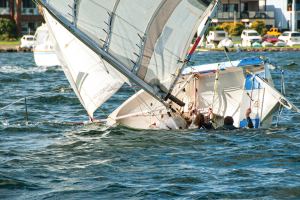
Wind force on the sails causes a sailboat to heel. Resistance to heeling, called righting moment (RM), results from the lateral movement of the boat’s center of buoyancy away from the center of gravity (CG).
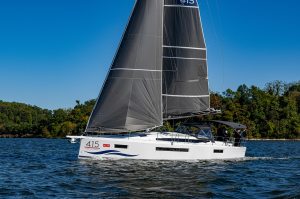
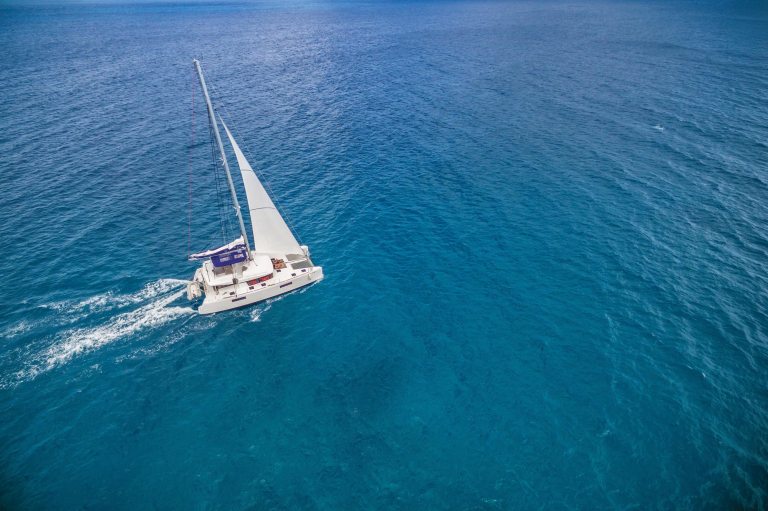
To compare the heeling behavior of a catamaran versus a monohull, consider a 45-foot mono as having similar accommodations to those of a 40-foot cruising cat. The mono displaces 30,000 pounds, and the cat displaces 18,500 pounds. Each has about 950 square feet of sail area.
The moment of force required to heel the monohull 1 degree is about 1,900 pounds-feet. The force to heel the cat the same amount is 9,200 pounds-feet, almost five times greater, because the newly immersed part of the catamaran is much farther from the CG than that part of a monohull.
In general, the righting moment of a monohull increases close to linearly up to about 25 degrees of heel. The maximum RM for this boat would be about 80,000 pounds-feet at about 65 degrees of heel.
For the catamaran, the RM increases linearly for the small angles of heel illustrated here.
Its maximum, 142,000 pounds-feet, occurs at the point the windward hull flies, in this case at about 16 degrees of heel.
The top illustration shows the two boats at rest. The middle one shows the catamaran at 1 degree of heel and the monohull subjected to the same force at 5 degrees of heel.
In the bottom panel, the monohull is heeling 15 degrees–the limit of comfort for some sailor–while the cat, under a similar load, heels only 3 degrees.
These numbers are approximations based on data from several boats.