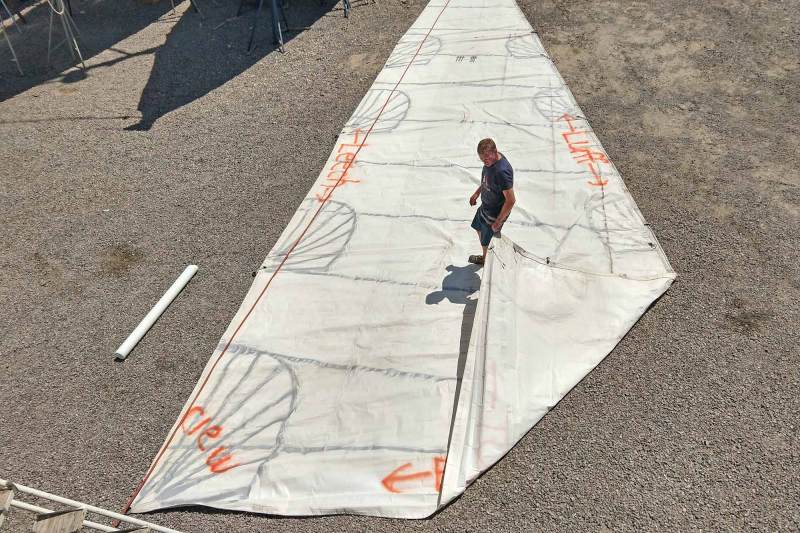
I’m not a racer, and I don’t want to sacrifice durability for performance.” These statements are in most new-sail inquiries that I receive. The simple interpretation: cruiser on a budget. I used to believe that I understood what that meant, and what good cruising sails were. I was wrong.
Before becoming a full-time cruising sailor, I was a sailmaker and upwind sail designer. From dinghy sails to a 900-pound Kevlar genoa for the first sailing superyacht, I lived sailmaking. I worked with the first batch of carbon fiber sailcloth, probably the most expensive sailcloth ever produced, for America3 in the 1992 America’s Cup. My specialty was sails for boats racing around the world, crewed and single-handers. Oh, and I made Dacron sails for day sailors and cruisers, too.
That job is a world away from my personal cruising ambitions. After a year spent preparing our Stevens 47, Totem, my family and I set off from Puget Sound in 2008 for a three- to five-year sabbatical. Our final pre-departure upgrades were a new watermaker and asymmetric sail. I knew a lot more about the sail. While puzzling over the installation details for the watermaker, I dialed up former colleagues to create the best cruising asym ever.
Our new asym tasted salty air flowing past on a lovely broad reach down to Monterey Bay in California. What a sail we were having—that is, until we shifted to gaze at our mainsail. Our main and genoa were of unknown age, veterans of a five-year loop around the Pacific. Like our budget, they were in relatively poor condition. The plan was to replace them in Mexico before departing for the South Pacific.
I had the best Dacron picked out. I knew the perfect luff curve profile to fit Totem’s mast prebend and to offset the broadseam effect that comes from turning two-dimensional sailcloth into a three-dimension foil. The new genoa would scale up to 135 percent because that was the perfect all-around size for cruising. The existing headsail was a 93 percent non-overlapping sliver with failing UV cover.
We departed Banderas Bay in Mexico on April Fools’ Day 2010, bound for the Marquesas with an inventory of four sails. It included the new asymmetric spinnaker, recently repaired mainsail and sliver-size headsail of unknown age, plus a storm staysail folded into a tight brick and stuffed under the V-berth. No joke, that’s what we went with. Cruisers on a budget.
Just shy of 10,000 nautical miles and 225 days later, we arrived in Coffs Harbor, Australia. Down Under, we felt on top of the world during our epic family adventure.
Along the crossing, the sailmaker in me began to question cruising sails. The awesome asym was put to use in Mexico’s lighter winds. From Mexico to Australia, it flew for just three hours. La Niña’s reinforced trade winds were too strong for such a big sail. The tiny headsail turned out to be a decent fit. Still a bit too small, but closer to the right compromise in size than the 135 percent sail that I had thought was perfect.
On the racecourse, we always had a selection of headsails to best fit the conditions. But on a cruising boat, a sail not in use is a sail stowed and taking up precious space. Designing a one- or maybe two-headsail inventory for cruising in changing regions is more nuanced than I had realized. I took these lessons to heart for the new main and headsail I planned to have before departing from Australia.
In 2012, we departed Oz, bound for Papua New Guinea, with our cruising kitty restored enough for the next chapter of cruising without a sabbatical end date in mind. Sadly, the sliver sail was still with us, but the new mainsail was a gem.
Radial laminate sails are the best with low-stretch materials: lighter weight, with superior shape holding from fibers aligned to load paths throughout the sail. Laminations were better than when I designed sails, though still not as durable as woven sailcloth. Despite the pluses, Totem’s new main was crosscut Dacron. With lessons from the Pacific crossing, I had the sail made with more carefully considered features.
On the old main, I cut off the foot hardware and liked the improved lower sail shape. The new sail was made loose-footed. Three nicely spaced reefs instead of two deep reefs improved sail-plan versatility. Leech reefs with lashed low-friction rings eliminated line chafe. Dyneema loops on the luff reef rings quieted the banging from usual webbing with metal rings that slammed into the mast sailing downwind. Polyester webbing chafe protection along the length of each batten pocket prevented chafe holes that I had to patch many times on the old sail.
The big improvement was adding a second layer of Dacron along the leech. Our mainsail is not normally a size that warrants a two-ply leech. I did so for toughness, expecting to be reefed a lot in the windy Indian Ocean. The real benefit turned out to be shape retention. After seven years, two oceans and 45,000 nautical miles, the sail shape remained nearly perfect. Dacron always distorts with moderate to heavy use, so this was a big surprise and well worth the trade-off of added weight.
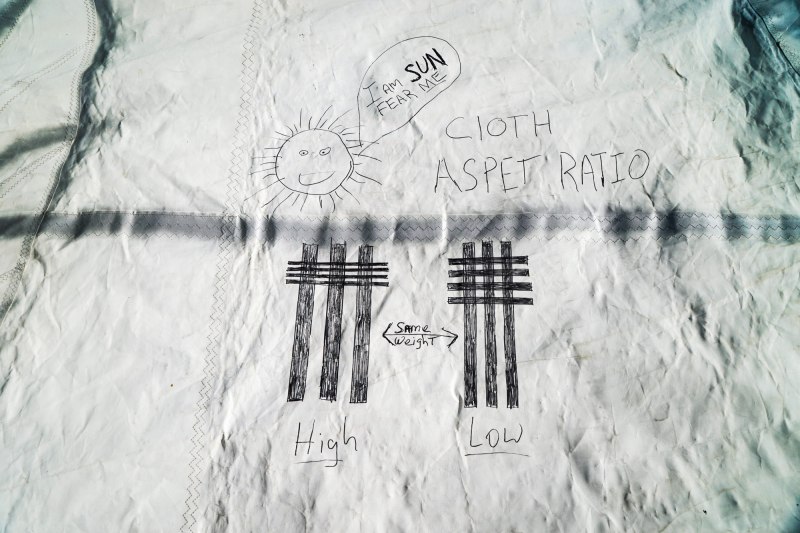
Not all of my choices were wins, however. Quality Dacron made from high-tenacity polyester fibers was an easy choice. The miss was choosing high-aspect Dacron, woven with much higher fiber density across the panel width and lower density along the panel length. Technically, this is correct for our mainsail geometry. Practically, it is a fail because the lower-density fibers are in tiny-diameter yarn bundles. Those smaller bundles are more subject to UV, and the sun destroyed them. This sail got us back to Mexico, but it became as weak as tissue paper.
The cost for that mainsail worked out to 13 cents per nautical mile. If I’d specified low-aspect Dacron, that metric would’ve been better still. For any cruiser on a budget, this is the meaningful metric, with one important distinction. Our sliver headsail lived until Malaysia in 2014. Without a full history, its cost per mile is unknowable, but it’s probably less than two nickels per nautical mile. Great value, except the sail was high-maintenance.
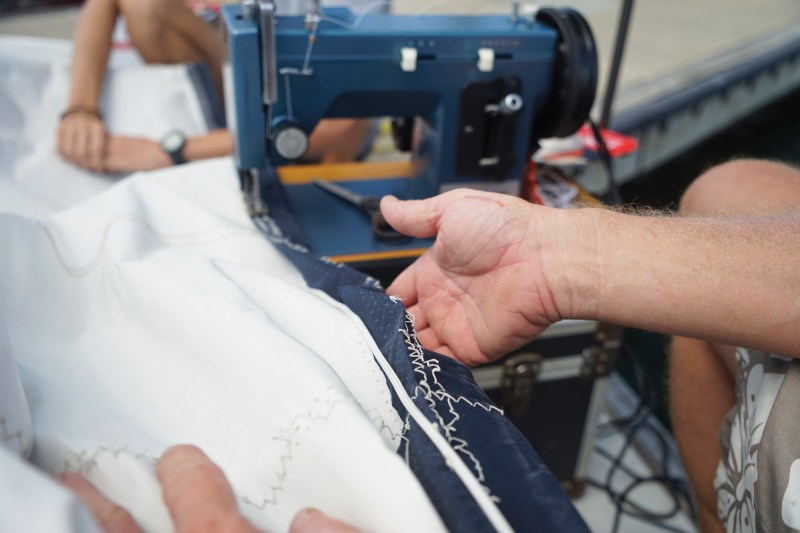
The UV cover and corner webbing straps weren’t sewn on with PTFE UV-resistant thread. UV-stabilized polyester thread is no match for tropical sun, and degrades in just two to three years. With full tropical exposure, the UV cover had to be resewn three times. This would be easy enough in a well-equipped sail loft. Executing this on the foredeck of a sailboat using a small sewing machine with sail bunched up all around me was not a fun project.
Resewing the cover also made a million small holes that weakened the UV cover and the well-used base Dacron. To reinforce this, I added a warp-oriented Dacron strip along the leech. It wasn’t easy or pretty, but it kept the sliver sail in one piece.
For the long-overdue headsail replacement, I settled on 110 percent as a versatile size. A compromise in light winds, but that’s what the asym was for… if there was a chance to use it. The new headsail had quality Dacron, and a low-aspect ratio this time to improve longevity in the face of tropical sun. The other features were well proven: triple-step stitching on the seams, PTFE thread on the UV cover and corner webbings, oversized radial reinforcing patches, and foam luff for better reefed shape when partially furled. The sail geometry was improved by raising the foot chafe-free above the bow pulpit, and the clew a reachable 6 feet above the deck.
My mistake with this genoa was not adding two plys to the leech, as I’d done on main. The cloth weight used was higher than the manufacturer’s recommendation, but the Indian Ocean didn’t care. Close-reaching in 30 to 35 knots of wind with two reefs in the mainsail and a partially furled genoa stretched the leech, permanently disfiguring it. The sail was not structurally compromised, but performance compromised as it stretched out of shape.
That ocean crossing was a spectacular experience and tough on sails. Among the relatively small collection of cruisers crossing that year, a handful of boats needed new sails. Some needed replacements even before reaching the far side where airports enabled sails to be shipped. In remote Chagos, I diagnosed the 4-year-old Dacron main and genoa from one boat as unrepairable. UV-damaged areas of both sails had the strength of a paper towel. It was the wrong Dacron sailcloth for extended cruising.
If you’re a cruiser on a budget looking to buy new sails, it’s fine to emphasize durability rather than performance, but go deeper on the details. Many sailmakers take pride in what they produce. And yet the uncomfortable truth is that crosscut Dacron sails seem so simple that cruiser-critical nuances are lost to a cookie-cutter sails mentality that I was guilty of for the white sails.
Consider in detail where you hope to cruise, and for how long. Seasonal and regional weather variations, El Niño and La Niña, and other considerations have a huge impact on sail choices, sizes, material and build details. That awesome asym that I was certain was perfect carried a high cost per nautical mile, and was mostly stowed for a decade before it earned its place in glorious sailing across the Atlantic Ocean.
Further consider the details of your boat beyond the make and model. Does it balance well, or develop weather helm? Is the boat tender, and does it feel overpowered or underpowered in light conditions? These tendencies speak to design features that your sailmaker should consider.
In tropical cruising regions, UV damage is the top reason for sails to fail. Inquire about specific sailcloth, thread and cover materials for your sails. Each has options with a wide range of outcomes. And remember to cover unprotected sails when not in use.
Great workmanship is lost to mediocre sailcloth. With a bigger budget, hybrid materials like woven Dacron and Dyneema make great sails that last and hold shape. An all-Dacron budget doesn’t have to mean blown-out sails. High-tenacity polyester Dacron costs more, but is superior to lower-grade Dacron. Adding a two-ply leech to either end of the Dacron spectrum can lock in sail shape even through demanding use. This is especially true with bigger sails and big roach catamaran mainsails.
In the refinements to the sails on Totem, I no longer see boring white crosscut sails. Our third mainsail is 8 years old, looks great and has years of life remaining. The genoa is our third as well, now at 115 percent overlap. They’re working sails that don’t sacrifice durability or performance, 18 years into cruising on a budget.