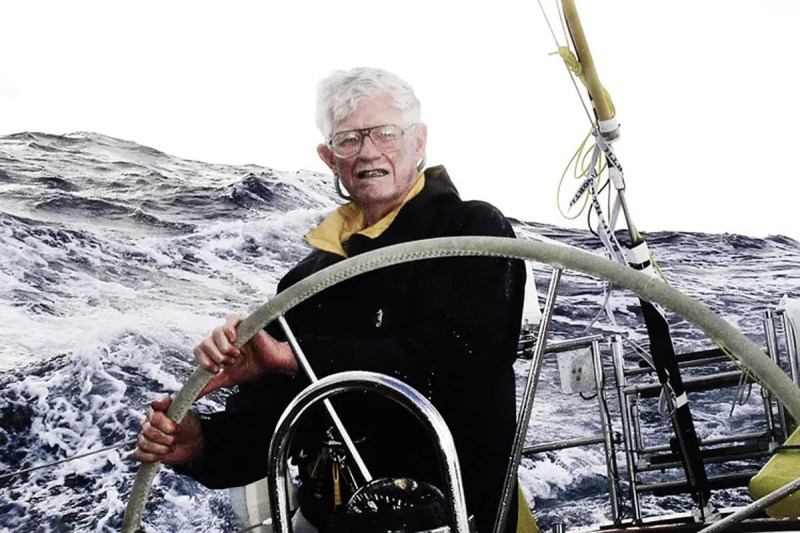
John Pierce Rousmaniere, who survived the 1979 Fastnet Race storm, wrote about it with unflinching clarity, and spent the rest of his life trying to make sure no sailor would ever have to live through something like it again, died on Aug. 8, 2026. He was 82.
The author or editor of nearly 40 books on sailing, seamanship and yachting history, Rousmaniere was widely regarded as the dean of yachting historians. But the title, however deserved, understates the man. He was a teacher, a survivor, a theologian and a sailor who logged more than 40,000 offshore miles—nine Newport Bermuda Races, two Fastnet Races, three transatlantic passages—before deciding, with characteristic honesty, that the sea had become too demanding for him to sail safely. He wrote about that decision too.
The storm that defined much of his life’s work struck in August 1979. Sailing aboard the 48-foot sloop Toscana during the Fastnet Race, Rousmaniere found himself in the center of a Force 10 storm that killed 15 sailors, sank five yachts, and forced 24 crews to abandon ship among a fleet of more than 300 boats. He turned the experience into Fastnet, Force 10 (1980), a first-person account that has never gone out of print and remains required reading for anyone heading offshore.
“He had a goal that a book like Fastnet, Force 10 would never need to be written again if sailors and boats were better prepared,” said Sheila McCurdy, vice chair of the board of trustees at Mystic Seaport Museum and past commodore of the Cruising Club of America.
That goal shaped the second arc of his career. Rousmaniere became one of the architects of the U.S. Sailing Association’s Safety at Sea Seminar, organized or participated in more than 100 safety courses, and served on U.S. Sailing independent review panels investigating fatal sailing accidents. His Annapolis Book of Seamanship, through four editions, became a standard reference at the U.S. Naval Academy, sailing schools, and chart tables across the country.
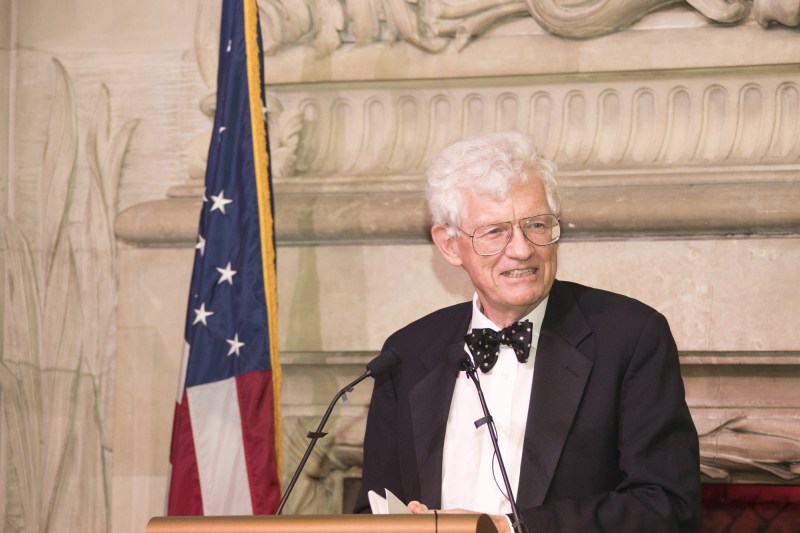
He was also a historian of rare range. His yachting titles include The Golden Pastime: A New History of Yachting (1986), A Berth to Bermuda: 100 Years of the World’s Classic Ocean Race (2006), and The New York Yacht Club: A History, 1844–2008 (2009). He contributed 40 essays to the Encyclopedia of New York City, wrote histories of the city’s institutions and cemeteries, and even contributed to a documentary on the Beatles.
“A new generation of historians is expanding our understanding of the past,” said Steven Tsuchiya, yachting historian and chair of the America’s Cup Hall of Fame Selection Committee, “yet they are all grateful for the excellent foundation John established. His books will remain touchstones for those who write about the sea and ships.”
Born in Louisville, Kentucky, in 1944, Rousmaniere graduated from Columbia University with a B.S. and an M.A., served as an assistant professor of history at West Point, and later earned a Master of Divinity from Union Theological Seminary—where he met his wife, Leah Ruth Robinson. They were together for 37 years.
Of all his achievements, those who knew him say he was most proud of having raised his two sons, Will and Dana, as a single parent.
In 2018, as his physical capabilities declined, Rousmaniere did what he had always done: he put his thoughts on paper. In an article published in Cruising World, “Safety at Sea: Giving Up Offshore Voyaging,” he explained why he had decided to leave the ocean behind.
“I wouldn’t want me on the foredeck,” he wrote. “It wouldn’t be fair to the rest of the crew.”
The letters that followed came from sailors all over the world, and from their spouses and children. They all said essentially the same thing: if John Rousmaniere could make that decision without shame or dishonor, so could they.
It may have been the most important lesson he ever taught.
Rousmaniere’s many honors included induction into the National Sailing Hall of Fame in 2020, the Bermuda Race Roll of Honour in 2024, the Cruising Club of America’s Richard S. Nye Trophy in 2009, and Mystic Seaport’s W.P. Stephens Award in 2014 for maritime history.
“He was a thoughtful man who made the sport better for everyone who sailed,” said Gary Jobson, America’s Cup winner and co-president of the National Sailing Hall of Fame. “John has left a lasting legacy that surpasses his list of accomplishments.”
A memorial service will be held at 10:30 a.m. on Aug. 22 at St. Paul’s Episcopal Church, 59 Court St., Dedham, Massachusetts. Gifts in his honor may be made to Courageous Sailing, 197 8th St., Charlestown, Massachusetts, courageoussailing.org, and to the Staff Christmas Fund at Bridges by Epoch Alzheimer’s Memory Care, 140 University Ave., Westwood, Massachusetts.