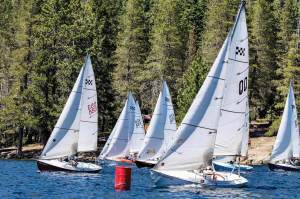
There is a photograph somewhere in a box in my mother’s closet of a skinny teenager in a borrowed life jacket, sitting on the rail of a Flying Junior on the Thames River in New London, Connecticut, looking absolutely terrified. That would be me, circa 1991, racing for the East Lyme High School sailing club at a qualifying regatta hosted by the United States Coast Guard Academy. I had been recruited (well, conscripted, really) to serve as crew, which in a two-person FJ means you’re either hiking out on the rail, trimming the jib or doing some panicked combination of both. My dad calls it railmeat. I called it the most confusing afternoon of my young life.
The Thames is not a forgiving classroom. Strong tidal currents run hard against the breeze, the wind shifts without warning or apology, and the competition (read: kids from programs with actual coaching and budgets) seemed to possess knowledge that simply was not transmitted to us. They bore away in the puffs. They pinched in the headers. They crossed us, and crossed us again. We did not cross them.
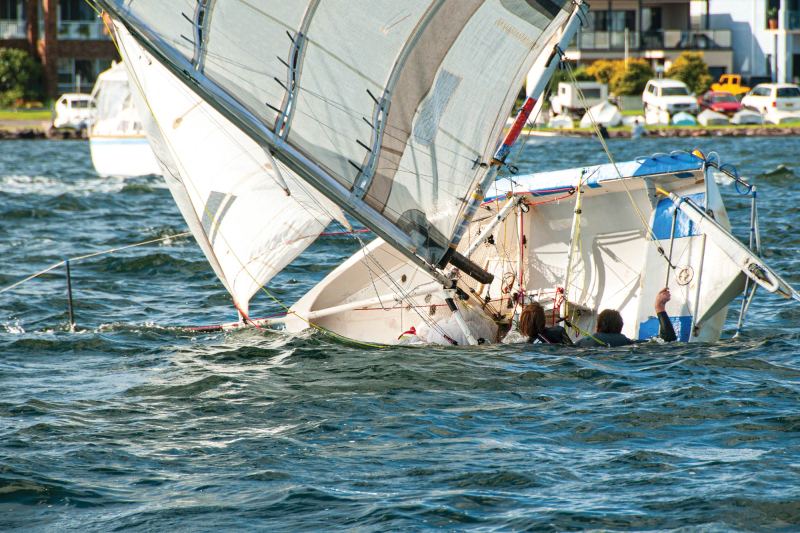
We also capsized. Repeatedly.
Here is the part they don’t mention in the brochure about sailing on the Thames off the USCGA facilities: The river bottom is not sand. It is not gravel. It is a thick, primordial, black-as-tar mud of apparently inexhaustible depth, and the controlling depths outside the channel are shallow enough that when a Flying Junior goes over and the mast finds the bottom, you are not simply righting the boat. You are conducting an archaeological excavation. Heaving on the centerboard. Tugging. Pleading. And then, once the boat finally lurches upright and you haul yourself back over the rail, soaking and triumphant, the mast delivers its verdict: a generous, cold, spectacular glob of Thames River mud dropping from 20 feet above, directly onto your head.
We posted some genuinely terrible finishes that year. I remember being lapped. I’m not certain that’s even possible in a short-course buoy race, but I believe we managed it.
And yet—and this is the part that has stayed with me across 30 years of sailing—I have never learned faster in my life. Not from books. Not from cruising guides. Not from any passage, however long or challenging. Racing did something that no other form of sailing had done: It made every decision matter immediately.
Bear away a half second late, and you’re in irons. Miss the lift on the layline, and watch three boats sail through your lee. The racecourse doesn’t grade on a curve, and it doesn’t soften the feedback. I had no idea what I was doing with a jib sheet until someone put one in my hands and told me the start was in four minutes. By the end of that first season, I desperately wanted to be better. That hunger has never entirely left.
I’ve been thinking about those afternoons on the Thames while assembling this issue, because we’re seeing something genuinely exciting happening across the broader sailing community: Cruisers, passagemakers, coastal wanderers, liveaboards and weekend sailors who’ve spent years admiring regatta fleets from the anchorage are crossing the starting line. Not in pursuit of silver, and not with professional crews. In pursuit of that same thing I stumbled into on the Thames: the particular aliveness of a sport where every choice has an immediate, irrefutable consequence.
Racing will make you a better sailor. Not because winning teaches you anything in particular, though winning is lovely, but because losing, and understanding why you lost, is one of the most efficient educational tools the sport has ever devised. You will learn to read a starting line. You will develop an instinct for pressure on the water. You will discover things about your sail trim, your boat speed and your own decision-making that a thousand pleasant day sails will never reveal. And you will want, with a motivation that is surprisingly difficult to manufacture any other way, to be better.
The Thames was a brutal teacher. I’d sign up again tomorrow.