My husband, Jamie, texted me from the shipyard: “You need to come see the galley.”
He’s an occasional texter at best, so I felt nervous. “Need?”
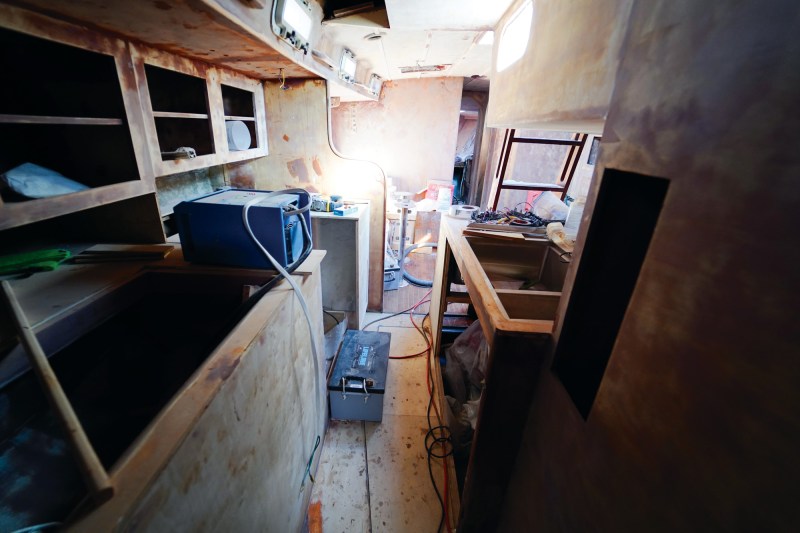
I hustled from our rental casita to the Cabrales boatyard in Puerto Peñasco, Mexico, where our Stevens 47 Totem rested on jackstands during a lengthy refit. I went aboard, and Jamie pointed out a hole in the galley sole where he’d fallen through to the bilge below.
Replacing portions of Totem’s sole was no longer a “someday” project. We already knew the aft cabin sole felt spongy underfoot. Exploratory prodding revealed the same problem beneath it.
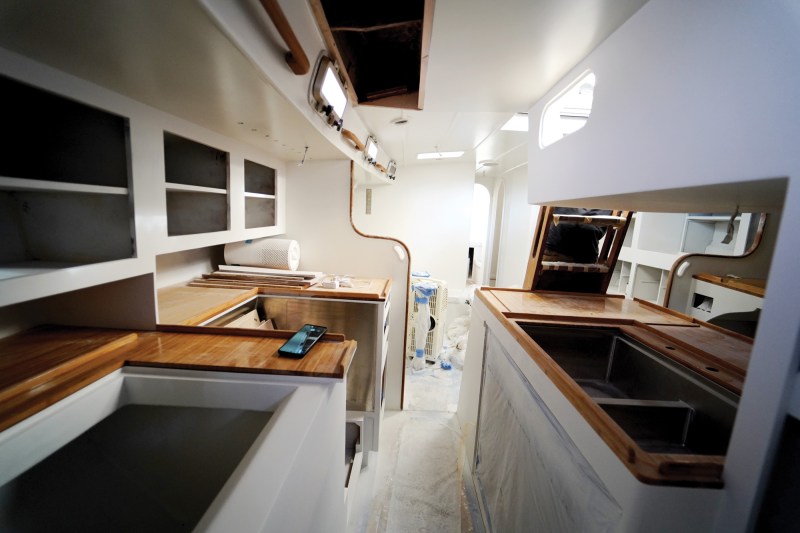
Many Stevens 47s have a lovely teak-and-juniper cabin sole throughout. Underneath is a plywood subfloor that didn’t age well after exposure to moisture over time. The plywood delaminated and rotted near wet areas like the fridge and showers. Our extended haulout in the dry Sonoran desert brought these hidden issues into sharp relief.
Matching the original sole was not possible. Attempting to fix this problem with similar flooring would look patchy and crude in contrast to sleek, newer finishes. We needed something entirely new.
Material Selection
Selecting a material for the new sole stymied us for weeks. It needed to stand up to the marine environment and the wear of daily traffic. We wanted something renewable and environmentally friendly. It had to blend visually with the original sole, which the main cabin would largely retain. We planned to paint most of the original teak interior white, so the new sole had to convey warmth for balance. We also wanted material that was easy to work with, easy to maintain, affordable and soft underfoot.
I ordered samples to compare. Recycled rubber was an early frontrunner, but the type we liked was backordered for months. Other rubber flooring looked great online, but it felt like cheap, plastic disappointment when we held chips in our hands. Vinyl and laminate were nonstarters.
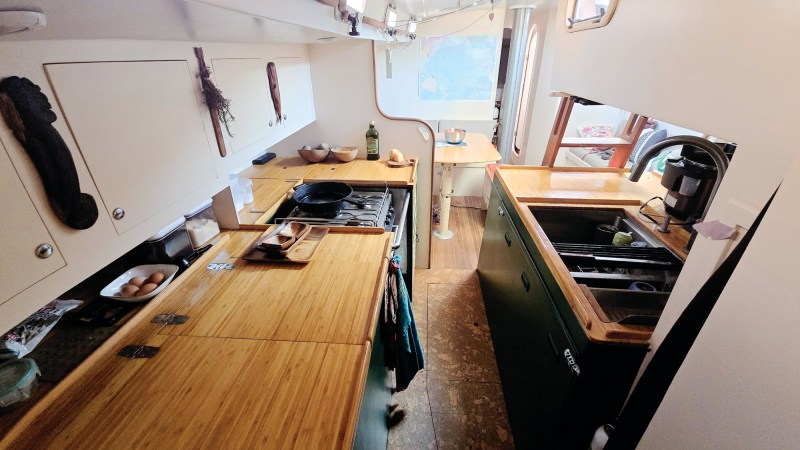
Cork, though, kept popping up, despite naysayers warning about staining and unsuitability for moist environments. We loved the cork floor kitchen in our old Seattle home. Cork is eco-friendly, naturally resistant to mold, unappealing for insects, insulating and resilient underfoot. Jamie and I were game to try it on the boat.
We quickly ruled out click-lock cork planks, which are common for home installations. Their medium-density fiberboard base wouldn’t survive in a damp marine environment, and they were too rigid for the subtle 3D curves of some flooring surfaces aboard.
Instead, we chose glue-down cork tiles that are ¼-inch (6 mm) thick, pure cork and flexible when lightly scored on the underside. Each tile measured 1-by-2 feet, a perfect size for small, irregular boat spaces.
And these tiles were relatively inexpensive. They’re available in a range of textures and color tones. We preferred a chunky, irregular grain to the uniform look, and we liked the deep toffee color that harmonized with the adjacent teak sole.
Substrate Preparation
Subfloor prep is critical to a successful installation of glue-down tiles.
The surface should be clean with any old adhesive or flooring removed. For us, this was easy, since we were starting from scratch.
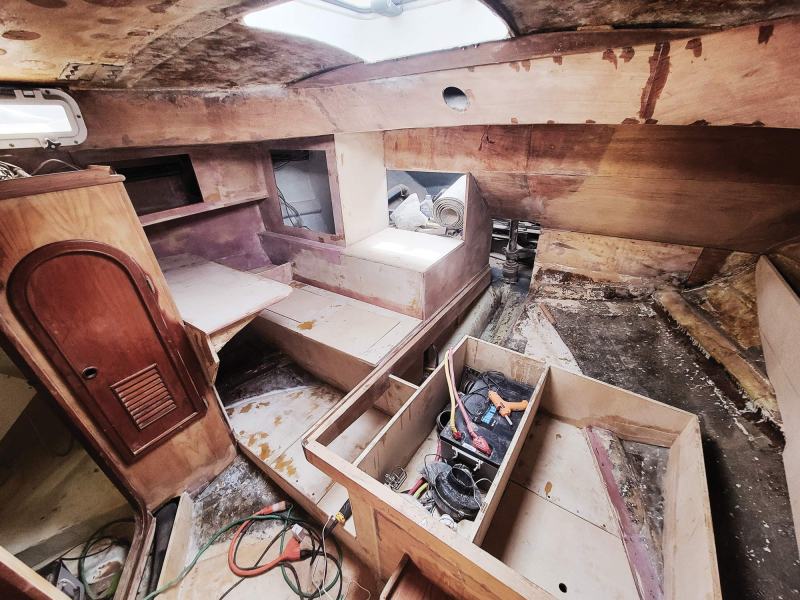
Jamie fabricated new subfloors from ¾-inch exterior-grade plywood, sealing every surface with epoxy. These subfloors will never rot.
Final surface prep was a light sand with 80-grit paper so the cork adhesive would bond well.
Cutting and Gluing
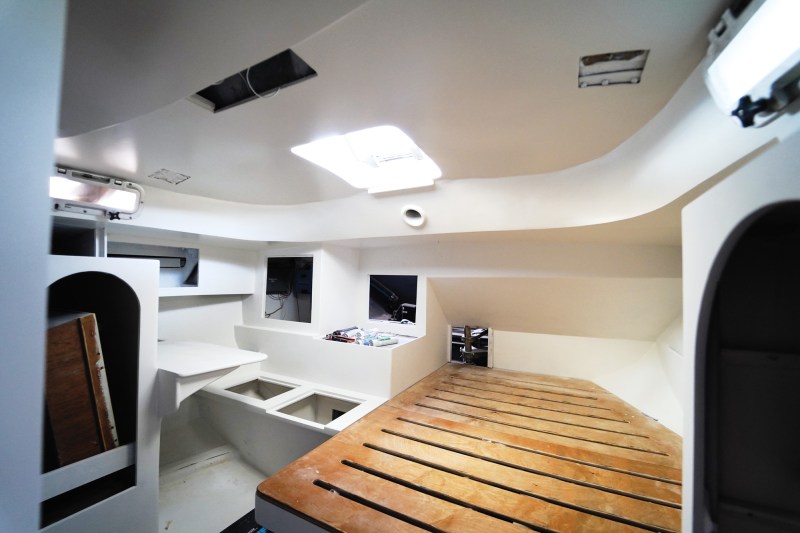
Before cutting or gluing, Jamie optimized panel orientation. This helped us to use the tiles efficiently, and to avoid awkward, sliver-size pieces in the layout. Most cuts were made from measurements, but for complex curves, he made templates with printer paper and tape. Cutting was easy with a sharp utility knife (and replacement blades) and a metal straight edge. He’d cut a panel, test-fit it and then glue it.
Where cork transitioned up a curve of the hull, templating was necessary for a good fit. The cork shaped easily over gentler curves, but tighter bends needed light scoring with a utility knife to form the necessary bends. Once the surfaces were prepared with adhesive, and after the tiles were carefully placed, a firm roller and plenty of pressure ensured good adhesion.
The supplier recommended Wakol D 3540 adhesive, but 3M 30NF Green Fastbond adhesive was easier for us to source, and it was also acceptable.
First, Jamie applied blue tape around the perimeter to protect it. A small, low-knap roller with glue from a plastic tray was all he needed to apply the adhesive to the subfloor and the bottom of each prepared cork tile. Two thin coats on each surface worked best, letting the first coat dry first.
Positioning the cork tile perfectly before its adhesive surface touched the subfloor adhesive took some finesse. Once there’s contact, the bond doesn’t come apart without damaging the tile.
Cruising with Cork
Two years of hard use later, the cork had proved outstanding. We had no trouble with moisture. It’s comfortable to walk on and has nonskid properties. There is no visible wear in high-traffic areas. Spills have not stained. Heavy falling objects did not leave dents. The cork self-healed.
Maintenance has been, well, what maintenance? Cork is easier than teak. A regular vacuum or sweep, and a damp mop or sponge when needed, keeps it looking fresh.
After five or 10 years, we’ll have to reseal it with polyurethane. So far, the result is perfect aboard Totem.
Follow circumnavigators Behan and Jamie Gifford at sailingtotem.com.