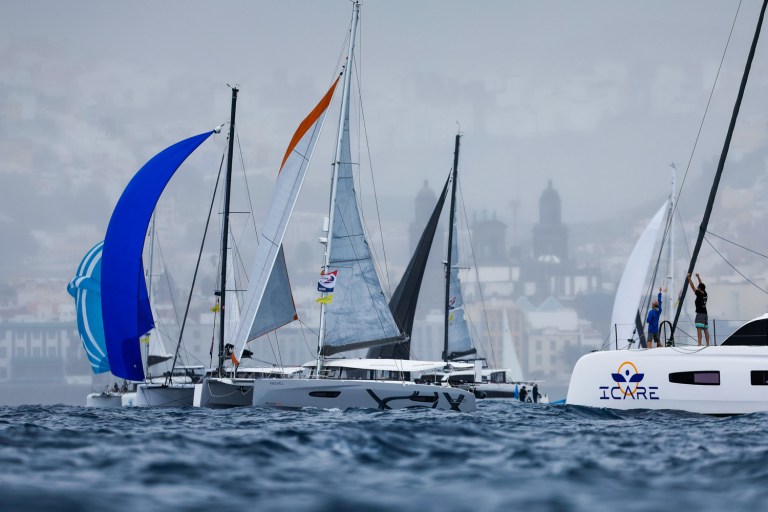
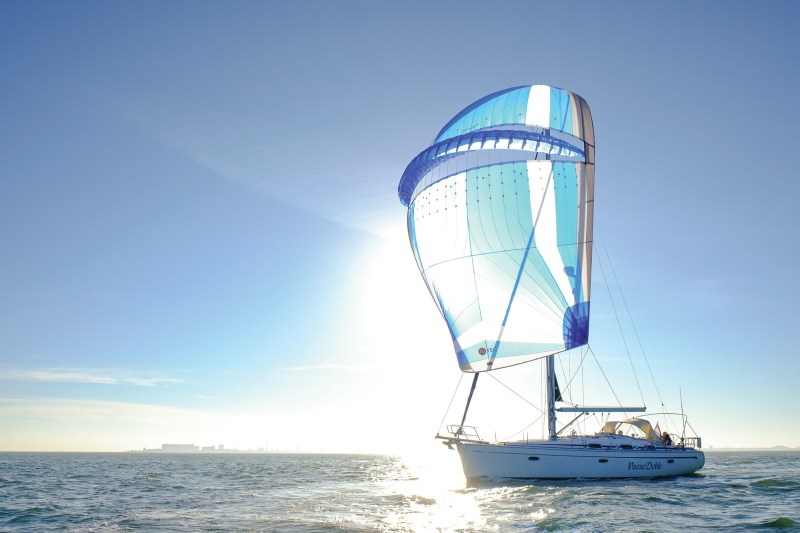
It was during my first Atlantic Rally for Cruisers in 2004 that I encountered the Parasailor. We sailed the entire crossing with one of the original models, using it in everything from flat calm to 30 knots. It was the only sail we touched for the whole passage. I fell in love with it on that trip, and I have not fallen out of love since.
That crossing eventually led me to the distributorship for the Netherlands and Belgium, and later to founding my own company, Bomarine. During the past two decades, with roughly 80,000 miles under my keel, most of it shorthanded, I have watched the Parasailor evolve through several generations.
When Istec, the German manufacturer, released its latest version, I wanted to see the improvements firsthand. So I called Pieter Bijvoets, a longtime customer who has owned a Parasailor for eight years, and arranged to meet him in Den Helder, the Netherlands, on a cold January day.
His boat is Paso Doble, a Bavaria 42. He and his wife, Maika, have sailed their original Parasailor extensively, including an overnight run toward the North Cape under spinnaker in Force 5 conditions, only dropping the sail when the wind climbed past 23 knots and rain squalls moved in. “We took the sail down to keep it from getting wet,” Pieter deadpanned.
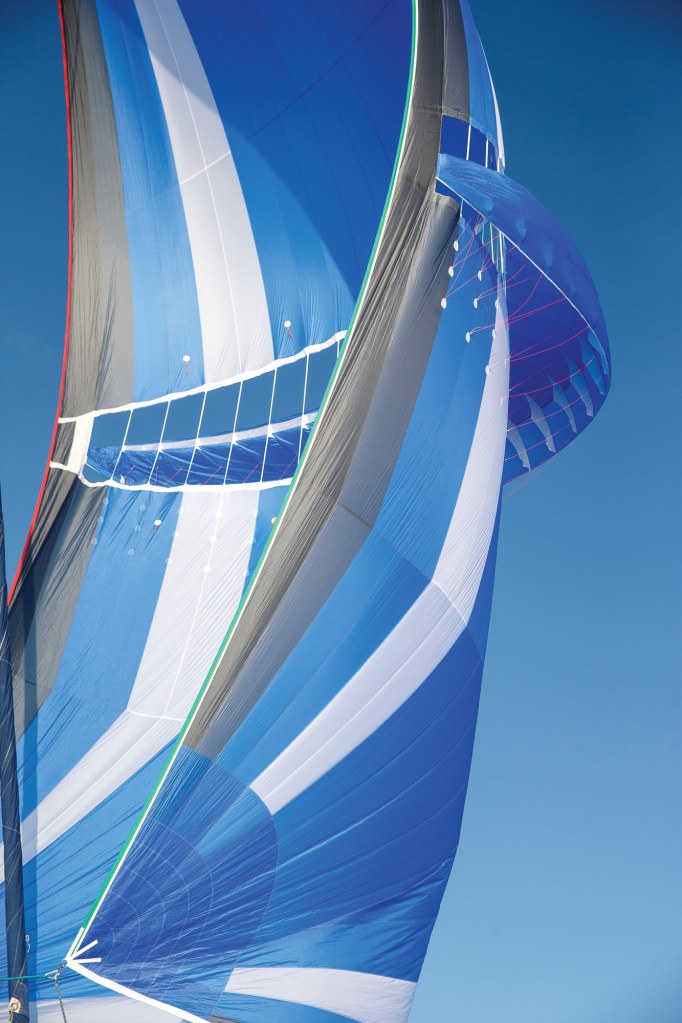
At first glance, a Parasailor looks like any other asymmetrical spinnaker. The difference is the open slot running the full width of the sail, with a wing insert that functions like a soft batten. That wing is what changes everything.
Three things happen as a result of this design. First, the wing maintains a stable sail shape from the moment it catches wind, allowing the sail to fill quickly, hold its form and require almost no trimming once it’s set. Second, the wing deflects airflow downward, generating lift as well as thrust. This design reduces heel and lifts the bow, which, on a deep downwind run in a seaway, is not a trivial benefit. Third, the open slot allows excess pressure and gusts to bleed through rather than loading up the sail like a balloon. The result is a sail that absorbs puffs instead of transmitting them directly to the helm.
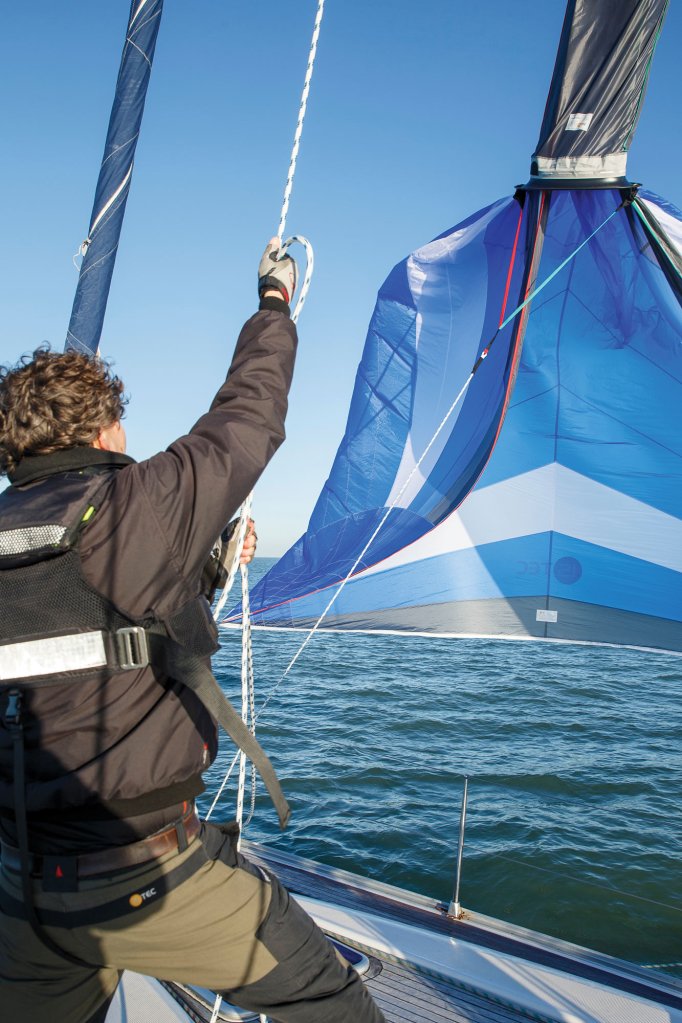
“With this version, I can sail even higher than with mine,” Bijvoets said, easing the sheet and steering up toward a beam reach. The big blue sail stood well off the bow and kept drawing. “They say 70 to 180 degrees apparent wind angle, and that seems accurate. It’s essentially a spinnaker and gennaker in one.”
Most Parasailor sailors drop the mainsail on deep downwind runs. On those angles, the main is largely a liability. It chafes against the spreaders, induces weather helm and complicates any jibe. Without it, the Parasailor pulls the boat along with a steadiness that is difficult to describe without sounding like a sales pitch. I will simply say the boat felt settled in a way that a standard spinnaker does not produce.
The key improvement in the latest version is a redesigned wing with extended flaps at the tips of a slightly shorter span, on the same principle as an airplane extending flaps for landing. The result is more lift and more thrust from a wing that is actually easier to handle than its predecessor.
The Easysnuffer system makes hoisting and dropping manageable for a short-handed crew. Bijvoets’ recommendation: Leave the storage bag in the bow, and feed the top and funnel through the forward hatch. The bag itself is surprisingly compact for a 1,463-square-foot sail, held down by six compression straps and secured with loops to an elastic band so nothing dangles on deck. When the loops are loosened on the foredeck, the bag doubles in size and a mesh strip reveals itself around the perimeter. Hoisting can be paused at any point without drama. The sail waits patiently while you deal with something else.
Dropping is equally controlled. Release the leeward sheet to spill pressure, pull the snuffer funnel down over the sail, and guide it through the forward hatch while the skipper eases the sleeve to the deck. Two people, no panic.
I should note one honest disadvantage: The Parasailor is not a sail for the sailor who enjoys continuous trimming. I once sailed with someone who was looking forward to fine-tuning the spinnaker throughout an entire ocean crossing. I had to disappoint her. Once the Parasailor is set, there is not much left to adjust. For some people, that will be a selling point. For others, fair warning.
The new-generation Parasailor requires tacklines and, on many boats, a bowsprit. It costs more than a standard asymmetrical spinnaker. And once you have used one offshore, you will find it difficult to go back to anything else.
Whether that last point belongs in the pros or cons column is a matter of perspective.