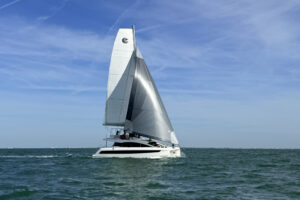

Ronnie Simpson moved like a cat: low to the deck, on the balls of his feet, nimble and quick, eyes darting everywhere, each step anticipating the next. I’ve sailed with him on a couple of occasions, and it’s always a pleasure. The dude is an excellent, intuitive sailor. This time, on a breezy afternoon off Newport, Rhode Island, in September, Ronnie was putting his Class 40 yacht, Koloa Maoli (so named for an endemic Hawaiian bird) through its paces for a photo shoot to promote his upcoming entry in the 2027 Global Solo Challenge, a nonstop single-handed race around the globe.
Ronnie knows all about this race. In its last running, nearly two-thirds of the way around the course—around the bloody planet—he was in third place overall aboard his 50-foot Shipyard Brewing and in great shape to score a podium finish. But when you ask what happened next, he pauses. “It was February 2, 2024,” he says, the day clearly etched into his memory. “Just rounded Cape Horn. But I didn’t celebrate. I knew what weather was ahead. I was so fearful. It was going to get super hard.”
It must be said that it takes a lot to scare the man. A veteran U.S. Marine who was nearly killed in combat in Iraq, Ronnie found solace and a calling after the war in sailing and the sea. He launched a career as a professional sailor and has now put nearly 200,000 ocean miles in his wake.
On that fateful February day off the coast of South America, he’d already seen a lot, but never the converging set of lows and storms that were descending on the South Atlantic. Shipyard Brewing was in the thick of the crosshairs. There was no escape.
“I was on port tack sailing upwind back towards Europe,” he says. “Three reefs in the main. The sea state was horrendous, crazy bad. The waves weren’t waves; they were triangular launch ramps. Multiple swells from all different directions. The boat was pounding and slamming. Then we got launched off a wave. It felt weightless. When we slammed down, the rig came down, too.”
He knew the next low was going to be even worse. There was no way to jury-rig a solution. If he stayed with the boat, bobbing like a cork with no stability, the chances of survival were beyond slim. He made the only correct, prudent call: mayday. Luckily, a Chinese freighter was near enough for a rescue mission, just in the nick of time.
Crashing and burning was bad, but what happened next was even worse. “It was a tough pill to swallow,” he says. “A really big blow. It was the first time I’d dealt with depression. I got into a very deep state and started to really question what life was about, what my life meant, if I should stop my life.”
Happily, Ronnie has a strong support system, starting with his partner, a good Maine gal named Marisa Veroneau. And then there are his brothers in arms, specifically the nonprofit US Patriot Sailing organization, which he continues to represent in his racing endeavors. His website (ronniesimpsonracing.com) is up and running, and he’s seeking sponsors for another round-the-world campaign. He’s out of the darkness. He’s emerged into the light.
“I’ve thought about a lot of things and eventually came to the conclusion that this is my life’s work,” he says. “I’ve always wanted to race alone around the world. I’ve lived my life in a certain way, and I think I did pretty darn well. Not that I needed to prove anything to anyone, except maybe to myself. But I believe I proved that I’m very capable of doing this, even though it ended so poorly last time and was so upsetting.”
Still, after all he went through, I had to ask the question: Wouldn’t it be easier now to just cut the losses? To move on?
“I decided it was important to at least try again,” he says. “I mean, round-the-world racing can be pretty cruel. There’s obviously no guarantee that you’re even going to finish. I could complete 80 percent of the race and get dismasted again. But I realized that my life would really be quite incomplete until I did at least give it another try. I really need to go finish this. It’s just all unfinished business.”