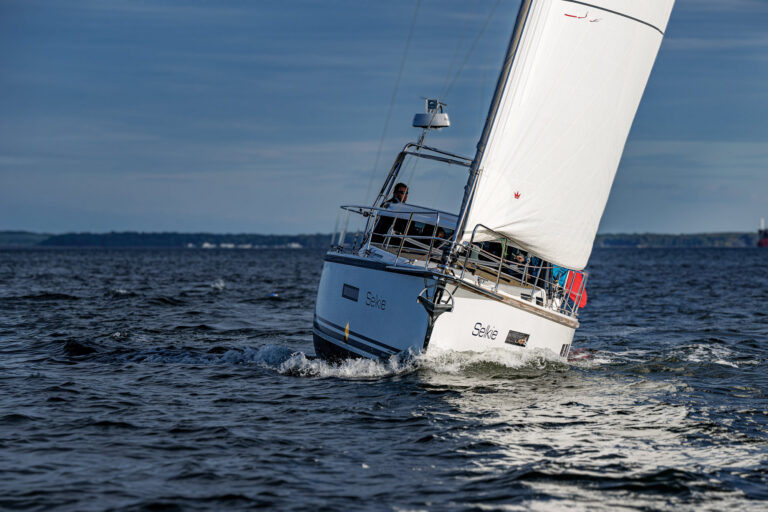
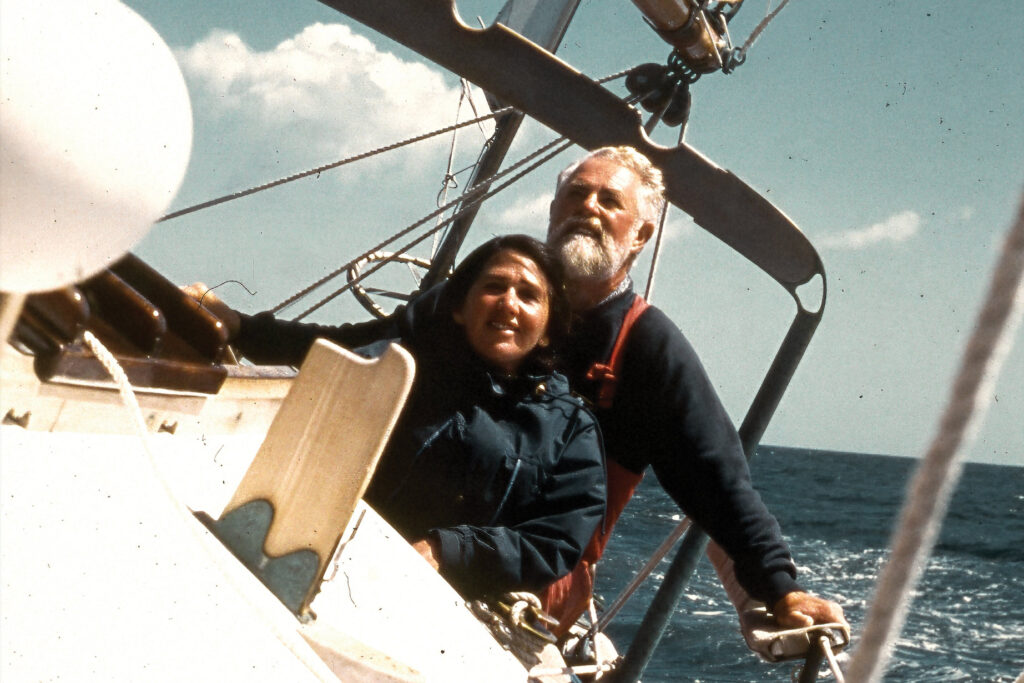
Sahula is kicking up her heels. Driven by a fresh westerly breeze, she eagerly surges through the cresting seas. With the yankee and staysail well eased, and two reefs in the mainsail, the speedometer shows 7.5 knots with frequent surges to 8. Occasional spray flies across the foredeck, turned to sparkling diamonds by the morning sun.
It is not often you get a 25-knot offshore breeze along Australia’s north Queensland coast. Normally the trade winds blow from the southeast, which means there can be up to a hundred miles of fetch to build up a sea. Combined with tidal currents that are often strong, the fresh southeast trade wind seas can be quite boisterous.
But today, with this offshore wind, the limited fetch between us and shore means easy sailing. There is one small downside to this: A line of large hills lies just a few miles inshore of us. The steep-sided valleys and ridges channel the wind, so it is not from a steady direction. Instead of putting the windvane in charge, one of us has to take the helm.
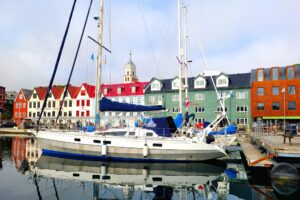
Ever since we lifted our anchor, my partner, David, has been steering. For three hours, he has been seated in his favorite position on the windward coaming, gently easing the wheel a few inches one way or the other to keep the 40-foot Van de Stadt cutter Sahula perfectly on course. He is grinning from ear to ear as he feels Sahula power through another gust. I am nestled happily onto the leeward cockpit bench, savoring every minute of this rare treat.
The miles tick off as the looming cliffs of Cape Cleveland grow ever closer. We only have 40 miles to go to reach today’s goal. We’ve got a fine wind, a good boat.
Only once did I move from where I have been comfortably watching the bow wave hissing by. That was when, halfway across the Bowling Green bight, I climbed below and boiled water for mid-morning tea. I cut two slices of David’s favorite fruitcake. As this fine morning flowed easily by, I was reminded of my first offshore sailing experience, one that my husband, Larry, carefully engineered exactly six decades ago.
On that early November evening, a warm, caressing offshore breeze soothed the ever-present northwest swells off the coast of Morro Bay in Southern California. The sweep of gaff sails outlined against sparkling skies competed for my attention with the green glow of bioluminescence in our wake.
Larry urged me to try my hand at the wheel. This was the first time I’d been more than 20 miles from shore. Agamemnon, a 36-foot Murray Peterson schooner, beam-reached along, creaming through the seas as only a schooner can, her blocks creaking, her bowsprit trying to kiss the waves.
At that time, Larry was working as a professional charter and delivery skipper while building his first cruising boat. We had known each other for six months. We’d spent more than five of those months living together. I’d been asking him to take me along when he delivered boats. Until this night, Larry had made excuses, limiting my sailing experiences to afternoons on various friends’ boats, or in the 7-foot sailing dinghy he’d helped me acquire as we worked together to build Seraffyn.
While we shared the midnight watch on board Agamemnon, Larry began showing me the finer points of steering with a wheel. Guided by him, I fought to keep my eyes on a star instead of constantly staring at the swinging compass card. When, only a short time later, I began to anticipate the schooner’s needs so I only had to make fine adjustments on the wheel, I began to wax poetical about the moment. Larry put his arm around me and said, “An old friend told me, you’ll go out 10 times and then it happens—a perfect sail—and you’ll keep going out nine times more to recapture that magic.”
It was a half dozen years and halfway around the world before I learned how carefully Larry had planned my introduction to his world.
We had just sailed into Poole, a town on the southern coast of England, and secured the boat at the quay. The main street in this small town runs right along the quay, so we’d become a bit of a local attraction. A young man came by and struck up a conversation. Larry invited him on board, and soon, our visitor said, “I’m dead keen on going off to the Med. Wife’s willing to give it a try. It’s a long weekend and we’re headed out tomorrow for a test run across the channel to France. The forecast is pretty bleak—Force 5 or 6 headwinds.”
“I’d can that idea,” Larry said. “That’s how I ruined sailing for my first girlfriend. Got her wet, scared. Why don’t you just reach over to Cowes? Take your wife out somewhere special for dinner, spend a day exploring Cowes, then the next day, reach back home. Try to make it a fun holiday. That’s how I eased Lin into this life.”
I listened as Larry described not only my first overnighter on board Agamemnon, but also the other small ruses he used to lure me into his dream and keep me there until it metamorphosed into mine. The local sailor listened, too. He changed his weekend plans.
His wife came by a few days later. Her eyes twinkled as she told us of their “grand adventure” up the Solent to Cowes, a prelude to what became several years of successful cruising.
Today, as Sahula rushes northward toward Townsville, I realize that Larry was right. For every day like this one, many will be far more challenging, and some downright uncomfortable and difficult. Right now, we are enjoying dream sailing, but in the back of my mind is the awareness that in two or three months, when cyclones become a real threat, we will have to beat south away from the tropics. Then, there are bound to be days when I wonder why I willingly go to sea in small sailboats.
But at this moment, a moment of sailing perfection, I silently thank the man who eased me into what became a sailing addiction. Then I turn to David and say, “My turn on the wheel. You need a break.”
He reluctantly changes places with me. I settle in behind the wheel and gradually begin to feel the rhythm that keeps Sahula moving at top speed.
Yes, this is a 1-in-10 day. And it is more than enough to keep me coming back for more.
After cruising more than 240,000 miles, US Sailing Hall of Fame inductee Lin Pardey is off to sea again. Her latest book, Passages: Cape Horn and Beyond, encourages folks to go simple, go small and go now.