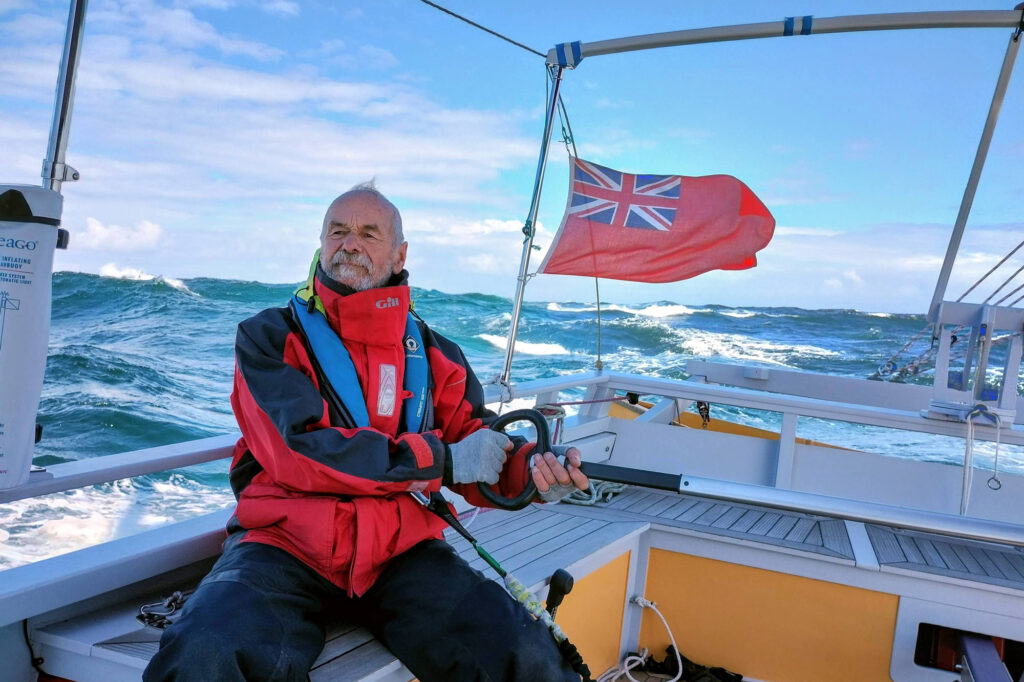
The Cruising Club of America has named British sailor Pete Hill as the recipient of its 2025 Blue Water Medal, recognizing more than 50 years of long-distance voyaging defined by simplicity, self-reliance and a deep commitment to life at sea.
Established more than a century ago, the Blue Water Medal is the CCA’s highest honor, awarded for exceptional seamanship and adventure by amateur sailors. Hill, 75, joins a lineage that includes Bill Tilman, Bernard Moitessier, Eric and Susan Hiscock, and Sir Robin Knox-Johnston.
Hill was notified of the award while cruising in New Caledonia. “I am blown away by this,” he said. “This is such an honor.”
Over five decades, Hill has completed extensive ocean passages aboard a succession of small cruising sailboats, many of them built or heavily modified by his own hand. Central to his philosophy is the junk rig, a low-tech sail plan he has repeatedly proven across the world’s oceans. His approach has resonated with a community of sailors who value seaworthiness, repairability, and independence over complexity.
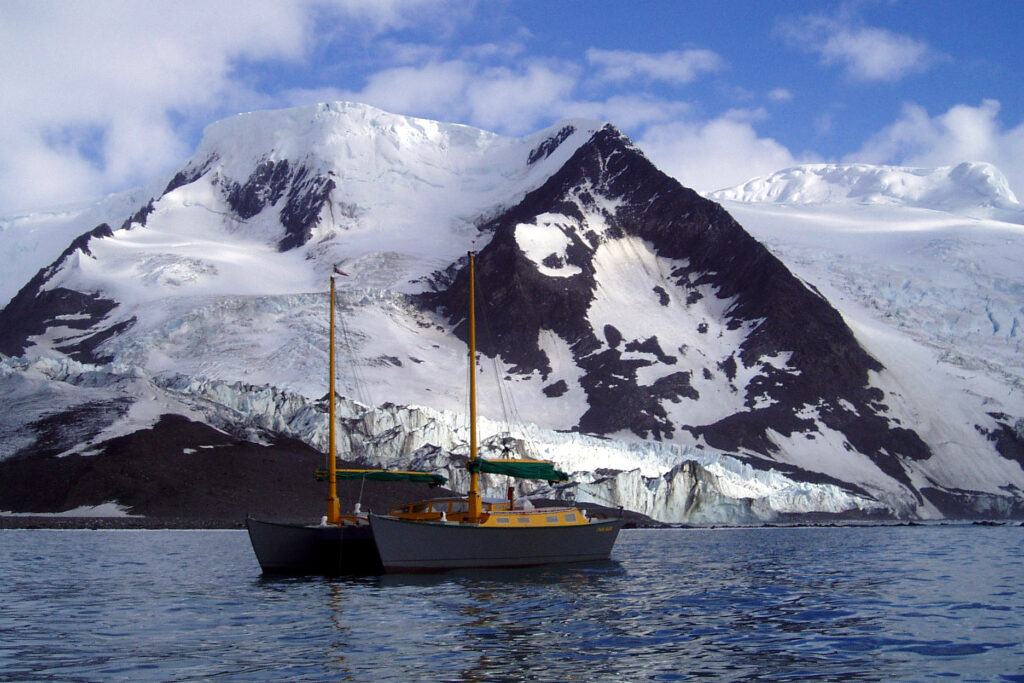
Hill’s offshore career began in the 1970s aboard a self-built 27-foot Wharram catamaran, which he sailed with his first wife, Annie, on a demanding North Atlantic circuit in 1975. The couple later built Badger, a 34-foot plywood dory, and cruised widely in both hemispheres, reaching from Greenland and arctic Norway south to the Falkland Islands, South Georgia, and Gough Island before returning north via Baffin Island and eventually sailing to Cape Town.
He later designed and built China Moon, a 38-foot junk-rigged catamaran, and spent five years cruising the high latitudes of the South Atlantic, including Cape Horn, the South Shetland Islands, Tristan da Cunha, and South Georgia. After selling the boat, Hill delivered her solo from Baltimore to Brazil in 41 days, then sailed nearly 10,000 nautical miles from Brazil to Tasmania with the new owner.
Hill also tested himself in organized ocean racing, finishing second but last in the 2006 Jester Challenge aboard a Kingfisher 22.
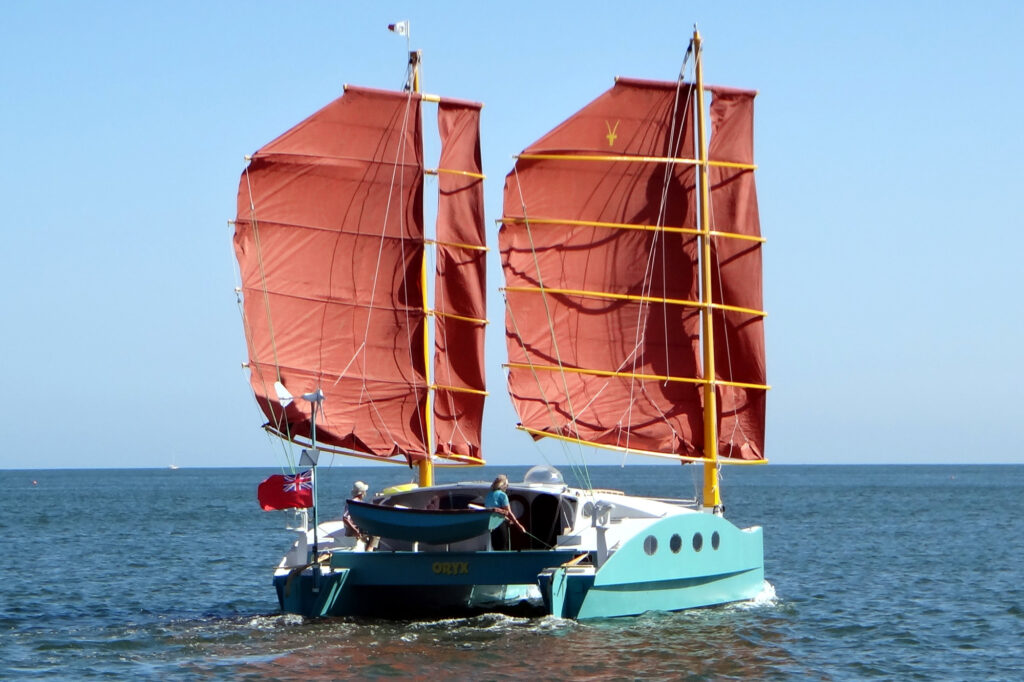
Subsequent projects included converting a Freedom 33 to a junk rig and cruising extensively in Brazil with his second wife, Carly, while contributing a multi-part cruising guide to Brazil for the Royal Cruising Club Pilotage Foundation. He later built Oryx, another junk-rigged catamaran, and crossed the South Atlantic from Brazil to Cape Town.
Hill’s life afloat has not been without tragedy. In 2015, Carly was lost overboard off South Africa. In the years that followed, Hill returned to sea alone, sailing singlehanded across the Indian Ocean to Mauritius and Australia.
During the pandemic, Hill and his partner, Linda Crew-Gee, built Kokachin, a junk-rigged schooner. Her first voyage included a North Atlantic crossing, cruising in the Caribbean, and a circumnavigation of Newfoundland. When China Moon unexpectedly came up for sale, Hill bought her back. After a refit in Tasmania, he and Crew-Gee departed for New Zealand in 2025, surviving a severe Tasman Sea storm that damaged the boat and required six days of continuous hand steering.
Hill and Crew-Gee are now cruising in the Pacific.
In honoring Hill, the CCA cited not only the scale of his voyages, but also his lifelong commitment to simple construction, practical seamanship, and boats designed to be understood and maintained by their owners. His career stands as a reminder that ocean cruising remains as much about judgment and resilience as technology.
More information on Hill’s boats and voyages can be found at junkrigventures.org.
The CCA also named five other 2025 award winners for their adventurous use of the seas, including Tamara Klink (Young Voyager Award); Philip “Greg” Velez (Rod Stephens Seamanship Trophy); Peter Willauer (Diana Russell Award); Christopher and Molly Barnes (Far Horizons Award); and Doug and Dale Bruce (Richard S. Nye Trophy).