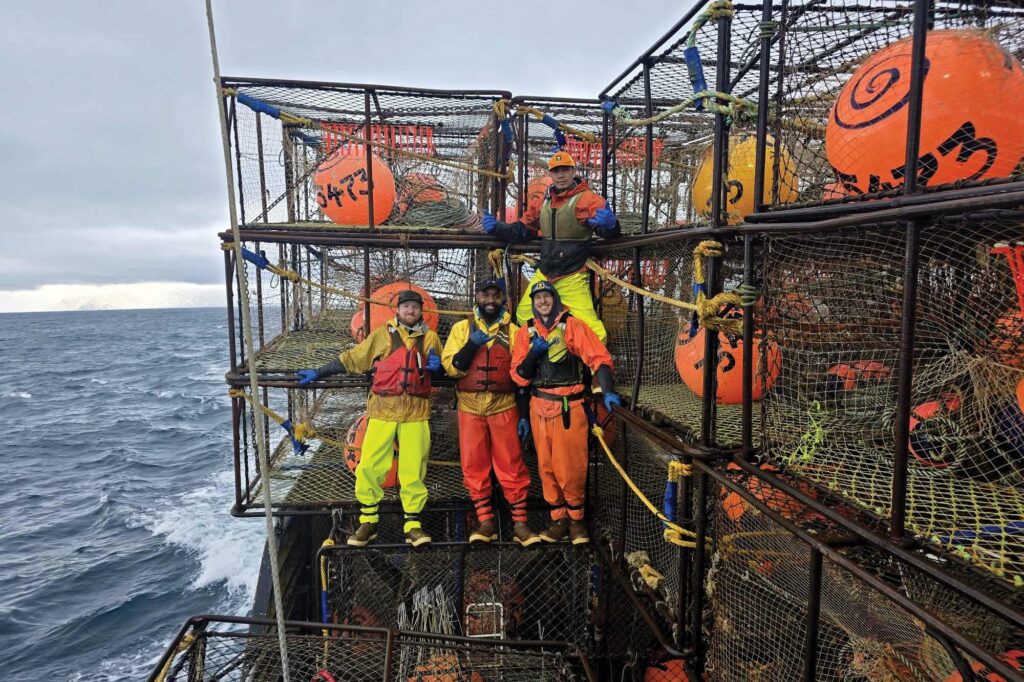
The wind screamed against the steel hull, sending icy mist sideways across the deck. It was the kind of cold that clawed into bone, the kind of wet that no amount of gear could keep out. Thirty-foot swells rolled like sleeping giants beneath the boat.
Dan Lambert, on hour 20 of a Bering Sea shift, gripped the rail with callused hands. Somewhere between sleep deprivation and survival mode, a thought drifted through his salt-slicked mind: I wonder how warm it is in Mexico right now.
This is Lambert’s reality—one foot in the violent rhythm of the North Pacific, the other in the slow-burn dream of a sailboat still on the hard. It’s a dream that, like most good ones, started with a friend and a little peer pressure.
Lambert grew up in Kodiak, Alaska. It’s a place where the sea doesn’t whisper. It roars. Kodiak is an island of steep hills, damp wind and hard-earned meals. The ocean was in Lambert’s blood before he ever stepped aboard a working vessel.
“Neither of my parents were fishermen,” he says, “but our whole town ran on it. You start young. You work hard. You learn quick or you don’t last.”
He spent his younger years in competitive swimming, always in the water, always moving. But swimming pools became fishing decks, and before long, summer jobs turned into seasons, then years. He worked his way through every part of the operation: salmon fishing in Bristol Bay, Pacific cod in the winter—endless cycles of openers, closers and cold so deep it rattled the teeth.
Yet, Lambert is not your average Bering Sea fisherman. Sure, he’s got the frostbitten fingers, the thousand-yard stare, the effortless way he ties knots that would leave most sailors Googling for help. But he also has a dry, unflinching wit. A laugh that sneaks out of the corner of his mouth. A storyteller’s soul wrapped in raingear and sarcasm. He’s the kind of guy who can make you laugh in the middle of a squall, and mean it.
Lambert didn’t move to Mexico for the tacos or the tequila. He came to help my friend Peter Metcalfe work on Peter’s 38-foot Hans Christian Kessel in the Cabrales Boatyard, the same yard where my boat, the 41-foot Cheoy Lee Avocet, spent her summer after our first cruising season. It was Lambert’s first time south of the border, and he had no plans to buy a boat—until, well, plans changed.
“I got food poisoning and was couch-riding in the cruiser’s lounge, half-dead, scrolling Facebook sailboat listings for no real reason,” he says. “Then I saw her—this 1976 Ta Chiao ketch. The photos looked familiar. Turned out the boat was literally across the yard. I could see her from the couch I was dying on. Felt like a sign.”
The boat, now named Rue De La Mer, isn’t pretty. Not yet, anyway. It has an inch-thick fiberglass hull and stained-glass portholes, two of its only redeeming features. But Lambert saw potential, maybe. Or at least a path out of the freeze-thaw loop of commercial fishing.
Coming from a background of journalism, he had always wanted to travel. Sailing, he thought, might be the cheap way to do it. He laughs now, like many of us do: “I’ve never been more wrong in my life.”
Still, he returns to the boatyard between seasons, chipping away at a refit list that reads more like a personal reckoning: rigging, electronics, sails, deck hardware, bowsprit, paint. “Honestly, way too much to list,” he says. “But not working on my boat makes me want to work on it. So there’s that.”
Lambert describes fishing for Pacific cod in the Bering Sea is as “the apex of commercial fishing.” Haul gear for 20 hours, sleep for three. Fill the boat with up to 200,000 pounds of cod. Repeat. “You’re just hoping to come back with all your appendages,” he says. Which, unfortunately, is not an exaggeration. Our friend went deep sea fishing off the coast of Canada and tells the tale of a buddy who lost a finger—clean off, just gone. He had photos to prove it.
And yet, when the fish are sorted and the hold is full, there are moments. Raft-ups in Bristol Bay. Grills lit. Rainiers cracked. Midnight sun hanging high above the water. For a brief second, the ocean turns soft again.
The real dream is not tied to quotas or survival. It’s the idea of floating freely, of chasing warm currents and slow mornings. Of anchoring somewhere that doesn’t feel like a battleground.
Lambert wants to start small. Shake out the sails, learn the rhythm. Someday, maybe, take the boat all the way north from Mexico, to bring it home. To prove something to himself. “I think the click moment will be when it finally hits the water,” he says. “Right now it’s just a dream sitting on jack stands.”
There’s something about people like Lambert that sticks. He reminds me that not all grit looks the same. That humor is armor. That storytelling is survival. Those dreams, even when absurd or unfinished, are worth documenting.
A lot of people are out there refitting boats in backwater yards with no real timelines and very questionable budgets. But few of them are hauling gear in the Bering Sea one month and sanding down their bowsprit in the desert the next. Fewer still can make you laugh while describing both.
Lambert is still waiting to cast off, but in all the ways that count, he’s already underway. He’s working, building, suffering, laughing—and above all, hoping. Maybe that’s what drew me to his story. Maybe that’s what makes me root for him.