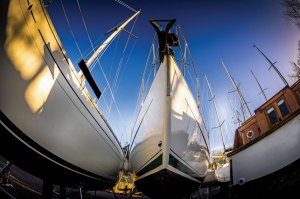
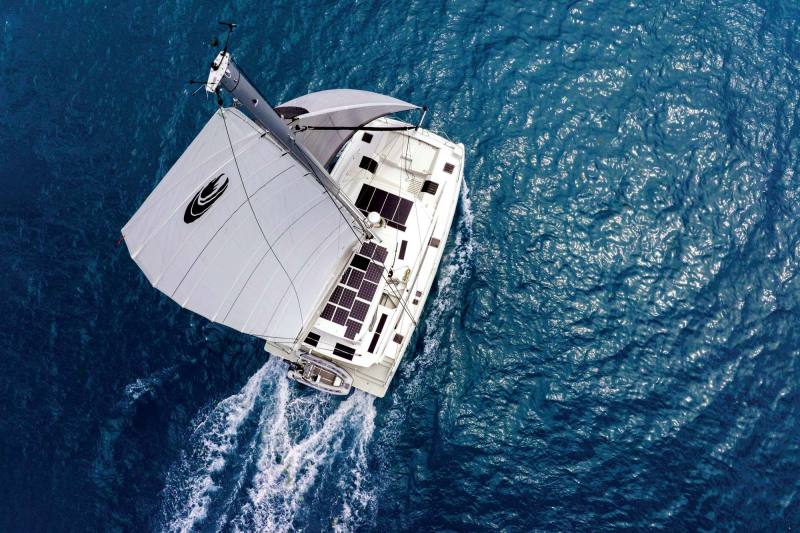
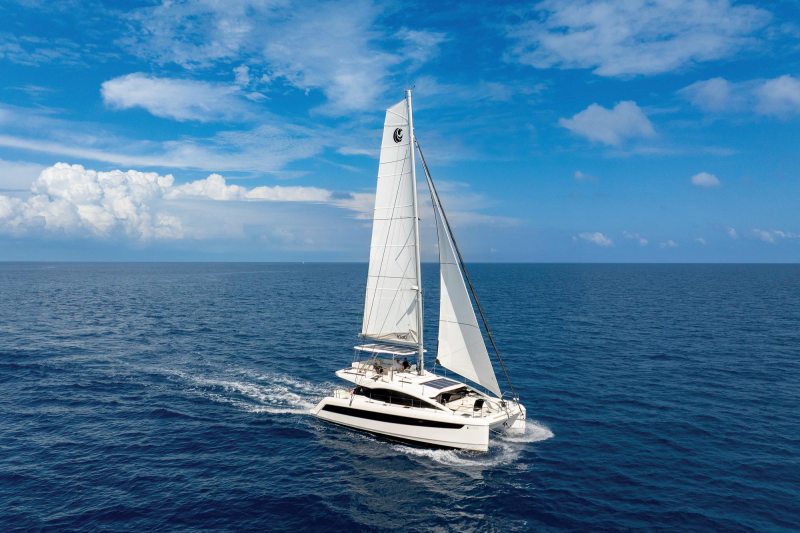
The mast caught my attention first. At 82 feet, 6 inches above the waterline, it’s a lot of aluminum for a 49-foot, 1-inch boat. A proportion like that is intentional. Aquila clearly didn’t come into the sailing catamaran market to build a modest first effort.
Aquila earned its reputation manufacturing power catamarans at the Sino Eagle facility in China, but the team behind the new sailing line reads like a who’s who of charter and production sailing pedigree—starting with Jean Raas, a former US National Sailing Team member who ran purchasing and logistics for The Moorings and Sunsail; his co-founder Lex Raas, who spent years developing catamarans at Beneteau and served as CEO of The Moorings; and Nick Harvey, Aquila’s new chief revenue officer who previously managed Lagoon distribution across Europe.
These aren’t powerboaters dabbling in sail. They know exactly what bluewater cruising sailors want, and the Aquila 50 Sail reflects that institutional knowledge at every turn.
Hull No. 1 made its debut at this year’s Miami International Boat Show, and we were aboard for a sea trial off Miami Beach in the days that followed. Light, variable air out of the north-northeast, 5 to 15 knots, and a modest dose of chop from passing boat traffic aren’t exactly the conditions that flatter a new design, which is precisely why they’re useful.
With jib and main drawing in 7 knots of true wind at 65 degrees apparent, the 50 Sail moved at 4 knots—modest, but honest in the light air. Bearing off to 90 to 100 degrees once we found 12 knots true, she pulled 6.1 knots over the ground. The boat felt balanced and settled, carrying the helm without drama and tracking cleanly through the short, leftover chop. The air conditioning ran the entire time under the hot South Florida sun, powered by the Torqeedo hybrid system without complaint, which tells you something about the electrical architecture.
The more compelling number came not from our sea trial, but instead from the delivery passage around the bottom of Florida. According to Aquila’s global brand director, Alain Raas, running tight on the beam in 25 to 30 knots of breeze, the 50 Sail hit 9.5 knots under sail, peaking at 10.6. That’s serious boatspeed for a cruising cat carrying 42,900 pounds light.
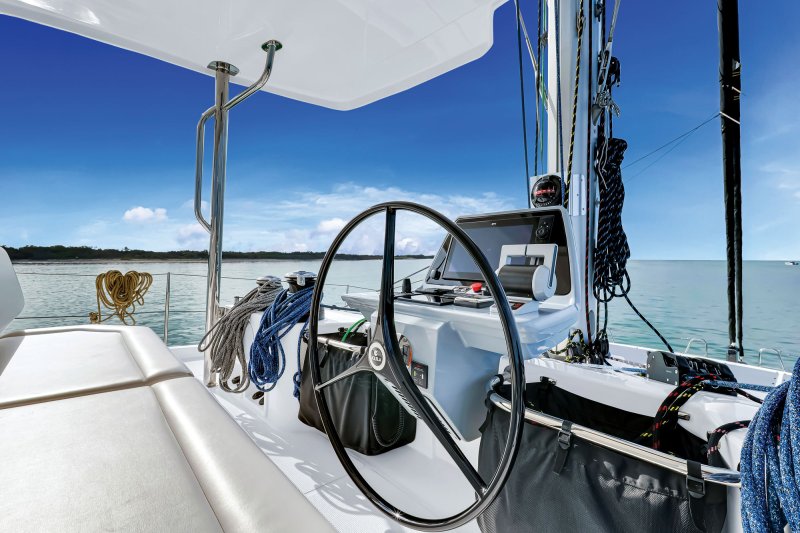
The double-spreader rig, engineered to make furling the full-batten main less of a wrestle, contributes to a well-mannered sail plan that rewards a shorthanded crew without punishing a solo one. Lazy jacks spread aft keep the main under control on the way down. It all works the way an experienced charter sailor would design it, because experienced charter sailors did.
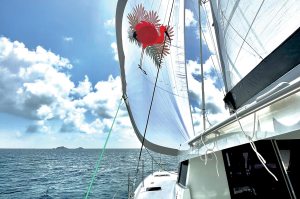
With the optional code zero set on a beam reach in the Miami chop, boatspeed climbed to 7.2 to 7.3 knots in 16 knots true. On deeper angles (105 to 120 degrees in 15 to 16 knots true) she held 7 knots. In the shifty stuff, running at 140 degrees with the apparent wind at 12 knots, she settled at 5.2 knots speed over ground.
None of these are racing numbers. All of them are passagemaking numbers, and that’s the point.
The propulsion is where Aquila placed its clearest bet. Buyers can specify twin 50 to 75 hp Volvo Penta or Yanmar saildrives in the conventional diesel configuration. The diesel version starts at $1.7 million well-optioned, or add $300,000 for what Aquila calls its Hybrid Ocean Drive: a pair of Torqeedo Deep Blue electric motors producing a combined 100 kW (roughly the equivalent of 80 hp), running on straight shafts, backed by 160 kWh of lithium batteries and a 40 kW Kohler generator.
The generator is forward, tucked under the foredeck seating just forward of the deckhouse windows—accessible, well-placed and sensibly isolated from the living spaces. It kicks on automatically when the battery’s state of charge drops to 30 percent, and it returns the bank to 80 percent in roughly 30 to 40 minutes.
Underway on electric alone, the boat ghosts along at 8 to 9 knots. Aquila calls it “motorsailing in silence,” and there’s no better phrase for it. Owners can run one shaft under power and regenerate on the other, stretching range and managing the battery bank with a logic that will feel familiar to anyone who has wrestled with energy budgets on a long passage.
Of the first four hulls sold, two went diesel—both headed into charter service—and two went hybrid. That split will likely narrow as hybrid buyers discover what Hull No. 1 demonstrated at the boat show: The 50 Sail ran the entire Miami International Boat Show without connecting to shore power once. Air conditioning, refrigeration, navigation systems, lights—all of it on the battery bank. In an anchorage, that would be independence.
Redundancy runs through the entire electrical architecture. The dinghy crane is a single-point-lift system that raises the tender electrically from high up in the structure rather than via a low-mounted hydraulic system exposed to the elements. This crane has three modes of operation: a switch panel on the port side of the swim platform, a handheld remote and a manual override. That’s the Aquila thinking in a nutshell: Anticipate the failure, and build around it.
The cockpit is substantial even by catamaran standards, organized by people who have spent real time in charter and passagemaking scenarios. The table here seats 10 and comes with four director’s chairs. Two loungers to port and starboard are angled for watching the world go by, which is precisely what I wanted to do in them. Two wet lockers drop into the cockpit sole for gear and water toys. A built-in air compressor near the transom serves the dive crowd. The cockpit enclosure, when not needed, recesses into a dedicated stowage system and disappears, a detail that sounds minor until you’ve lived with a lashed-and-rolled enclosure flogging in the breeze.
But back to the dinghy crane, which deserves its own paragraph: Most catamarans handle tender stowage awkwardly. It’s an afterthought bolted to the stern, sacrificing cockpit real estate or requiring two people and a prayer. The Aquila system lifts the dinghy on a single point of contact, electric motor running cleanly from above, and deposits it on chocks at the after edge of the transom with a slight overhang, recovering 6 feet of usable transom access for the social area that the cockpit was designed to be. It is a clever solution to a problem that has frustrated bluewater cruisers for decades.
The flybridge helm is positioned logically, with the U-shaped settee seating eight people and a 16-inch multifunction display on the molded fiberglass console. Forward access to the bow runs along dedicated port and starboard stairways with stainless stanchions and Spectra lifelines. The Aquila DNA carries over from the powercat line, where bridge-to-bow access was a signature feature from the start.
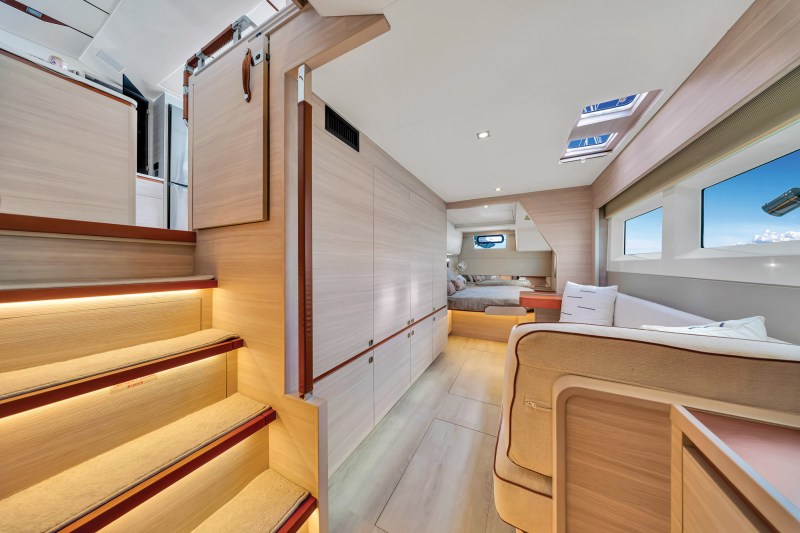
Interior accommodations run from four to six staterooms depending on configuration, all with ensuite heads and walk-in showers. The master occupies the full length of the port hull with a 73-by-76-inch memory foam berth, a chaise seating area and a vanity. It’s a space that’s genuinely livable rather than merely adequate.
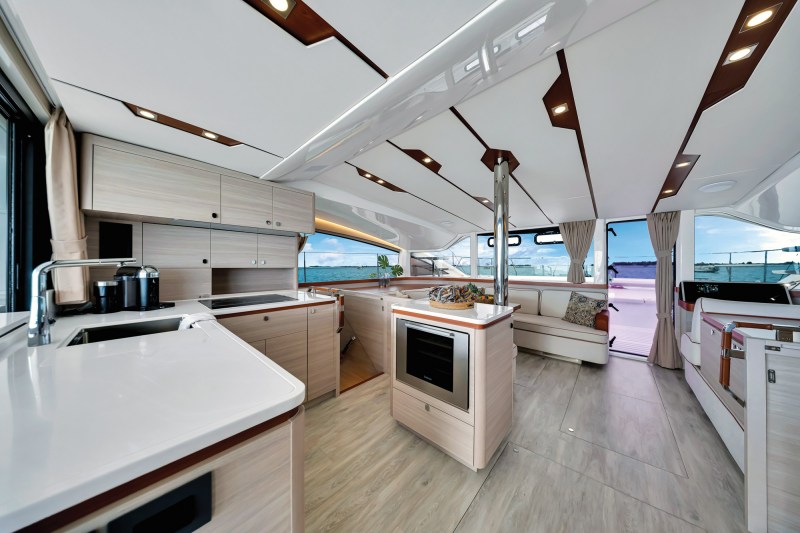
The galley has a four-burner induction cooktop with Corian countertops, a full-size French door refrigerator and separate freezer, and a bar window that opens directly to the cockpit. This last feature—Aquila’s signature bar connection between galley and cockpit—makes the transition from passage life to anchored life feel effortless.
Construction throughout is resin-infused vinylester with PVC foam core, no plywood in any structural component or below the waterline, with bulkheads glassed directly to hull and deck. Hulls, decks and bulkheads are all molded as single-piece components. The fuel tanks were designed around the boat; they sit under the cockpit table, easily accessed through a lifting sole panel, positioned for ideal longitudinal weight balance. It’s a small thing to mention but a significant thing to live with offshore.
My personal takeaway: The Aquila 50 Sail is a serious first effort from a team that knows what bluewater cruisers actually need. It is not a racing machine, nor is it trying to be. At 42,900 pounds light displacement with an 82-foot mast, 1,748 square feet of upwind sail area in the optional square-top configuration, and a hybrid drivetrain that ran an entire boat show on battery power alone, it is a capable, well-considered, passagemaking platform at a price ($1.7 million diesel, $2 million hybrid) that puts it squarely in the premium cruising catamaran class.
The 45-foot model debuted at the Cannes Yachting Festival in September, with a 65-footer to follow. If the 50 is any guide to what Aquila has in mind for the full range, the established players in this market should be paying attention.