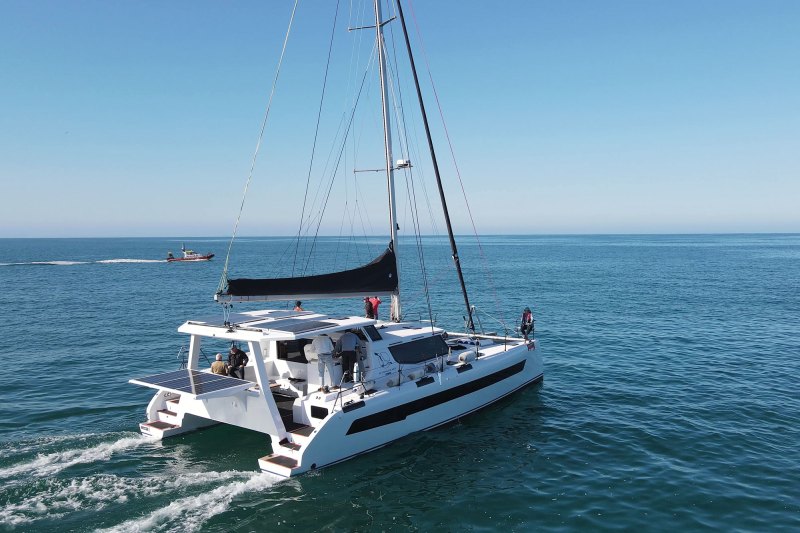
Two days after a weak cold front had pushed through, the wind off West Palm Beach, Florida, was still hunting. It shifted north to northeast, 10 to 15 knots with occasional lulls that dropped it to almost nothing. Not the conditions most sailors would choose to sea trial a new boat.
But for our purposes, sailing the St. Francis 460 in honest, post-frontal chop with a mixed breeze was better than any dog-day demo. Light air reveals a boat’s true sailing character. Leftover slop tests its structure. The 460, hull slicing through the short, steep seas with a steadiness that felt more like a 50-footer than a 45, passed both tests.
St. Francis Marine has been building catamarans in St. Francis Bay, South Africa, since 1988, when founder Duncan Lethbridge commissioned naval architect Angelo Lavranos to design a cruising cat for his family. That boat, the St. Francis 43, created enough demand that a small factory followed. The yard has operated that way ever since: deliberate, uncompromising, building around four boats a year.
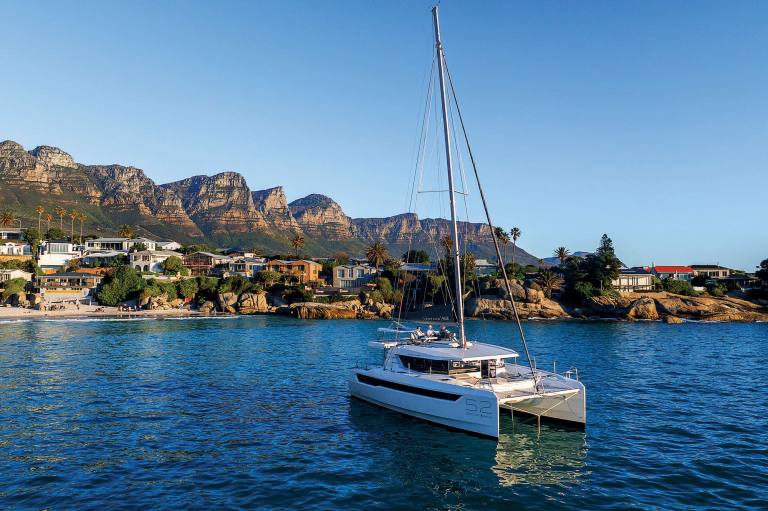
The 460, Kokoro, which debuted at the 2026 Miami International Boat Show, is a collaboration between Lavranos and Anton du Toit of Du Toit Yacht Design, developed alongside input from brokers and customers. Its closest sibling is the SF50, which took top honors as the Best Cruising Catamaran in Cruising World’s 2006 Boat of the Year contest. The 460 shares that boat’s DNA—protected helm, shorthanded systems, serious offshore intent—scaled to a more accessible 45 feet, 10 inches.
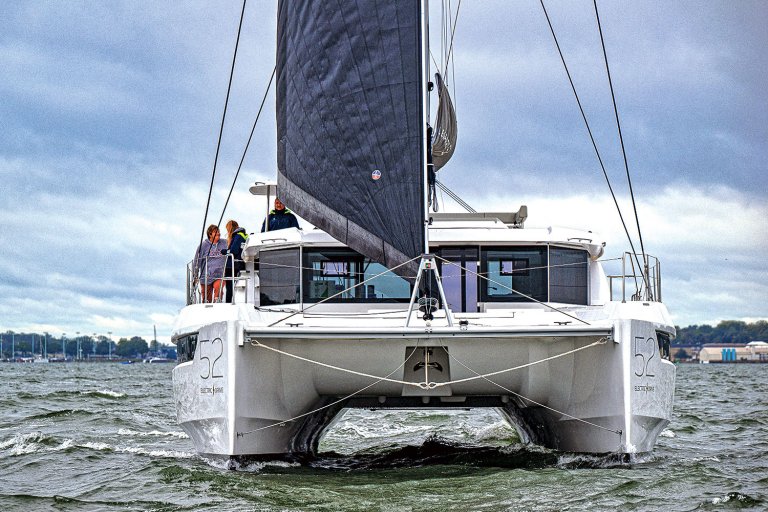
The hull tells the story before you even step aboard. St. Francis builds using vinylester resin-infused foam-core sandwich construction throughout, with carbon fiber reinforcement at every high-load point. The infusion process alone shed nearly 1,800 pounds compared to the yard’s older vacuum-bagged system, producing a structure that is stiffer, lighter and impervious to delamination. All bulkheads are carbon-reinforced and glassed directly into the hull and deck. No mechanical fasteners, no creaks, no flex. Bridge-deck clearance is generous.
And there are compound-curve countertops in the galley, a detail that sounds cosmetic until you’re offshore in a seaway and grateful your coffee isn’t sliding into your lap. The countertops reflect the same thinking: Every decision answers a bluewater question.
Much of Kokoro’s technical sophistication traces directly to Michael Farnitano, the boat’s original owner, who worked closely with St. Francis throughout the build. A technically minded sailor with strong convictions about offshore self-sufficiency, Farnitano pushed the yard on systems redundancy, energy independence and what he believed a serious cruising cat should be capable of without a marina. The boat that emerged is a statement about how a purpose-built liveaboard can be smartly configured, and the hybrid propulsion system is its most visible expression.
Ren Guindon, St. Francis’ sales representative, framed the boat’s entire design philosophy in a single sentence: “Everything we do at St. Francis is to singlehand.” It’s not a marketing line. The deck layout, the enclosed helm, the sail plan, the systems redundancy—every decision traces back to the same question: Can one person manage this, offshore, at night, in weather?
St. Francis partnered with Hybrid Marine in the UK to integrate a 43.2 kWh lithium battery bank—six 48-volt magnesium-lithium units, supported by additional 24- and 12-volt lithium banks and AGM start batteries—with upgraded twin 57 hp Yanmar diesels and an electric drive system on each shaft. Motoring at 2,300 rpm, the boat logged 9.4 knots over ground. On electric alone, she’ll sustain 4 to 6 knots for as long as four hours. That’s enough to enter an anchorage, navigate a marina or ghost out of a harbor at dawn without waking anyone aboard or ashore.
Hydrogeneration under sail replenishes the battery bank on passage. The standard specification runs twin 45 hp Yanmars for buyers who don’t need the full hybrid suite, but this boat’s template is based on Farnitano’s conviction that a liveaboard passage boat should carry tested technology for true energy independence, with no propane aboard and electricity doing the work.
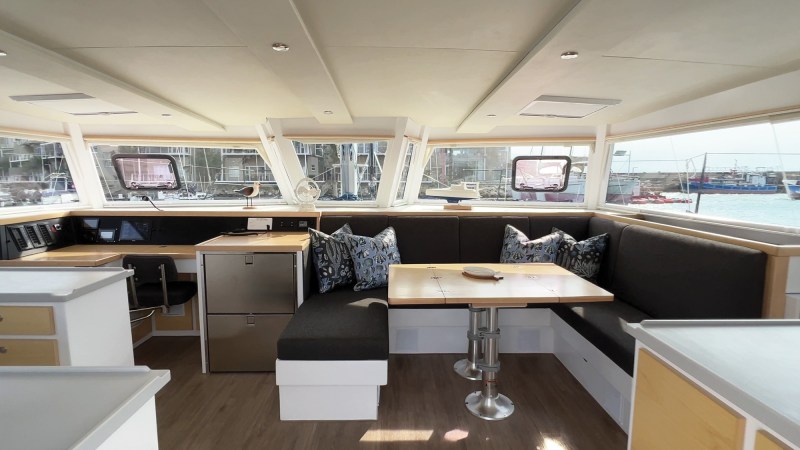
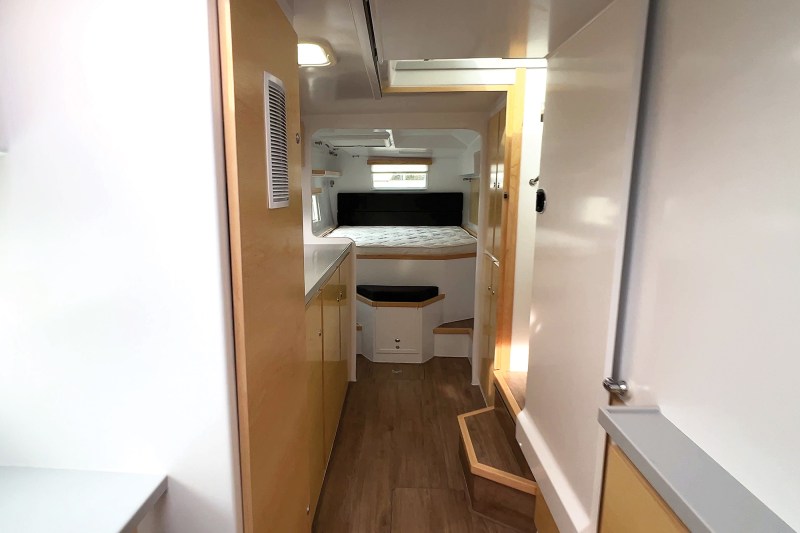
Belowdecks, the 460 offers three- or four-stateroom layouts built around a bright, airy saloon. Oversized windows dissolve the boundary between interior and sea. The galley runs on a Kenyon induction stove, LG oven and Bosch refrigeration. No propane, no compromise.
A sliding door between the saloon and cockpit opens both spaces into a single covered living area, practical for trade-wind passages and excellent at anchor. The enclosed helm station keeps the watch dry and connected, with visibility in every direction—what Guindon calls total protection for the operator.
On the water, the 460 proved its intentions. With a full main and genoa in the post-frontal chop off Palm Beach, she drove cleanly through the seas, cutting rather than slamming, tracking without fuss. On a reach with the code zero drawing, she settled into 7.5 knots at 8.5 knots of apparent wind, easy and unhurried with plenty of boat left in reserve.
Upwind was the more telling story. Pinching to 43 degrees apparent in 13 knots true, she still pushed through at 5.1 knots. That’s not a number that wins races, but it’s entirely respectable for a fully loaded bluewater cruising cat in light, shifty air. In steadier breeze, Guindon said, she’ll hold 30 to 35 degrees apparent wind angle and keep making meaningful forward progress. Under power, at 2,400 rpm with the main up and a 3-knot contrary current pushing against us, she still logged 7.5 knots.
Tacking shorthanded was straightforward. The sail plan is honest, the deck layout rewards a two-person crew without punishing a solo one, and the enclosed helm kept the watch comfortable and in command throughout.
Also on board with us during the sea trial was Kokoro’s new caretaker: a former three-time Fountaine Pajot owner who followed St. Francis for years before seeing the 460 at Annapolis and making his move. He wanted a boat that was not a production cat, something with more waterline, more personalization. He had only recently taken delivery when we got aboard, with the handover including a Bahamas passage and a Gulf Stream crossing, yet he was already moving around the boat with the quiet confidence of someone who had found his footing.
That, perhaps, is the most honest endorsement of the 460’s shorthanded ethos: a new owner, still learning the boat, already comfortable. “Solid,” he said more than once during the day. “Well built.” He was already planning a run up the East Coast to Maine. The Great Lakes were on the list after that.
At roughly $1.3 million base and $1.6 million fully equipped, the St. Francis 460 is not a casual decision. Neither is a bluewater passage. This boat’s owner is already planning to cruise to Maine. After a day on the 460, it’s hard to argue with his reasoning.