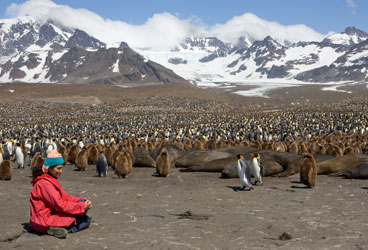
St. Andrews Bay
CW_ concludes the extraordinary five-part adventure series by documentary filmmakers Deborah Shapiro and Rolf Bjelke in which they recount their four-year, 22,500-nautical-mile circumnavigation of the Southern Ocean. Sailing the 40-foot steel ketch_ Northern Light_ in the Roaring 40s, Furious 50s, and Screaming 60s, Deborah and Rolf explore the beautiful and far-flung subantarctic islands strung like pearls around the bottom of the Earth._
I’ll be forever grateful to the Swiss man who taught Rolf and me how to interact with fur seals, because dealing with them improperly can turn any visit ashore on South Georgia into a dangerous encounter. Luckily, we met Hansjoerg in Grytviken, our first stop and his last after a monthlong charter around this overseas territory of the United Kingdom.
“I was really scared of fur seals at first,” he told us over a cup of tea. “Just getting close to shore in the dinghy, where we could see the bulls fighting, made my heart pound hard. When we landed, I instinctively wanted to get through the line of seals on the beach as quickly as possible. My friends and I moved as a group, each of us brandishing a stick. The seals moved out of our way, but that movement aggravated their neighbors and created a ripple of conflict through the community. Our skipper took it slowly instead. It didn’t take long to learn that his method was better.”
Naturally, previous experience colors us all. On this circumnavigation of the Southern Ocean, our first run-in with a seal was on the subantarctic Auckland Island, which lies south of New Zealand. There Rolf and I were repeatedly treed by a Hooker sea-lion bull that wouldn’t allow us to walk anywhere in the cove where he kept his harem. The next season, I was scared silly on New Zealand’s Campbell Island when I was suddenly surrounded by five roaring bull sea lions. I was sure one was going to knock me over, then crush me to death. As a consequence, I’d been dreading that there are now 4 to 5 million adult fur seals filling South Georgia’s beaches. Our permit protects us from the “worst” places—tourists aren’t allowed to go ashore on the western part of island, where the most crowded breeding colonies are located.
A Moment of Truth
After finishing our check-in procedure at the administrative center in Grytviken and resting for a few days to recover from the passage, it’s time for Rolf and me to put ourselves to the test. We move to Jason Harbour and anchor just outside a shallow, nearly enclosed lagoon. Aboard the inflatable, we cruise along the shore checking out the situation. There’s a lot of movement on the beach. Even above the noise of the outboard, we can hear the cacophonous bellows of the disgruntled bulls and the wails of crying pups. Family groups are spread across all the potential landing spots. Fortunately, the narrow beach is only one breeding group deep—not so scary a scene for our first attempt. Finding one group of resting elephant seals, we decide to land in the few feet of open space between them and the fur seals. In our experience, elephant seals usually don’t wake up from the noise we make while landing. If they do, they just raise their heads, maybe open their mouths wide, then go back to sleep. If they move, it’s to get away, not to charge.
Following Hansjoerg’s advice, we don’t wear black clothing. And after pulling the dinghy up on the beach, we sit on a pontoon. The bull closest to us is agitated by our arrival and dances around at the edge of his territory, making a lot of fancy head moves and growling. But he doesn’t attack! While waiting for him to calm down, we check out his small family, just one female and one pup. After a few minutes, the bull ignores us completely. To re-establish contact with his pup, he gently noses it in the ribs. The pup, only a few weeks old, gets curious about us, but its advances in our direction are warded off by his father. We stand up and walk slowly inland. The elephant seals slumber. The papa and pup don’t react as we pass. The female never even wakes up.
Including the ones in the back of our heads, we keep our eyes on the seals on the beach and in the neighboring tussock grass as we continue onward. Climbing, we pass between nonbreeding solo seals resting on the hills. I’m still nervous, and my mouth is dry, but I remain adamant that when charged, I’ll hold out my ski pole and stand my ground. Hansjoerg assured us that the fur seal’s nose is so sensitive that it won’t risk advancing into the pole. The most dangerous part of the climb is through a small gully, where seals on both sides are hidden between overhanging clumps of tussock. We move as quietly as we can, but some seals notice us and lunge at our heads. Luckily, we’re out of range.
The next day, when we go ashore in the same place, the elephant seals are gone. The fur-seal harem whose space they temporarily commandeered has moved back in. We land between it and yesterday’s family of three. We’ve been accepted. The only reaction to our intrusion is the new bull making a noise like a whining dog—until his attention is diverted by one of his females giving birth. As he and we watch silently, the procedure is completed in seconds. Immediately, the mother moves the pup away from the bloody placenta, then licks her newborn clean. A young nonbreeding male comes barreling down the hill. He’s got speed on to run the gauntlet to the water. Snarling, the bull intercepts him. He tries to bite the youngster’s neck, but he misses and sinks his teeth into a hind flipper.
“That youngster could use a session with Hansjoerg,” Rolf says. We walk on.
South Georgia is a high island, with a mountain ridge running along the entirety of its 100-mile length. At 54 degrees south, the island sits in the cold Antarctic Circumpolar Current. The summertime water temperature near the island used to be 35 F to 40 F, but with the recent breakup of the Larsen Ice Shelf, there’s more ice near South Georgia these days, and the water temperature remains closer to the freezing point.
In the Furious 50s, the prevailing westerly winds are an important factor in the making of South Georgia’s climate. The interaction of the moist wind with the high topography creates distinct climate zones on the small landmass. We decide to skip the south coast. In the direct path of the westerly wind’s onslaught, that zone is the most cold, damp, and glaciated. The few anchorages it provides are rather open and prone to fill with ice. Rather than make the cruise a tactical challenge of circumnavigation, we decide to visit the comparatively warmer, drier, and sunnier leeward coast with the intention of getting to know that area well.
Using GRIB files and the weatherfax prognosis from Chile, we’ll usually know when bad weather is approaching. As first-time visitors, what we don’t know is where to find the best shelter. Sure, one can easily recognize possible places on the charts. But seeing the shape and depth of an anchorage is just the start. The local topography has to be considered also, because a high, complex landscape creates many factors that influence the wind. It’s not uncommon for neighboring fjords to experience different wind directions and strengths during a blow. And one spot in an anchorage can be OK while only 50 feet away rages a tempest, because it’s in what we call a “wind channel”—a path that the wind is forced to take because of local topography. We try to identify the location of wind channels in an anchorage before dropping the hook.
In Search of Shelter
During the first few weeks of our stay, we use every spell of good weather to move to a new anchorage. Each is tested and judged. We stay in the central section of the coast while a wall of dense fog obscures the eastern climate zone. Ashore as much as possible, we walk as long and far as we can. We’re unhindered here by the dense bush found on other subantarctic islands, so the hiking is fabulous. Only glaciers and steep mountains stop our progress. It’s difficult to decide if we ooh and aah more over the starkly contrasting black-and-white alpine scenery of the interior; the low-altitude lush, green vegetation; the glittering, blue icebergs in the fjords; or the wildlife. South Georgia must be the most densely populated animal habitat left on Earth. On this island, one can imagine the world of hundreds of years ago, before mankind launched the industrial era and started encroaching on ecosystems and carving up habitats.
When the first gale of our stay is forecast, we’ve not yet found any anchorage that we can trust. So we hightail it back to Grytviken and tie up to the only dock on the island. Secure, we relax while it blows. But a cruise ship anchored outside the bay is in a wind channel. One gust after another churns up the surface of the water around the many-decked vessel. Then a particularly severe gust hits it. Like a wave, a wall of spray rolls across the entire ship. It heels and starts “sailing” toward shore. Minutes later, the captain radios the station to say they’re canceling their visit and leaving to go elsewhere.
When the first storm of our stay is predicted, we choose to return to the dock again. Thankfully, it’s well situated—the worst wind channel is 100 yards away in the middle of the bay. We probably experience an average of 80 knots, together with some absolute shriekers. Northern Light is quite tender. To keep from getting a bent stanchion or damaging shrouds against the dock, we keep a constant check on the tide and adjust lines and fenders accordingly. Other people are also busy during the storm. A group of four cruise ships spend the night circling inside neighboring Cumberland Bay, the largest bit of protected water in South Georgia. One ship reports measuring a gust at 104 knots.
Over time, two spots in the central coast become favorites: Cobblers Cove and Ocean Harbour. Both are rimmed by wildlife extravaganzas. In fact, the mix of wildlife is so generous and extreme that it looks like a computer-generated montage. Both anchorages afford nearly 360-degree protection, and neither is affected by glacial ice. The holding is good in both, but neither is excellent, so in gale-force wind, we usually seek shelter in Ocean Harbour, the bigger of the two.
There’s good anchoring depth everywhere in the innermost part of Ocean Harbour, which measures a quarter of a mile wide by half a mile long; we can get shelter for any wind direction and yet always have room to drag. The head of the bay disappears up two valleys, so we expect wind channels in heavy wind. And because the northern side of the anchorage rises nearly vertical for 1,500 feet, we also expect exaggerated gusts along the steep rock face when wind whips out of the valleys.
Gale-force southwesterlies at sea morph up to storm-force gusts in Ocean Harbour. Still, during the first gale, our tandem-anchor system works. We’ve added 15 feet of chain and a 44-pound Delta anchor ahead of our normal 53-pound Bugel. We stay put. The next time, we rely on just the Bugel. It drags, and we experience the major South Georgia anchorage nightmare: bull kelp, a heavy, brown-leafed kelp, with stems the size of my wrist, that grows in undulating patches called forests. When a boat drags, the anchor or anchor chain almost certainly becomes entangled in kelp. When you weigh anchor, clumps of kelp come up wrapped around the chain. Some people use sharpened hoes to chop the kelp off at deck level. We’re prepared with a normal handsaw to cut it away; it’s a sweaty, dirty job as the 10-foot-wide clump, mixed with clay, has to be cut, hacked, and chopped away. But worse, the cutting slows the anchor-tripping maneuver, which can be disastrous in gale- or storm-force wind if there’s not much distance astern to the shore. In Ocean Harbour, fortunately, there is, and we reanchor using the tandem system to stay put.
Besides kelp, there are two additional anchoring hazards. The first is manmade. Whaling stations of different sizes have been built over the years in every bay on South Georgia that provides shelter. With the exception of Grytviken, where the buildings have been dismantled but the machinery left as a museum display, the defunct whaling stations exist today as nothing more than scandalous industrial trash dumps. Due to the on-site dangers, going within 200 meters of any of them is now prohibited, but that distance is still much too close for visiting sailboats because the floor of any bay can be littered with industrial trash. Sailors, without ever knowing what snagged their vessels, have had to cut their chains and leave anchors behind. One charter vessel got its anchor tangled in heavy steel cables; the windlass was strong enough to haul everything up, and they freed the anchor. Another charter skipper dove to free his anchor, which was jammed under an anchor from a big ship.
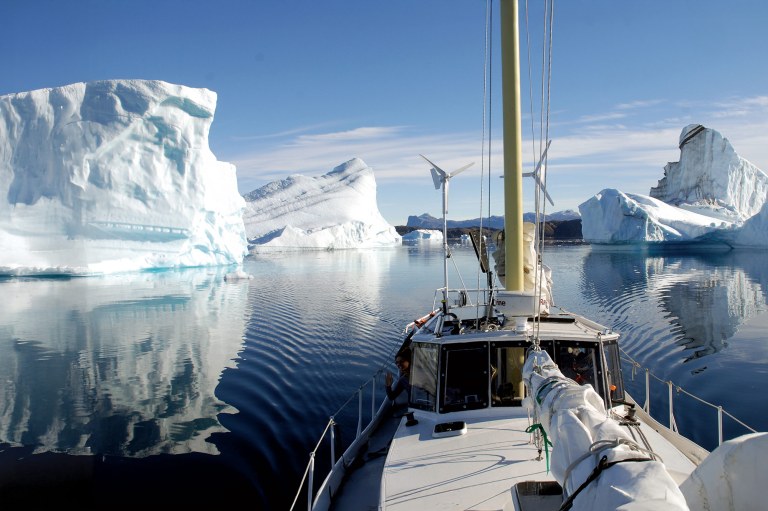
The other anchoring hazard is ice. The coastal anchorages we visit on the northern coast are generally free of ice, because the ice floats past them, but one must beware when anchoring in coves inside the fjords. Glaciers at the head of the fjords calve all the time, and the ice then moves out with wind and tide. We were fortunate not to be disturbed by ice at Jason Harbour, and I made the classic mistake of recommending our anchoring spot to friends. When they went in and anchored, it was indeed free of ice. But they were awakened in the middle of the night by an odd sound, like rushing water in a fast-running creek. They looked outside. The noise was made by a moving iceberg about to collide with their boat. And it had company. They had to leave, fast. It took the better part of an hour to pick their way out through the maze of ice.
A Royal Welcome
During the first month of our visit, Rolf and I never see more than 30 king penguins at a time. We desperately want to see the colony of 200,000 king penguin pairs in St. Andrew’s Bay. But this bay is in the eastern section, the windiest of South Georgia’s three weather zones. It’s also an open roadstead. To make the visit’s degree of difficulty even higher, one can only get ashore on the rare day when there’s very little swell. We hang around at neighboring anchorages, waiting for the right conditions. Finally they arrive. Or so we think. Our first visit ashore in St. Andrew’s lasts only 20 minutes. We never even make it to the edge of the colony. Though it’s calm, a swell suddenly picks up, and the anchorage becomes untenable. We get out in the nick of time. But patience pays off. On New Year’s Day, our second visit lasts a few hours.
The noise level of so many birds is deafening. Nonetheless, time loses meaning as we wander in awe around the edge of the rookery. King penguins are big. An adult weighs in at 35 pounds and stands three feet tall. That means that when we sit down, we’re at eye level with the birds. And they’re beautiful. Besides their teardrop-shaped orange neck patches, some also have iridescent green feathers on their heads. Like the emperor penguin, kings incubate their egg on their feet. Having no nest, there’s no territory to protect. So there’s not as much bickering between neighbors as in other penguin rookeries.
Visitors aren’t allowed to approach a king penguin. But the birds obey no such taboo. They approach us when we’re sitting down to check us out. Some peck at our boots and clothes. As usual, the youngsters are the more playful. One chick, in the brown-fluffball stage, adopts us and follows us wherever we go. It’s so special to have contact with a wild creature that expresses its personality and interacts as it wishes. Rolf and I agree that these encounters alone are payback enough for the concerns and difficulties involved in our high-latitude adventure cruising.
Our visit at the rookery takes place while the glacial backdrop glitters in the sunshine and lenticular clouds hover above the highest peaks. But the 1,007-millibar high is cracking. We move farther east, to anchor in Gold Harbour, considered the most spectacular spot at South Georgia. The barometric pressure drops continuously for two days, until the low’s center passes. At 968 millibars, the system is a signature Southern Ocean blaster.
No Rest for the Weary
Gold Harbour is another open roadstead, but the gale-force southwest wind is blowing offshore. Fortunately, we’re not anchored in the wind channel. We watch as gusts sweep out of a valley and pass to port, a couple of hundred feet away. The wind intensifies, and at the height of the storm, a particularly strong gust lays Northern Light over so far that water rushes over the toerail and up on deck. And because the gust lasts, the water level continues to rise until it partially covers the galley portholes. It feels like forever before the boat rights itself. Rolf shakes his head. “This is the first time that’s happened in the 30 years I’ve been sailing Northern Light,” he says.
It’s difficult to describe sounds, but no matter the tone of the shrieks, a pattern forms, and one becomes used to it. Suddenly, even that pattern changes as the shrieks change to an all-out roar, and a sustained hurricane-force gust blasts Northern Light. I watch the landscape moving while the boat is forced back. Finally she stops; the anchor chain must be ramrod straight. Then, for a split second, the noise ceases. And the feeling of pressure also disappears from the cabin. Then, suddenly, the wind is back—at the same strength but from the opposite direction. As the boat starts to swing, we look at each other in amazement. “Whoa,” I say. Rolf responds, “Yeah. Heavy refill.” That’s what we call this phenomenon, when an area of low pressure left in the wake of a gust fills with wind. It can come from any direction.
The question is, will we lose holding? We have tandem anchors out. They probably twisted around each other in the 180-degree wind shift. And there’s a tripping line on the lead anchor. We wish now that there wasn’t. It, too, may be tangled, preventing us from getting under way quickly enough. All night, we flit around the bay on storm-force winds and heavier gusts. But we never drag. Both of us stay up and on full alert. When it’s over, we’re bleary-eyed, but on a rising barometer we leave to seek shelter once again in Ocean Harbour. Halfway there, the pressure starts to fall again. By nighttime, it’s down to 960 millibars. Another storm is raging. It’s impossible to rest. Both of us are up through another night.
**
The Time Comes**
By the morning, the weather machine’s energy is as low as ours. The forecast is for a three- to five-day spell of moderate wind. That’s just what we need to negotiate the 800 iceberg-filled miles at the beginning of the passage away from South Georgia. We weigh anchor and leave.
On January 7, the night is five hours long. During the five days that it’ll take us to get out of the ice-infested Circumpolar Current, we’ll heave to when it’s dark. There are 8,700 nautical miles of Southern Ocean separating us from Hobart and the completion of our circumnavigation. If we can stop at France’s Kerguelen Islands, we’ll get a few days of respite; otherwise, we have 60 to 65 days of nonstop sailing ahead. But at this moment, the length of the passage isn’t the issue. All we care about is taking advantage of this spell of good weather. And as long as it holds, we can rest, four hours on, four hours off.
Deborah Shapiro and Rolf Bjelke have been cruising together on Northern Light since 1982. To read previous articles in this series, log on to CW’s website (www.cruisingworld.com/1102pearls).