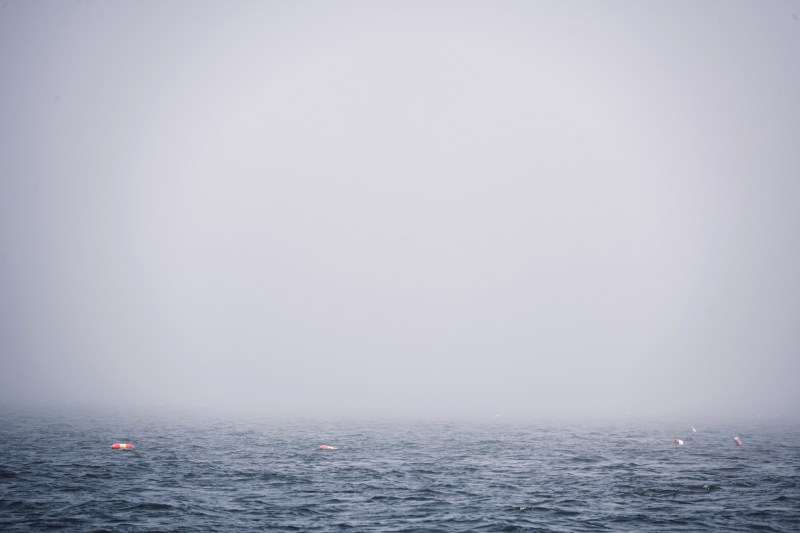
The idea of sailing to Maine always made me nervous. Lobster pots everywhere, frequent fog and the prospect of anchoring on rocky bottoms all loomed large in my imagination. I pictured snagging a lobster pot, having to jump into frigid water to cut it free, only to be swept by the current into another pot or, worse, a rocky shore. The fact that I would be single-handing part of the time didn’t help.
Before leaving, I discovered that sailors tend to fall into two camps: those who love Maine and consider it among the most beautiful cruising grounds they’ve ever sailed, and those who say they’ll never go back, presumably because they had a bad encounter with lobster gear. Unsure which camp I’d join, I decided to go.
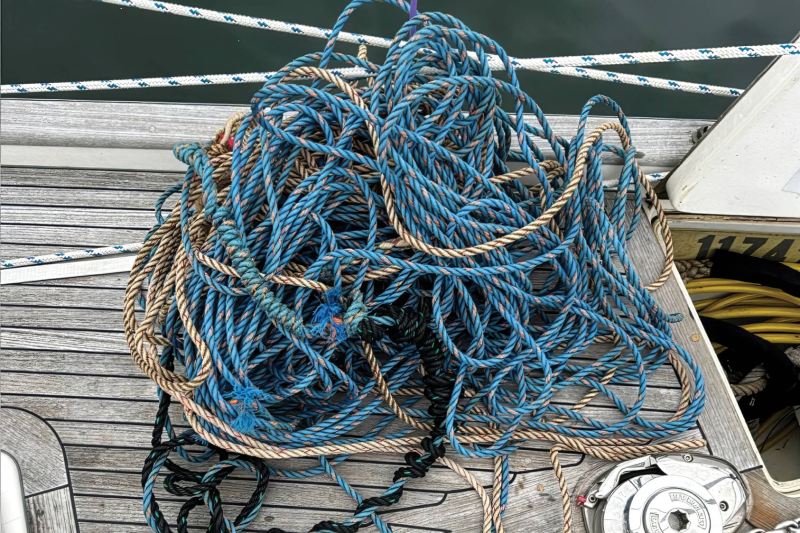
In preparation for the Salty Dawg Downeast Rally to Penobscot Bay, I attended a Salty Dawg webinar that recommended installing a “shark cutter” to sever lobster warp if it fouled the propeller. Installing one would have required hiring a diver in muddy Chesapeake Bay water, and the least-expensive model was around $700, so I opted to go without. A Maine sailor I spoke with offered simpler advice: Carry a camp saw (the folding kind with aggressive teeth) because a rigging knife won’t cut lobster warp effectively. Armed with that, I headed north.
Understanding Lobster Pots
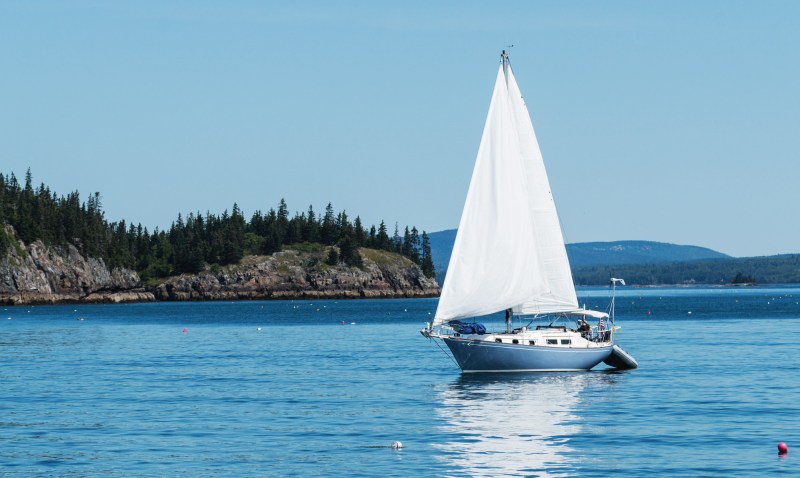
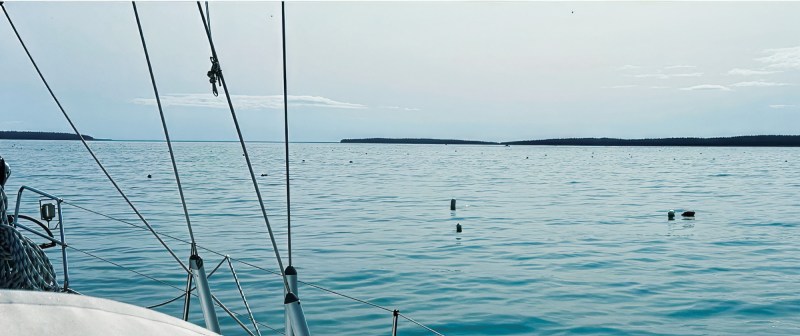
Lobster pots are marked by brightly colored floats, typically arranged in one of two ways. Some are single “main” floats attached by a long line, or warp, to the trap on the seafloor. Others include a secondary float called a toggle, connected to the main float by 10 to 20 feet of line. Toggles exist because at high tide, the main float may be pulled underwater if the warp is too short. The toggle helps lobstermen relocate the trap.
Never pass between a main float and its toggle. The line connecting them is just below the surface and easy to snag.
Fortunately, distinguishing the two is usually straightforward. The toggle, which isn’t tied to a heavy object, lies flat on the water. The main float, attached to the warp, usually stands upright or at an angle, depending on tide, current and warp length. If the warp is long and light, even the main float may lie flat, in which case the presence (or absence) of another float nearby is the clue. If most floats in an area lie flat with no nearby companions, they are likely single main floats.
When passing a single float, it’s best to pass downwind or downcurrent, since the warp angles off underwater in the opposite direction. The same logic applies to toggles: Pass downwind or downcurrent of whatever float you see. In calm conditions, toggles can lie anywhere relative to the main float, making things trickier.
Always pass downwind or downcurrent of any float, leaving 20 to 30 feet of clearance. Even when passing upwind or upcurrent, keep the same margin.
In theory, warps often run nearly vertical, meaning you could pass quite close without snagging a keel or rudder, but doing so is asking for trouble. Pots are generally spaced 100 to 200 feet apart, often more, leaving plenty of room to weave a safe path. Sailing through a lobster field feels like navigating a slalom course.
Tricky Situations
One especially dangerous scenario occurs when the main float is completely submerged because the warp is too short for the depth, leaving only the toggle visible. Passing close to that toggle can take you directly over the unseen main float and its warp.
Similarly, in waves, a main float may appear and disappear beneath crests. Any float, even a fleeting one, deserves wide clearance.
The worst case is a submerged main float with no toggle at all. These are rare, but they do exist, and unless someone is standing a sharp watch on the bow, they’re nearly impossible to spot. I saw a few pass within 5 feet of my boat during six weeks in Maine. In those moments, praying felt like the only available strategy.
Sail or Power?
Motoring, not sailing, is usually best in dense lobster fields. You have better control and fewer distractions. I once had to make a rapid 90-degree turn to avoid a float I didn’t see until the last moment. That turn would have been much harder under sail.
Motoring does increase the risk of wrapping warp around the propeller, so if you do hit a pot, immediately put the engine in neutral to prevent the line from tightening or wrapping multiple times. Folding props can sometimes be folded, but there’s rarely enough time. One advantage of sailing with a folding prop is that you’re less likely to snag a line, though the keel or rudder might still catch one, but those are easier to clear.
Radar: Better Than You Think
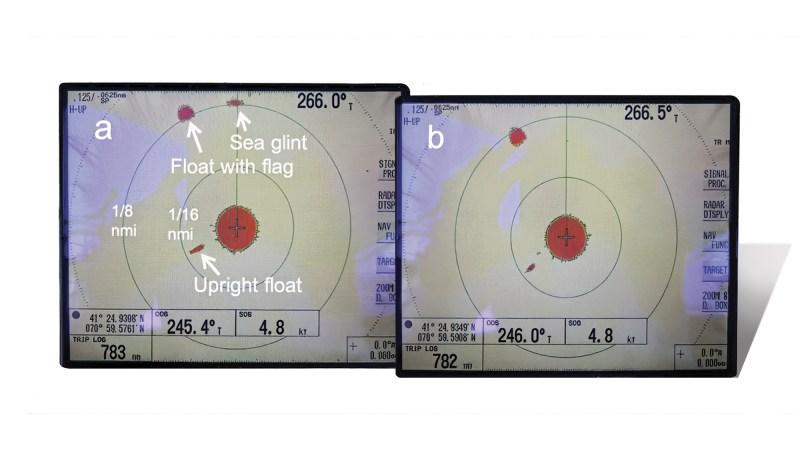
I was once told that lobster floats don’t show up on radar unless a boat is far offshore. That’s not true. My radar picked them up quite well in calm seas.
Use radar when conditions allow. In calm water, radar can show floats hundreds of feet ahead, a capability that’s especially useful in fog or at night. However, waves (particularly chop) create sea clutter that obscures buoy returns, making radar less effective.
Radar resolution isn’t sufficient to thread between individual pots, and it often can’t distinguish between a main float and a toggle. Still, it provides a valuable picture of overall field density and helps guide where to focus your eyes. In fog, radar is especially helpful, though visual confirmation remains essential. At night, radar helps early detection, but a powerful searchlight is needed for final identification because most floats are reflective.
In fog or darkness, motor very slowly—or better yet, stay put. The slower the scene evolves, the easier it is to interpret radar returns and manage everything else at the helm.
Fatigue Is a Real Hazard
Navigating lobster fields demands sustained concentration. Don’t push more than two or three hours at a time without rest or a crew change.
Even at slow speed, you’re scanning ahead, checking radar, monitoring AIS, listening for engines and bells, and keeping an eye on instruments. Attempting to discern a slow-moving vessel among dozens of stationary radar targets is mentally exhausting.
I found myself worn down after about three hours, my attention wandering, occasionally mistaking reflections for floats. Adding sail trim to that workload doesn’t help.
When I first entered Penobscot Bay, fog settled in unexpectedly. We took turns on the bow calling out floats. I wasn’t yet using radar for pot detection and didn’t check AIS frequently enough.
While motoring up a shipping channel, where pots seemed fewer, I suddenly heard my boat’s name on VHF radio. A large merchant vessel was quickly bearing down on us. I hadn’t expected ships of that size in the bay.
With a closing speed near 20 knots, I gunned the engine and cleared the channel just in time, watching a massive hull loom out of the fog a few hundred feet away. It was a vivid reminder that lobster pots aren’t the only hazard demanding attention.
The Bottom Line
Sailing through Maine’s fog and lobster fields is not as daunting as it first appears. Pots are usually spaced far enough apart that, with several hundred feet of visibility (often aided by radar), you can pick a safe path, provided you maintain 20 to 30 feet of clearance from any float and never pass between a main float and its toggle.
The greatest risks come from submerged main floats, especially those without toggles, and from motoring into the sun in choppy seas, where floats vanish in wave troughs. Keeping speed down is essential. An extra pair of eyes helps immensely, and regular breaks are critical.
During six weeks in Penobscot Bay and around Mount Desert Island, I never snagged a lobster pot, though there were close calls. Ironically, on my final day departing, I ran over a length of lobster warp that had been cut previously and left floating, invisible on the surface. Thanks to quick action, my engine being in neutral and that camp saw, it was easily cleared, though it required a chilly swim.
As for other concerns: Anchoring turned out to be fine, with good mud holding everywhere I stopped. While many islands are privately owned and off-limits, the coastal towns are welcoming and charming. Winds can be variable, making rigid itineraries impractical, but that’s true anywhere good cruising exists.
In the end, I joined the camp that believes Maine is one of the most beautiful sailing grounds on the East Coast. I plan to return as often as I can.
Editor’s Note: Since publishing Dean Wilkening’s first-timer account of sailing Maine, we’ve heard from a number of longtime Maine sailors and lobstermen, and their feedback is worth sharing.
The point of contention centers on cutting lobster warp when a line is fouled. To be clear: cutting should be the absolute last resort, and we regret that the article may have implied otherwise. Maine’s lobster industry generates roughly $1 billion in GDP for the state and is made up almost entirely of small, family-run operations. Each trap, warp, and buoy setup represents an investment of many hundreds of dollars. Cutting a line doesn’t just cause inconvenience—it can represent a serious financial loss for a working family, and the gear is rarely recovered.
Several experienced readers remind us that patience, not a knife, is usually the right first response to a fouled line. If you snag a pot, drop your hook, put on the kettle, and take your time. A boat hook will often free the line without anyone getting wet. If the warp is wrapped around the prop, try slowly reversing while watching from the dinghy—it may unwind on its own. If you must go in the water, tie off to the boat, work deliberately, and don’t be in a rush.
If cutting truly becomes unavoidable, retain both ends of the warp and tie them back together before moving on. It costs you a few minutes and may save a lobsterman’s gear.
One reader’s advice is worth repeating here: “Recreational mariners are guests where people are trying to make a living. Show some class and manners.” We couldn’t agree more. The lobster buoys are part of what makes Maine, Maine—and the lobstermen working those waters will be the first to help if you’re ever in trouble. Treat them accordingly. —Andrew Parkinson, editor-in-chief