Bolero refit
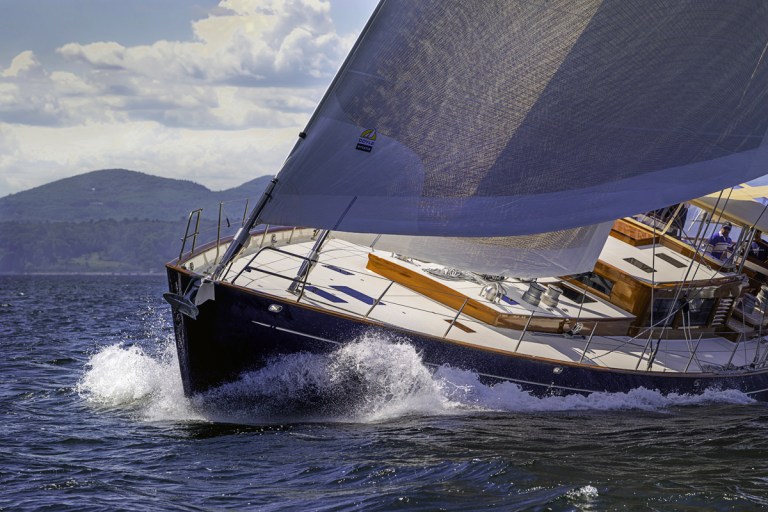
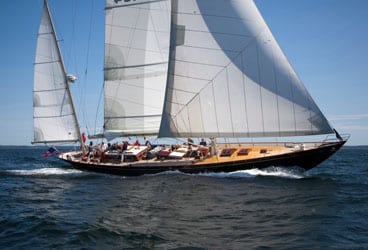
It was the fall of 2004 when I last checked in with Bolero, the breathtaking, 73-foot, wooden yawl that’s generally considered to be near the apex of the Top 10 list of the great designs of Olin Stephens II. At the age of 55, she was coming off a major restoration of her hull and a summer of glorious racing on the Classic Yacht circuit, winning six of 13 races and the Concours d’Elegance at the Sparkman & Stephens 75th-anniversary gathering at Connecticut’s Mystic Seaport. As a member of her racing crew then, I have a lively memory of the pleasure Bolero brought to her sailors and anybody who caught sight of her slim, black hull and towering rig.
I later told the story of this thoroughbred and her community of designers, builders, owners, sailors, and restorers in the book In a Class by Herself: The Yawl Bolero and the Passion for Craftsmanship. By the time the title was in bookstores and on Amazon.com, Bolero was in Europe for four years of cruising in the Mediterranean and the English Channel with her owners, Ed Kane and Marty Wallace. When I caught a glimpse of Bolero at Valencia during the 2007 America’s Cup match, she looked as gorgeous as ever. On board, however, there were worries. “We were cracking frames,” Kane recalls glumly. “We noticed a broken frame, then another, then another. We put a fiber-optic camera down there and found more cracked frames. I don’t know if the cracks were old or new, but we had a lot of rough weather in Greece and Turkey. The boat wasn’t sinking, but it was a real problem.”
Deciding that another restoration was in order, in the fall of 2008 Kane brought Bolero to Rockport Marine, a boatyard in Maine that specializes in wooden boats. When she emerged from the shed this past spring, Kane told me, Bolero looked almost exactly as she did before, even though a lot about her was brand-spanking-new or restored. On the outside, she was the same Bolero, only polished up with a new deck, new sails and electronics, and newly painted spars. But lift the floorboards and everything’s different: new laminated frames, new planking, new systems, air-conditioning, and more additions.
“The whole boat’s been redone,” said Kane. “If you took a big, brand-new, state-of-the-art cruising boat, it would look exactly like this. We were basically rebuilding the boat.”
The 61-year story of Bolero is one of many dreams, some frustrations, one near-death experience by abandonment, and a miraculous recovery occurring in three stages over the past 15 years. As close to royalty as an American yacht can be, she was designed by Sparkman & Stephens and built in 1949 by the Henry B. Nevins Yacht Yard. The owner was John Nicholas Brown, of the Rhode Island Browns. An art historian, a technology buff (he was the civilian head of the U.S. Navy’s air operations), and the soon to be commodore of the New York Yacht Club, he had standards at least as high as those of the designer and the builder. In my research for the book, I came across a copy of the yacht’s final specifications in which it was stated that the hull was to be painted with “two coats semi-gloss, best grade yacht black.” Brown crossed out “semi-gloss” and inserted “high gloss.”
In her six years under Brown and his family, she was one of the super-star racing yachts of her day, regularly winning major races on elapsed time and often on corrected time, too. The racing record was a small part of her allure. A subsequent owner, Gunter Sunkler, her first restorer, spoke of “the magical qualities that she always had.” The word “sleek” could have been invented to describe this boat. On board, in any decent breeze, she was a thing of tremendous, urgent force.
Brown told Olin Stephens that “the greatest of all sensations” was “the Bolero feeling under sail.” One man who truly appreciated those qualities was Carleton Mitchell. Hearing in 1954 that Brown was thinking of putting her up for sale, Mitchell seriously considered making a bid. “I thought it would be a wonderful thing to race Bolero until your money ran out,” he once told me. In the end, he chose to build a smaller, and also fabled, Sparkman & Stephens boat, Finisterre.
After selling Bolero to a leading Swedish yachtsman, Sven Salen, Brown, according to one of his crew, Dick Goennel, suffered a hard bout of seller’s remorse.”He missed her hugeness and her glamour, and he missed those times when people were always circling around her with their cameras.” Today, Bolero is still close to the heart of the New York Yacht Club. Its Newport clubhouse, Harbour Court, is the Brown family’s former home, and the informal dining room there is named The Bolero Grill, complete with a replica transom hung on the wall.
Bolero had a fine racing career over many years in Sweden and San Francisco, across the Atlantic, and on the U.S. East Coast, where Ted Turner took her helm for a while. But by 1990, she was abandoned and rotting away in a Florida canal, with her masts and winches in hock and her condition described by one observer as “positively decrepit.” Sunkler bought her and did a partial restoration in Maryland before selling her to Ed Kane, an experienced cruising sailor from Boston who’d acquired an itch for classic boats.
Soon enough, Kane discovered that owning Bolero would be both a joy and a burden. The boat’s surveyor, George C. Welch, wrote in his survey: “She requires of her owner a custodial obligation and responsibility that has absolutely nothing to do with financial return on investment or annual cost of maintaining and operating her.”
In September 2001, Kane took Bolero to Brewer’s Pilots Point Marina, in Westbrook, Connecticut. While master craftsman Hans Zimmer was replanking her, replacing the stem and forefoot, and making other repairs, the Bolero alumni association energetically lobbied Kane to have the boat restored to her precise, perfect, original condition. Kane complied in almost every way, but he resisted pressure to paint the transom the original glossy black and had it varnished. “The contrarian in me made me do it,” he said with a grin. This was his boat.
Kane is contrary in another way: He’s not much interested in competition. To quote his wife, Marty: “Racing’s not what gets us up in the morning.” Their tastes run to cruising to Newfoundland and living on board for a week or two at Edgartown, on Martha’s Vineyard. It’s not that he doesn’t enjoy sailing fast. “You know how it is when a boat gets going? Like using a passing gear on a car?” Kane says. It’s just that he doesn’t derive a whole lot of personal satisfaction from shifting into that gear against other boats. After the starting gun fires, he’s likely to go below and do some reading, even take a nap. Despite all that, after the repaired Bolero was launched in 2004, Kane and Wallace insisted that she must compete. He felt he owed a summer of racing to Newport, to the New York Yacht Club, to the memory of John Nicholas Brown, and above all, to Bolero herself. “This boat wants to race.”
The summer after Bolero‘s successful 2004 racing season, however, she was cruising in Greece. The fact is, Bolero was conceived as a dual-purpose boat. Commodore Brown asked Olin Stephens for “a comfortable cruising boat with a turn of speed.” Brown got his speed, all right, but some people today may be amazed by the definition of comfort. This 73-foot, 94,000-pound boat has a beam of but 15 feet one inch. By modern-day standards, the accommodations—which were designed to the Browns’ requirements—are a little cramped, with an owner’s cabin that’s strikingly modest for such a yacht. Kane and Wallace are, by nature, quite modest, and they wouldn’t have it any other way. The refits over the years have left the original accommodations plan intact except for a little more counter space here, a different door there.
Bolero cruised happily in Europe for several weeks a year, from Turkey to England, until the structural issues arose and Kane decided that the hull needed serious attention. After the boat returned to Newport in the summer of 2008, the owner of Rockport Marine, Taylor Allen, went down to take a look with Kane and the boat’s captain, Spike White. Pulling a couple of planks revealed many broken frames, and removing the headliner below exposed rot in the deck beams. Kane committed to a lengthy and expensive major project. That was the same day that Lehman Brothers failed, but he carried on, and Bolero was delivered Down East to Rockport, Maine.
“I give Ed a huge amount of credit for tackling this at that time,” says Allen.
The project took 20 months with a crew that sometimes numbered as many as 20 skilled workers. Of her 120 original white oak frames, 47 were replaced with new laminated frames, which are stronger than traditional solid oak. (“We didn’t want to do this job again,” Kane told me.) She was replanked with sipo, or African mahogany, over cedar, with epoxy glue between the layers. The horn timber—the boat’s backbone from the transom to the stern post—was also replaced.
During the refit, the original deck was restored. Bolero had been built with a cedar deck, but over the years, as it aged and leaked, layers of plywood and teak were piled on top of it. Rockport Marine stripped off the old layers, replaced the rotting deck beams, and installed a new deck with an Alaskan yellow cedar veneer. Yet_ Bolero_ remained essentially the same boat. For Kane and Wallace, Bolero is a historical artifact that they feel obliged to maintain.
“We’ve always thought we have a duty to put it back the way it should be,” Kane has said. “This boat is historically accurate.” She has electric winches, roller furling, and air-conditioning, yes. But she is undeniably Bolero.
Bolero was again hauled out in Rockport on a brilliant, cool day in late September this year when I stopped by to chat up the restorers and take a tour of the boat. Rockport Marine is nestled in a small notch of flat land between Penobscot Bay and the hills of Rockport. The air there is perfumed by the sweet smell of wood shavings, and its sheds and flat places are packed with wooden boats. The largest was Bolero, her masts towering over a gathering of trim Concordia yawls and sloops and some lovely products off the drawing board of the Danish-born New England yacht designer K. Aage Nielsen, among them a 35-foot sloop called Northern Crown that had been built for an old friend of mine, Donald Starr. Northern Crown is now in the loving hands of Taylor Allen, the yard’s owner; his father founded Rockport Marine in 1961. Allen informed me that Ed Kane had been there just that morning to climb on board another Nielsen woodie for an overnight cruise.
Wooden boats are always full of surprises, and the latest was a bad leak in Bolero‘s centerboard trunk, more than nine feet below the yawl’s waterline. The garboard plank was pulled, and the metal trunk was getting some squirts of 3M 5200, one of many modern materials that Henry Nevins could only have dreamed of using. John England, the head of the Bolero restoration project, led me on a tour of the boat. He was dryly humorous in the best Down East tradition. When I asked about the many Concordias at the yard, he joked, “They seem to grow here. If we ever succeed in finding the male, we can put a stop to it.” England also made my cheeks rosy by saying that several of the photographs in my book on Bolero had educated him about how the Nevins Yacht Yard had built the boat back in 1949. As he led me up the long ladder and showed me all the improvements, England assured me that in every way, the third restoration of this famous yacht had left her better, handier, more seamanlike, and above all, stronger. “They’ve been mollycoddling Bolero. Now they can sail her hard. She’s as strong as a new hull.”
Kane was content. “Two full restorations of the same boat must be some sort of record,” he told me with just enough irony to indicate how expensive they had been, each probably well into seven-figure territory. Not that this had discouraged him from wooden boats. Around the time he bought Bolero, he helped restored Marilee, a 1926 Herreshoff New York Yacht Club 40 sloop, for the 2001 America’s Cup Jubilee. Recently, he’s considered buying and restoring Baruna, Bolero‘s older near sister and dueling partner for many years. “That would mean another big restoration and owning two boats,” he said, “but of course I already own two boats.” The second is the replica of an Olin Stephens 6-Meter, Cherokee, built at the International Yacht Restoration School’s Museum of Yachting. He’s so passionate about wooden boats and restorations that he took a course in building wooden boats at IYRS.
“Normally Eddie doesn’t like project sorts of things,” says Marty. “But he really likes that these boats are preserved and sailing.”
I asked Ed if his attitude has changed about racing. He said Bolero is back on the Classics circuit and doing well in her duels with another Sparkman & Stephens oldie, Black Watch. And Marty has become more competitive. “She steers the boat a lot and buys so many new sails that she’s a sailmaker’s dream customer,” he reports. They’ve even added a spinnaker, an asymmetric, to the sail inventory after losing a race in Europe to two boats that had them.
“We went around a point and the wind went aft, and they set spinnakers, but we didn’t have one, and they were gone,” he recalled.
All the same, I didn’t have the sense that sailboat racing was getting Kane up in the morning in 2010, any more than it had in 2004.
I had one last question for the owner of this classic yacht: “Is Bolero‘s transom still finished bright?”
Kane the contrarian laughed at this reminder of his old stubbornness. “It’s black now.”
That pleased England, who is one of those restoration-minded fellows who likes to keep things the way they were. “We won on a couple of original things. We got the cedar deck. And we got the transom painted black.” Not bad for a boat in her seventh decade.
Besides In a Class by Herself:_ The Yawl Bolero and the Passion for Craftsmanship_, writer and sailor John Rousmaniere has written The Annapolis Book of Seamanship; Fastnet, Force 10; After the Storm; A Berth to Bermuda; and, most recently, histories of the Shelter Island and New York yacht clubs.