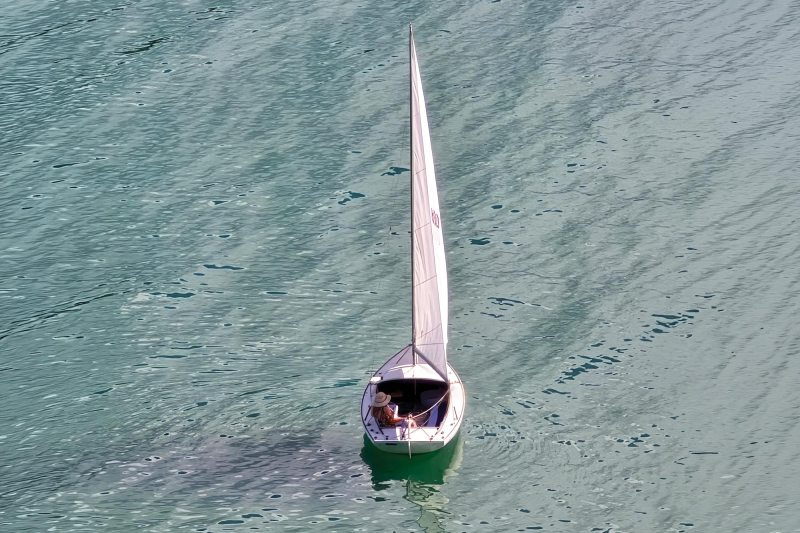
A light breeze etched the cove’s waters. I tried to ignore the sparkle, tried to get in one more hour of editing. I continued staring at the book manuscript that filled the screen of my computer, and then I finally gave up. I walked into my partner David’s art studio and suggested we head out for a quiet sail on Felicity. But he was fully engrossed in his latest painting.
“No problem, I‘ll head out on my own,” I said as I turned to head toward the jetty. Within minutes, I had Felicity’s sails up, her lines cast off. Then I began beating to windward, toward the entrance to the cove.
When I reached open water, I eased the sails and settled Felicity onto a comfortable beam reach. Sails trimmed and cleated, tiller extension in hand, I recalled the first solo sail I’d taken on this boat. That had been several years and several voyages ago, when my then-husband Larry’s advancing Parkinson’s disease meant he could no longer safely climb into the little boat for short forays around our island home.
For a time, the little boat had sat unused. With no one along to hold the tiller while I hauled up the sails or sheeted in the headsail, I’d needed to add a tiller extension. The first chance I got, I bought one. The moment it was in place, I headed out for my first solo sail on Felicity. On that particular day, Felicity had been on her mooring, where I’d moved her to give friends and visitors easier access to our marina berth. Being on the mooring had also made it far easier to get underway than when she had been lying alongside the jetty. I rowed out to where she lay, climbed on board, doubled up the mooring line and led the two ends to the foredeck cleat. I hoisted the mainsail while she was head to wind. I uncleated both ends of the mooring line and led them aft until Felicity turned almost downwind. Then I let go of one end of the mooring line and pulled the line in while the boat gathered way.
Sailing downwind under just the mainsail, I wove my way past a dozen moored boats en route to the open water where I would have room to let her do as she wished.
“Sweet boat, looks like fun!” someone called out from one of the moored boats. Its hailing port was Dunedin, near the bottom of New Zealand’s South Island. “Welcome to North Cove!” I responded. “Wander by and say hello when you see Felicity back on its mooring!”
My pride got the better of me once I realized someone might be watching me try to hoist the jib. I was pretty sure things looked sloppy as I tried to get it up and pulling. So, I ran onward under mainsail alone until I had rounded the high headland that shelters the cove. Then, where no one could watch, I prepared to hoist the jib.
Just as I’d expected, the minute I let go of the tiller, Felicity snapped up into the wind, her mainsail flogged, and the hanks on the jib jammed on the turnbuckle. But, I got the little jib up and setting, and then I grabbed the tiller extension, hauled the sail in and reached off across Kawau Bay, an island-studded, 5-by-5-mile stretch of water that provides wonderful gunkholing.
About halfway across the bay, I realized I needed to take a pee. I was glad this occurred when it did because it led to an interesting and useful learning experience. I realized I couldn’t steer and solve my physical problem at the same time.
“OK, let’s try heaving to,” I said out loud. I pulled in the mainsail, hauled the jib to windward and let go of the tiller. Felicity slowed down, then tacked through the wind, tried to bear away, and then slowly headed up, tacked again. Though this wasn’t perfect, the motion was slow enough that I was able to achieve relief.
That business done, I was almost ready to ease the jib and begin reaching off again when I decided to take a page out of my own book, The Capable Cruiser. In the chapter called “Sixteen Ways to Keep Your Lover,” one of the suggestions is: “Remember everyone is looking. Until you’ve both gained confidence maneuvering your boat … find some time during the week when fewer eyes will be around to witness your screw-ups, and practice docking, anchoring and mooring procedures without the spectator pressures.”
I looked around. No boats in sight. The nearest house was at least 2 miles away. For the next hour I just messed about, reefing the mainsail by rolling it around the boom and then seeing if Felicity hove to better with the smaller mainsail and backed jib—not perfect, but she lay quietly enough that I could consider this configuration if I wanted to stop for lunch.
I tried changing the halyard lead to see if I could figure an easier way to steer and hoist the mainsail at the same time. I played around with ways to tie the tiller so the boat would hold a steady course on its own. I fumbled about quite a bit, and once again, I was reminded how much easier it is to see what works and what doesn’t when you do it on board a small boat.
And yes, I learned several ways not to do things, along with a few ways that worked. To an outsider, I probably would have looked out of control. But I did gain confidence, as all I had to think about was the boat, not about who might be watching. Only when I noticed the sun getting low, when it would be wise to head back home, did I realize that I had been having fun.
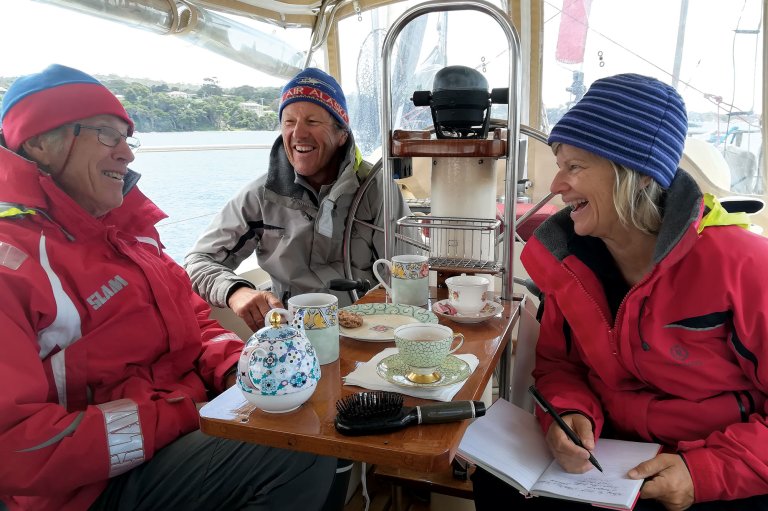
As I reached back into the cove, I was slightly disappointed to see that the dinghy on the visiting boat was gone. The crew was no longer on board. But within minutes of sailing up to the mooring and securing Felicity, the couple rowed alongside. We spent the next hour talking about places we’d each cruised to, places we’d like to see, and their goal of spending the next month exploring the waters around Kawau before heading south toward their home port.
It was an altogether good afternoon, and a reminder that sailing is the X factor of cruising.
After cruising more than 240,000 miles, US Sailing Hall of Fame inductee Lin Pardey is off to sea again. Her latest book, Passages: Cape Horn and Beyond, encourages folks to go simple, go small and go now.