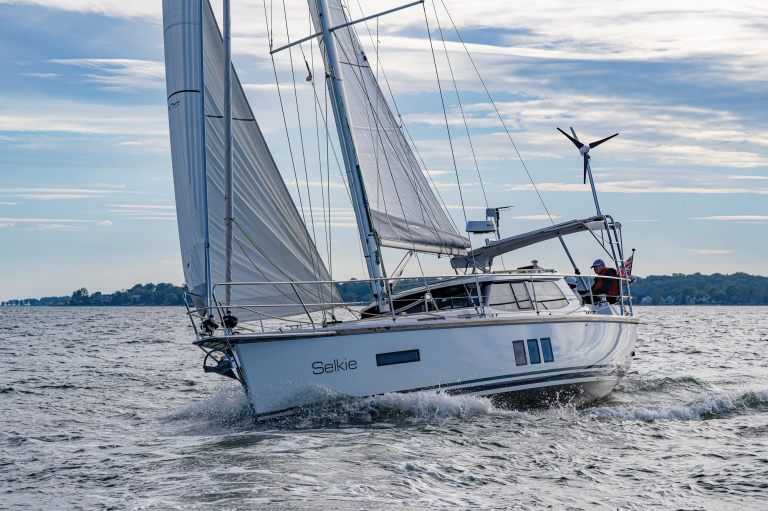
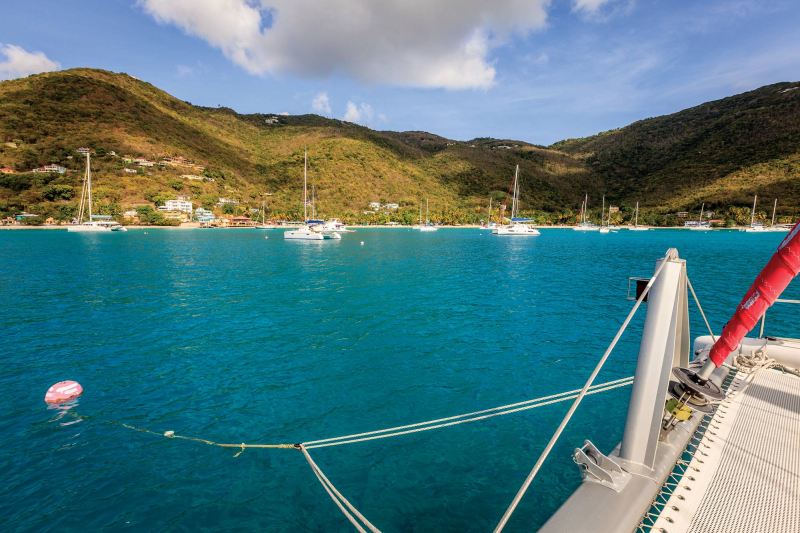
We had a nice day sailing for about 40 miles along the coast of Maine. Well before dark, we sailed into a quiet cove with several working lobster boats and a handful of sailboats on moorings. We found a mooring that had a bottle with a note attached that asked for a $15 fee for the night. We picked up the mooring and settled in.
It was all good until a 45-foot powerboat came barreling into the harbor at 10 knots, creating large waves. Worse, a woman was on the bow holding a boat hook while a man was on the flybridge yelling at her over a loudspeaker about how to grab the mooring buoy. He yelled more and more about less and less. The poor woman couldn’t reach the mooring.
This unfortunate display continued for 30 minutes. Eventually, the boat left.
Compare that awful scene to the seamanship skills of Harold Vanderbilt, who enjoyed sailing his J Class sloops, Rainbow and Ranger, up to his mooring during the America’s Cup summers in the 1930s. His goal was to stop a 120-foot-long, 250,000-pound yacht right at the mooring so the crew could simply pull up the mooring line and secure the vessel. Newspapers reported that different crew steered the vessel each day. They all sought to finish the practice day with perfection.
The first thing I do when preparing to take a mooring is circle around the field to get a sense of how much room there is for maneuvering. If any current is running, note how strong it is and what direction it is flowing (set and drift). See if there is a mooring lanyard or if you must provide your own line to attach through the eye of the mooring.
Next, hold a brief crew meeting to assign specific duties. Ask everyone to stay low so the helmsperson has ample visibility. Note the direction of the wind by looking at flags and masthead pennants. Your goal is to be heading directly into the wind as you approach the mooring.
It takes careful judgment to keep the boat moving while it is slowing down. It helps to have one crewmember using arm signals to let the helmsperson know if the course needs to be altered to reach the buoy. For example: Point to starboard if the course needs to be altered to starboard.
Before making the final turn, prepare the halyards to drop the sails. The headsail needs to be dropped or rolled up first. Douse the sail before making the turn. It helps to have the headsail folded on the foredeck if there is no roller furler. This gives the crew room to move around.
Approach the mooring with just the mainsail set. One crewmember needs to keep control of the mainsail sheet, so it does not swing wildly when the boat goes head to wind. Make sure the main sheet is free to run through the blocks before the maneuver.
In light wind, make your turn into the wind about three or four boat lengths from the buoy. Keep in mind that the faster you turn the boat, the faster it will come to a stop. Your turn should take about three boat lengths of distance.
Keep most of the crew off the bow. Weight forward slows a boat down. When the crewman on the bow secures the mooring line, he should hail, “Made!” to the helmsperson.
One crewmember should be ready with a boat hook to grab the mooring pendant. Bring the pendant on deck quickly. Feed the line through a fairlead and secure it to a cleat. I recommend wearing shoes during this exercise. Gloves can be helpful as well.
Late one night in arriving in Yarmouth, Nova Scotia, I grabbed a mooring pendant with my bare hands. It was dark, and my crewmates were three teenage daughters who were exhausted. To my horror, the pendant was covered with slimy creatures and a few barnacles. Gloves would have made the unpleasant experience better.
If you are short trying to reach the mooring buoy, then circle around and try again. It will be easy to judge how to shorten up your turn for the second try. The more dangerous problem is when you overshoot the mooring at a fast speed and get the mooring anchor line or pendant stuck on your rudder or propeller. If you are sailing too fast, change your course and steer away from the mooring buoy before you arrive at it. And try again with less speed.
Take time with your crew to practice catching a mooring. Give everyone on the boat a chance to steer. They will work hard to make a good approach and landing. When I was a junior officer on a US naval destroyer in the 1970s, the captain announced one morning that we were going to practice docking the ship. He had the eight junior officers draw straws to see who would go first. I drew the last straw and went last. It was a long day. I watched one terrible landing after another. Finally, it was my turn, and as luck would have it, I made a perfect landing and got rewarded with an invitation to dinner with the captain and executive officer. My experience racing dinghies paid off. It was the best day of my 10-year career in the US Navy Reserve.
Retrieving a mooring buoy is easier when you use an engine, but all the same principles apply. The advantage of the engine is being able to back down in reverse if you are going too fast. Like Commodore Vanderbilt, I find it more fun to use my sails and judgment to grab the mooring.
Docking also takes concentration to do well. Always keep a little speed so the boat has maneuverability. Only one person should be in charge and communicating when approaching a dock. Cardinal rule: no yelling.
Make sure adequate fenders are over the side and sitting slightly above the water. Fender lines should be secured to the rail or cleats with half-hitches. I take the time to demonstrate proper knots for the crew.
If you are securing a boat alongside a dock and not in a slip, there are four basic lines ready to tie up the boat: bow line, stern line, forward spring and aft spring. Lay these on deck with neat coils so they are ready to heave to someone on the dock. It is always helpful if someone is available on the dock to lend a hand, but sometimes a crewmember needs to step onto the dock. In this case, get the boat close to the dock and make sure the boat is moving slowly for safety.
Be careful changing gears. Slowly put the throttle in forward or reverse. It takes a few moments to stop a boat’s momentum, so factor this time in when making your approach.
Make your approach on a 20-degree angle with the bow closer to the dock. The first line that is thrown should be the aft spring. This will slow the boat down and help pull the stern toward the dock. Next, send the stern line. The third line thrown is the bow line, and finally, the forward spring.
I like to get all the crew involved with a line in hand and the fenders set up. Be sure to secure the lines with a proper knot on the cleats. A boat always looks shipshape when the lines are neatly coiled.
When the boat stops and is secure, everyone will feel a sense of accomplishment. To this day, I still smile thinking about the perfect landing I made on the naval vessel some 50 years ago.