On the final eve of a stellar cruising season in New Zealand, we were resting easy on the hook in Opua Harbor. We had every reason to relax, with a favorable forecast for our upcoming passage to Fiji and our pre-departure checklist complete.
Little did we know that a near-disaster awaited us long before we hit the high seas. That night, a 70-knot microburst blasted through the crowded anchorage. In the chaos, an unmanned, derelict 60-foot trawler dragged more than 2,400 feet, threaded its way through a maze of anchored boats, and ultimately slammed into our hull.
This may come as a surprise, but some of the most harrowing moments of the cruising life happen when the sails are furled. While bad luck, like ours in Opua, can happen, experience has taught us that many anchoring hazards can be avoided by considering four key elements: holding, weather, currents and other boats.
Resources such as nautical charts, GPS and cruiser reports can help determine what’s underneath the keel. While firm sand is considered ideal, beware of steep drop-offs or sea shelves that can drastically increase the scope needed should your ground tackle slide to a greater depth. Grass, mud and towers of coral, known as bommies, are just some of the holdings that can pose challenges for cruisers in different parts of the world, but more often than not, if captains know what they’re dealing with, solutions abound. Do your research and plan accordingly, bringing trip lines, pearl buoys and dive gear to ensure you can free your rode should a problem arise.
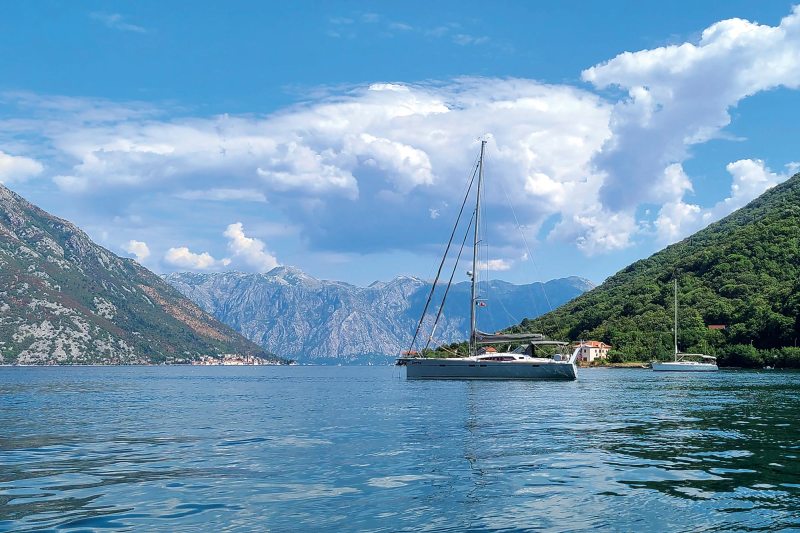
While a capable captain is ever attuned to the general forecast, a keen grasp of local microclimates can serve as the deciding factor in a vessel’s security at anchor. Our awareness of the bora—a fierce, katabatic wind known to wreak havoc in the Adriatic—kept us hypervigilant during a severe lightning storm in Montenegro. Because we maintained a live anchor watch, we were able to act fast, avoid a substantial drag and prevent our vessel from bashing into a rocky lee shore.
Sailors with local knowledge will also leave plenty of extra swinging room in areas with high tidal ranges or reversing streams where heavy, deep-draft keelboats will align themselves with the current. At the same time, light-displacement or high-freeboard vessels may be driven entirely by the wind, turning an orderly anchorage into chaos.
Likewise, in extremely protected bays with negligible wind and current, boats will often dance to the beat of different drummers, drifting aimlessly on their rodes. Our aluminum hull once bumped a steel vessel in Antigua’s notoriously crowded and tranquil Freeman’s Bay. Fortunately, because both captains were on watch, a strategically placed fender prevented any damage.
This brings us to the one hazard that often feels entirely out of our control: other boats. The simplest way to resolve this anxiety is to know thy neighbor. Don’t be shy. Drop by in your dinghy and chat. A competent captain will appreciate your due diligence and will likely want to exchange the same data.
We found ourselves surrounded by a tightly packed fleet during an unexpected squall in Makemo, an atoll in French Polynesia. Situated at the receiving end of a long fetch, the anchorage offered little protection from the rising, short-period waves. No one could be entirely certain their anchor hadn’t caught on a fragile coral bommie. Yet, because the fleet had communicated beforehand, panic was averted. Everyone knew who had what ground tackle deployed where, and every crew kept their VHF radios tuned to Channel 16.
Regarding neighboring vessels, ask about a few key parameters: the type, weight and location of their anchor, their total scope, and whether they are utilizing an anchor alarm. On our boat, we rely on the Anchor Pro app as a digital watchman to ensure a good night’s sleep.
If suspect vessels are unattended or you don’t like what you hear from a nearby boat—such as an undersized Danforth on a short rope rode—it is always prudent to move rather than invite unnecessary risk. Peace of mind means anchoring near vessels deploying adequately sized, modern anchors that are engineered to reset during a 180-degree wind shift, riding on a minimum scope of 5:1 chain and a properly sized nylon snubber.
The nuances of fleet management don’t end when it is time to weigh anchor. We were the only vessel as far as the eye could see when we dropped the hook at dusk in Delaware Bay. But a horrendous surprise awaited us when, hoping to catch the morning tidal gate, we raised anchor before dawn—only to find that a 65-foot monohull had tucked in next to us in the dead of night. If you must hoist your anchor in the dark, always spin up your radar, check your chartplotter for AIS targets, and sweep your surroundings with a high-powered spotlight before you begin bringing in the chain.
It’s the cruiser’s paradox: We spend our passages attuned to every detail, yet the moment the hook drops and the chain rumbles out, a psychological all-clear sound. We tidy the lines, crack open a sundowner, and trust in the notion of safe harbor.
In reality, good seamanship is required, even when standing still and even-keeled.